Mayors of flooded municipalities in Tarragona demand solutions to evacuate water to the sea
Roda de Berà and El Vendrell ask the Generalitat and the Spanish government for structural actions on the train line, the N-340 and the streams
-
CAT -
CAST
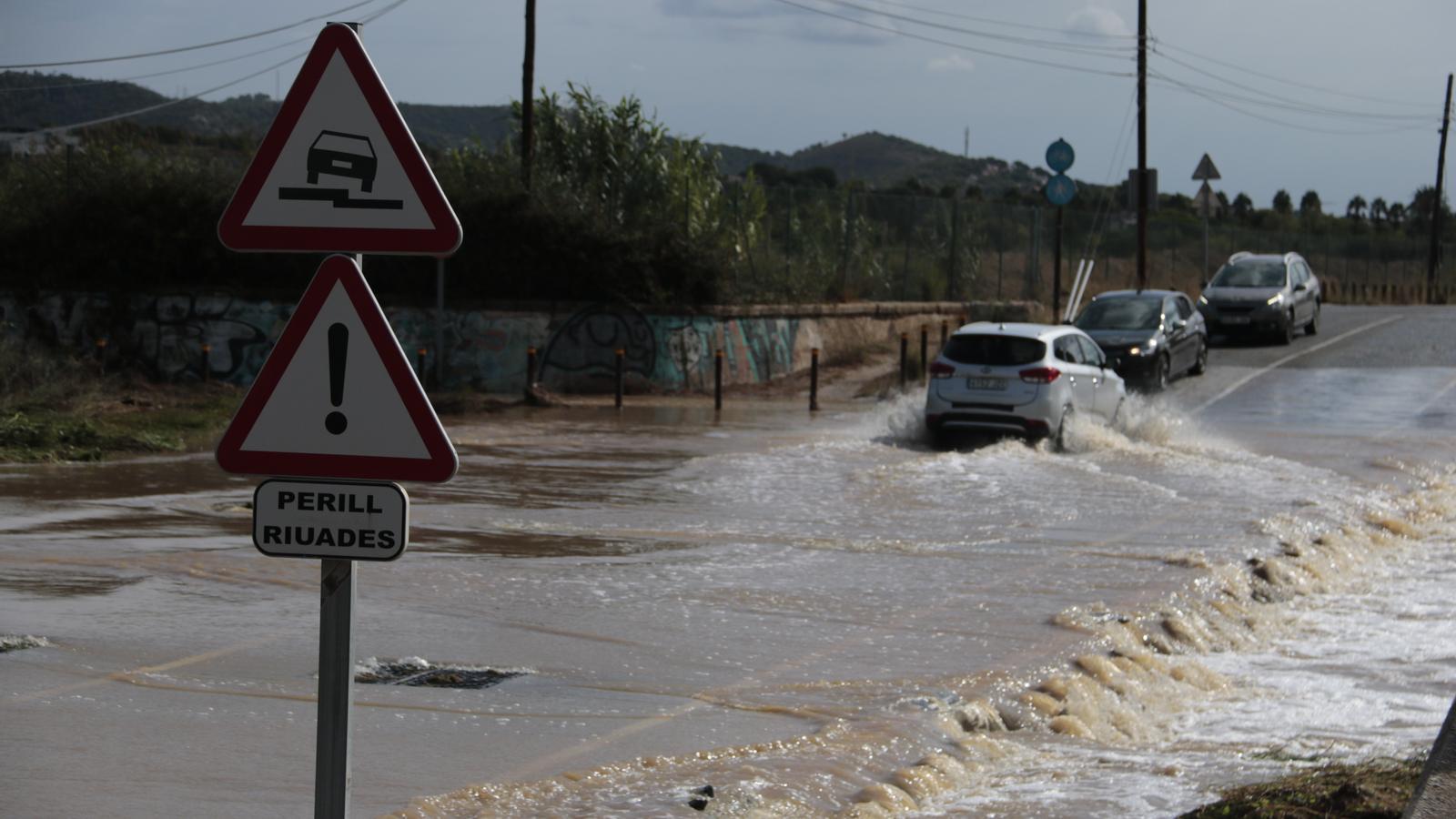
BarcelonaTorrential rains in the Tarragonès and Baix Penedès have highlighted the vulnerability of the coast to extreme precipitation events and have reopened the debate on the territory's capacity to manage their consequences, mainly evacuating water. The mayors of Roda de Berà and El Vendrell, two of the municipalities most affected by the floods, have called this Sunday for structural actions and specifically point to the railway line and the N-340 as infrastructures that can hinder its exit to the sea at various points, and cause serious floods like those experienced this past weekend. The Government has made itself available to the city councils to repair the damaged infrastructures, although it rules out declaring the territories as a "catastrophic zone".
The mayor of El Vendrell, Kenneth Martínez, has argued this Sunday that "brave decisions" must be made in the face of a problem he considers "structural". As he explained to the ACN, both the railway line and the N-340 act as barriers to the passage of water at various points along the coast. The train line, he argued, concentrates the water's exit at certain points, which can cause it to accumulate and circulate "as if it were a siphon". Therefore, Martínez has asked to address the issue as "a matter of national importance" and to study the construction of more underpasses beneath the infrastructures, as well as new reservoirs and channels. The objective is to increase the territory's capacity to absorb and evacuate water during exceptional precipitation episodes. The neighborhood association Federació Xarxa Vendrellenca has also asked the administrations for a technical review of the floods and data on drainage infrastructures.
The diagnosis is shared by the mayor of Roda de Berà, Pere Virgili, who has called on Adif to act "forcefully" and to allocate "whatever money is necessary" to make the railway infrastructure more permeable. In the maritime neighborhoods of various municipalities in the area, the problem is often not just the water coming down from higher ground, but the difficulty for it to continue its course to the sea. "The water that cannot get out," he summarized. Virgili specified that this was one of the issues that the municipalities raised with the Minister of Justice, Ramon Espadaler, after the episode, and recalled that his government had already requested the expansion of one of the water crossings during the works on the Berà tunnel. Now, the council wants to raise the issue again with the Government's sub-delegation so that it can forward it to Adif and the Spanish government.
Flooded campsites and hotels
The need to act on infrastructure is not the only element that mayors want to review. In El Vendrell, Martínez has also called for rethinking the management of ravines, especially when they cross more than one municipality. According to the mayor, currently "there is no good protocol" nor a sufficiently homogeneous criterion to act on these watercourses. For this reason, he advocates for "protocolizing" and "professionalizing" the response, with shared criteria among municipalities that allow anticipating actions when heavy rainfall episodes are predicted. However, the water was being evacuated during the early morning and by early Sunday morning a large part of the seafront had already returned to normal. The main damage was concentrated on vehicles, some shops and garages, and beach furniture.
In parallel, in Roda de Berà, the city council continues to assess the damage to public roads and is working especially on the beaches and the coastal area. Virgili estimates around twenty vehicles affected and points out that the beaches will hardly be able to recover their state before the flood before the end of the summer. One of the most affected points has been a campsite located in a flood-prone area. Virgili admitted that it will be necessary to study whether "some configuration" of the space needs to be reconsidered. The mayor recalled that in recent years actions have already been carried out jointly with the Catalan Water Agency (ACA) to reduce the impact of the water runoff. Now, however, the City Council will have to assess whether the measures applied so far are sufficient after an episode like this past weekend.
In Coma-ruga, the effects of the flood were still visible this Sunday. In front of the Maramar hotel, cleaning workers were removing water and mud marks left on the ground floor windows while clients collected their belongings and dealt with insurers and tow truck services to remove affected vehicles. Numerous cars were submerged in water and cannot start. Some tourists have opted to advance their return home. Others have decided to maintain their planned arrangements. Elena Pérez, also from Zaragoza, has decided to spend the last day of her vacation in Coma-ruga even though her vehicle has been rendered unusable by the water. "We are fine, it is important to value that," she explained, while the family deals with the insurer for the car's removal.
Why was ES-Alert not activated?
The absence of ES-Alert during the episode has also opened a debate on the criteria for activating the mass alert system on mobile phones. The Minister of Justice, Ramon Espadaler, argued that ES-Alert was not activated because the Meteocat alert level was 4 out of 6 and it was "not justified", and the director of Meteocat, Sarai Sarroca, supported the actions of Civil Protection and recalled that prediction and vigilance warnings were issued, the latter raised from orange to red. Neither Martínez nor Virgili have questioned the decision, but both have agreed that the reasons must be explained to the public.
