Four years without knowing the name of the civil guard who emptied his eye in Melilla
Zakaria crossed the fence when he was still a minor and was fleeing from the war in his country, now he is 22 years old and lives as a refugee in Barcelona
-
CAT -
CAST
BarcelonaZakaria crossed the Melilla fence in March 2022, fleeing the armed conflict in his country, Mali, when he was still a minor. That day, baton blows to the face from a civil guard caused an irreversible injury to his left eye, where he has lost his vision. Less than two years later, he continues to ask the justice system to identify the name of the officer, and this Wednesday he took an important step in the proceedings by explaining to the judge everything he experienced that day. "I am here so that justice can verify what happened; I do not want it to happen to anyone else," he said after testifying.
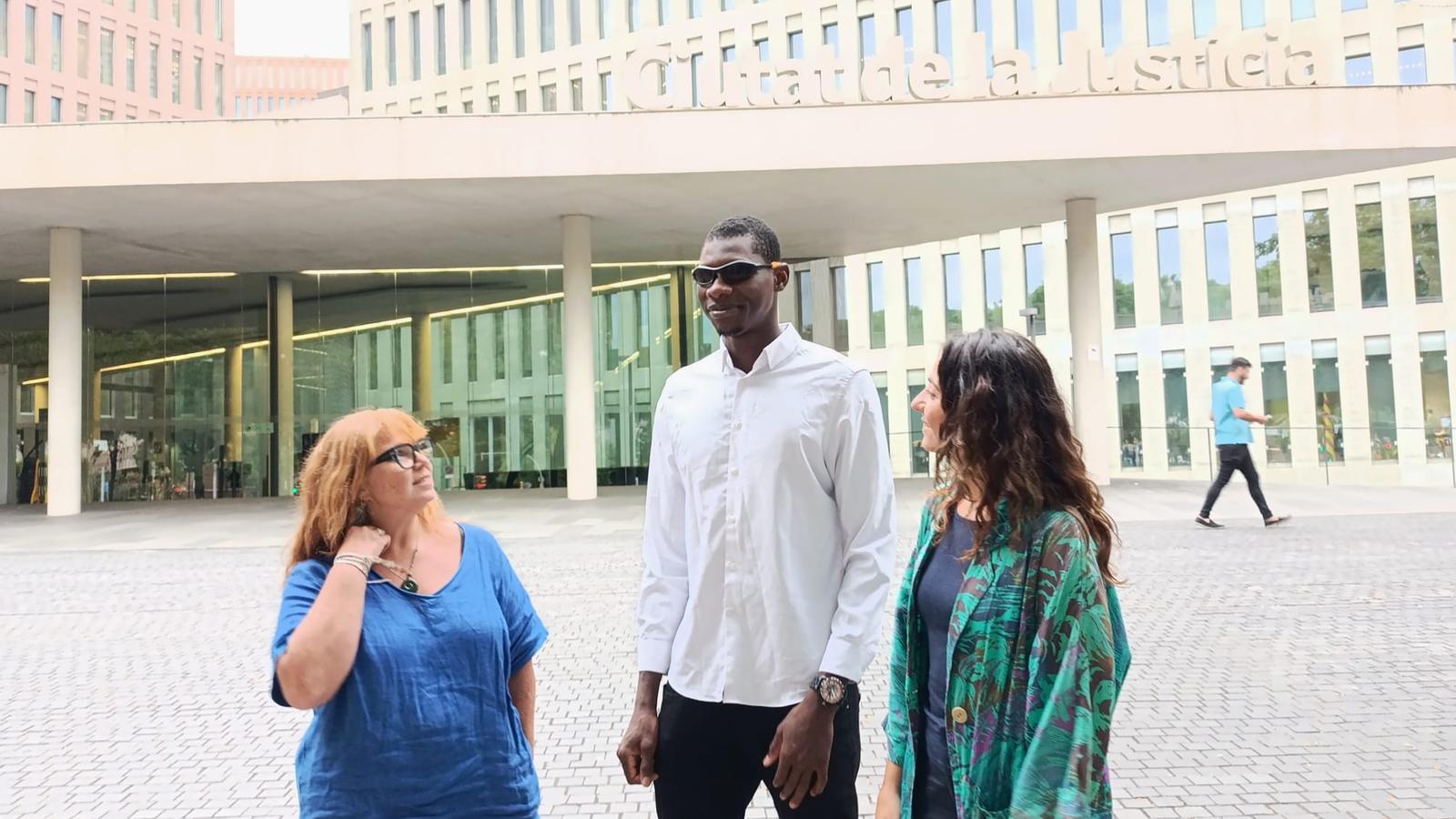
"I feel good; I did not think I would make it this far because I could not have done it alone," he added upon leaving the courthouse, accompanied by Irídia psychologist Paula Rossi and lawyer Sònia Olivella. He testified from Barcelona because that is where he now lives, via videoconference with the Melilla court handling the case and without any representative from the Public Prosecutor's Office, which has not appeared in the case's investigation so far, according to the private prosecution.
After years of moving with his family to different areas of Mali to escape the armed conflict, in 2020 he decided to travel to Spain. He stayed in Morocco for a little over a year, working in different cities, and finally, he hid for eight months on Mount Gurugú, in Morocco, until he managed to jump the Melilla fence on March 2, 2022, at seventeen years old. That morning, hundreds of other people also crossed the border.
Once in Spanish territory, among the police unit was a civil guard who struck the young man twice in the face. The blows impacted his left eye, causing an irreversible injury, and his back, where they left scars. Zakaria filed a complaint in 2023 for crimes of torture and injury. "It is essential for reparation to be able to explain to a judge what happened," assessed Olivella, coordinator of litigation at Irídia, who highlighted the instructor's attention to detail, allowing the complainant to explain himself.
The case includes medical reports and testimonies, but so far the civil guard who struck the young man has not been identified. In fact, the first judge who received the case archived it immediately due to the lack of a perpetrator, and after an appeal, had to reopen it despite the opposition of the Public Prosecutor's Office. The investigation has indeed identified the agent's hierarchical superior, who testified as a witness without clarifying which of his subordinates was the perpetrator. Now, the private prosecution of Irídia, on behalf of Zakaria, has requested various reports on which agents were in the operation and what positions they were in to find him.
Sequelae
Zakaria explains that the pains still continue and do not let him sleep at night. After the injury from the beatings in Melilla, he was hospitalized for fifteen days in the city and had a first surgery on his eye. Until he turned 18, he was held in a juvenile center in the autonomous city. He now lives in Barcelona, where he was operated on for the second time a year ago, at Sant Pau, to remove his eyeball. He explains that he still has pain and that he cannot sleep at night. He had previously worked as a cook, but now he cannot because the heat and steam would not be good for the wound, and he is studying hospitality.
During these years, he has also been granted refugee status in Spain for having arrived there fleeing an armed conflict. Once he obtained his papers, they also recognized a 40% disability for the loss of vision in one eye.
