Mother and daughter die injured by the fall of a wall in Roda de Berà during the downpours
The victims, one only 18 years old, were trapped by the collapse of the structure
BarcelonaTwo of the three people injured by the fall of a wall in Roda de Berà during the torrential rain episode early Saturday morning have died. They were a mother and her 18-year-old daughter, who had been trapped under the wall of a home that collapsed in the port area of the municipality. Both were transferred to the Joan XXIII Hospital in Tarragona in critical and serious condition, respectively. Health sources confirm that the victims of this tragic incident died during the night. of a mother and her 18-year-old daughter, who had been trapped under the wall of a home that collapsed in the port area of the municipality. Both were transferred to the Joan XXIII Hospital in Tarragona in critical and serious condition, respectively. Health sources confirm that the victims of this tragic incident died during the night.
The confirmation comes after an episode of confusion about their condition. On Monday, the mayor of Roda de Berà, Pere Virgili, initially reported the death of the mother and daughter, but the council rectified hours later and assured that both were still alive, with vital signs and connected to life support. "We deeply regret the confusion and apologize for the distress and pain that this erroneous information may have caused," concluded the City Council, which has decreed two days of official mourning and the council's flags will fly at half-mast as a sign of mourning.
The President of the Generalitat, Salvador Illa, also expressed his condolences to the family and friends of the two women on social media: “My heartfelt condolences to the family and friends of the mother and daughter who lost their lives as a result of the floods last weekend in Roda de Berà. News that deeply affects us. All my support in these very painful moments”.
A day without light in Tarragona
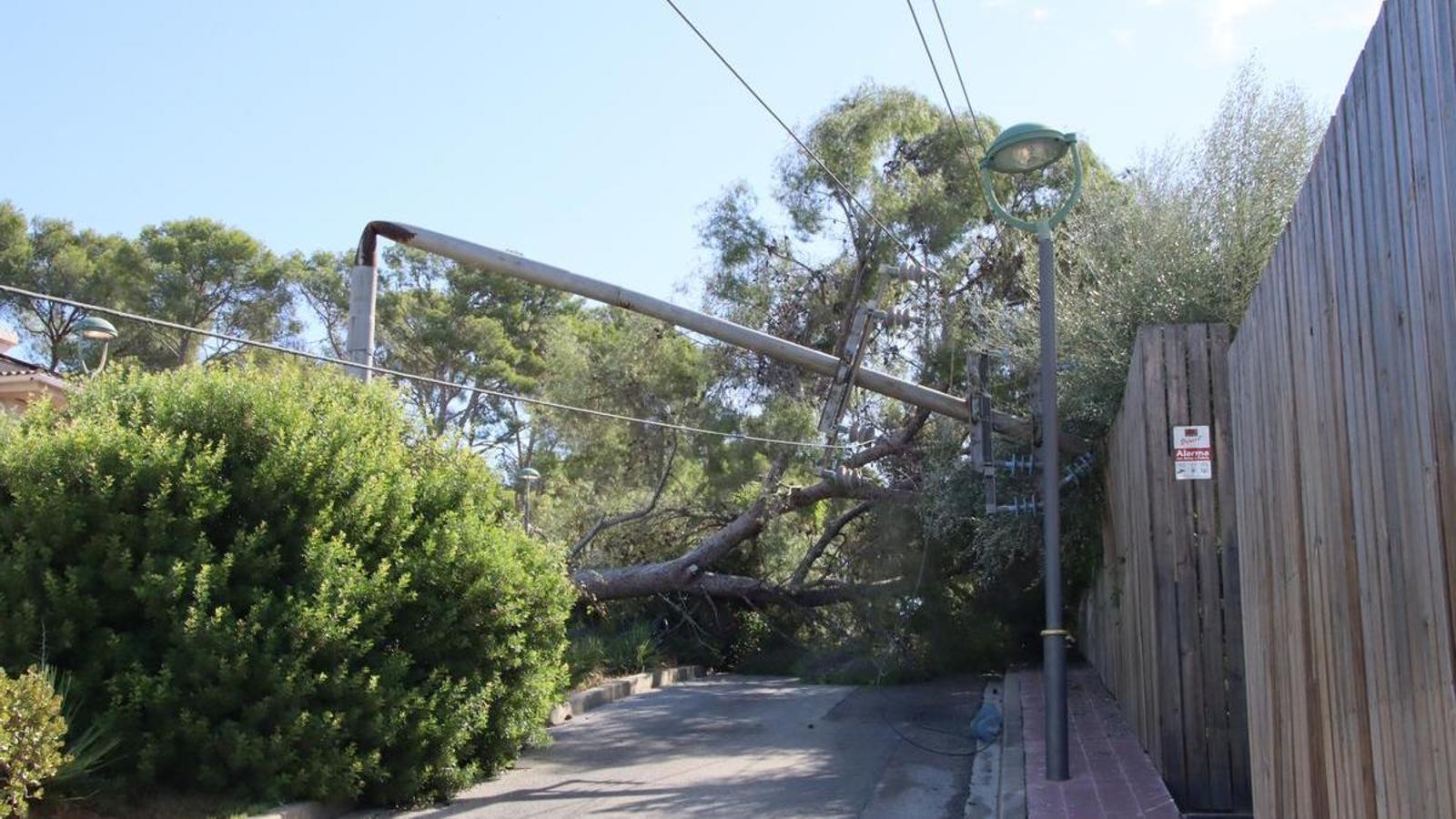
This Monday, another serious storm affected the region of Tarragonès and the capital suffered the worst consequences. In fact, some areas have taken hours to recover. This is the case of some 2,000 homes subscribed to the company Endesa, which have been without electricity all night due to the heavy rainfall recorded, which caused small floods and fallen trees. The strong winds caused them to fall on the wiring and electrical infrastructure, leaving thousands of subscribers without supply until it was restored this Tuesday at noon.
The main impacts have been registered in the developments in the Llevant area of the city, and the neighbors who have been left without electricity supply have been those of Monnars, l'Escorpí and Rodolat del Moro. According to the company's report to the ACN, to mitigate the situation, several generators have been installed to provide provisional supply to the areas where power outages have occurred until they could be restored.
The company has worked with about fifteen teams of electrical operators on the ground, accompanied by five felling brigades. In parallel, there were company teams touring the various affected areas to inspect the lines and detect other anomalies. Endesa has highlighted that the work to restore the electrical supply has been carried out in coordination with the Guardia Urbana of Tarragona and the Bombers de la Generalitat.
Progressive recovery
The main impacts of the storm in Tarragona have been concentrated in the Part Baixa, El Serrallo, the beach areas, La Móra, the Entrevies and Francolí industrial estates, and various urbanizations in Llevant, which are progressively returning to normal. The storm has also affected several campsites in the city, where some families have had to be temporarily rehoused within the same establishments or in others nearby, as some clients explained to the ACN. Regarding mobility, the Municipal Transport Company (EMT) has explained that it maintains provisional disruptions on four bus lines. Service will be restored as traffic routes allow. The mayor of Tarragona, Rubén Viñuales, stressed that, despite the intensity of the storm and the numerous incidents, there have been no personal injuries.
Regarding the hailstorm recorded in Segrià, initial ground checks indicate that there will be little impact on crops. This is due, on the one hand, to the fact that stone fruit has already been practically harvested and, on the other, that pears have been harvested by 70%. The heavy rainfall that has affected the central area of Ribera d'Ebre, especially the municipalities of Móra d'Ebre and Móra la Nova, has left completely perforated fibrocement roofs, unusable solar panels, and cars with broken windows and visibly dented roofs.
The ES-Alert transmission
Despite heavy rains on both Saturday and Monday, the Generalitat did not send any ES-Alert to the public. The Government spokesperson and Minister of Territory, Sílvia Paneque, assured that this alert is sent according to a "technical" criterion, although she clarified that the management of the torrential rain episode in recent days in Tarragona will be reviewed. Nevertheless, and as the Government argued on Saturday, she highlighted that the forecasts for Tarragonès and Baix Penedès did not reach level 5 or 6 of emergency, from which the alert is planned to be sent.
According to Paneque, it is Civil Protection that decides "if it is useful" to send an ES-Alert when there is an update on the danger of precipitation, as happened this Monday, when level 6 was reached. On the other hand, the deputy director general of Coordination and Management of Emergencies of Civil Protection, Imma Solé, justified that an ES-Alert message was not sent because the precipitation was “sudden” and had “little predictability”. In an interview with El matí de Catalunya Ràdio, she stated that there was no forecast that it could “produce a situation of this type”.
Solé stressed that when the downpours occurred, the margin for warning was “minimal”. Therefore, the official pointed out that the public could not be alerted as on other occasions, such as "the day before so that people can prepare". Solé recalled that this technology is used when there is a “high probability”, with levels from 5 out of 6 and 6 out of 6. In this regard, Solé remarked that there is a “climate emergency situation”, in which “extreme phenomena are becoming increasingly frequent”. This, she pointed out, means that “they are not sufficiently detectable”.
