Why has the Supreme Court now opened the amnesty tap?
The high court has applied the law to six convicted of disobedience and three convicted of aggravated public disorder, but has not moved a pawn on embezzlement

-
CAT -
CAST
MadridThe ruling of the CJEU on the amnesty law has caused a ripple effect. In recent days, the Supreme Court has rushed to close six cases that were on its table and had been pending for months. However, despite this sudden awakening, the fourteen people who have benefited from the penal oblivion law do not – strictly speaking – have anything to do with Luxembourg's endorsement. It was a filter that the high court implicitly set and which has ended up being the pretext for keeping all these cases frozen for nine months, given that last October the Constitutional Court had explicitly given the green light to apply the law.
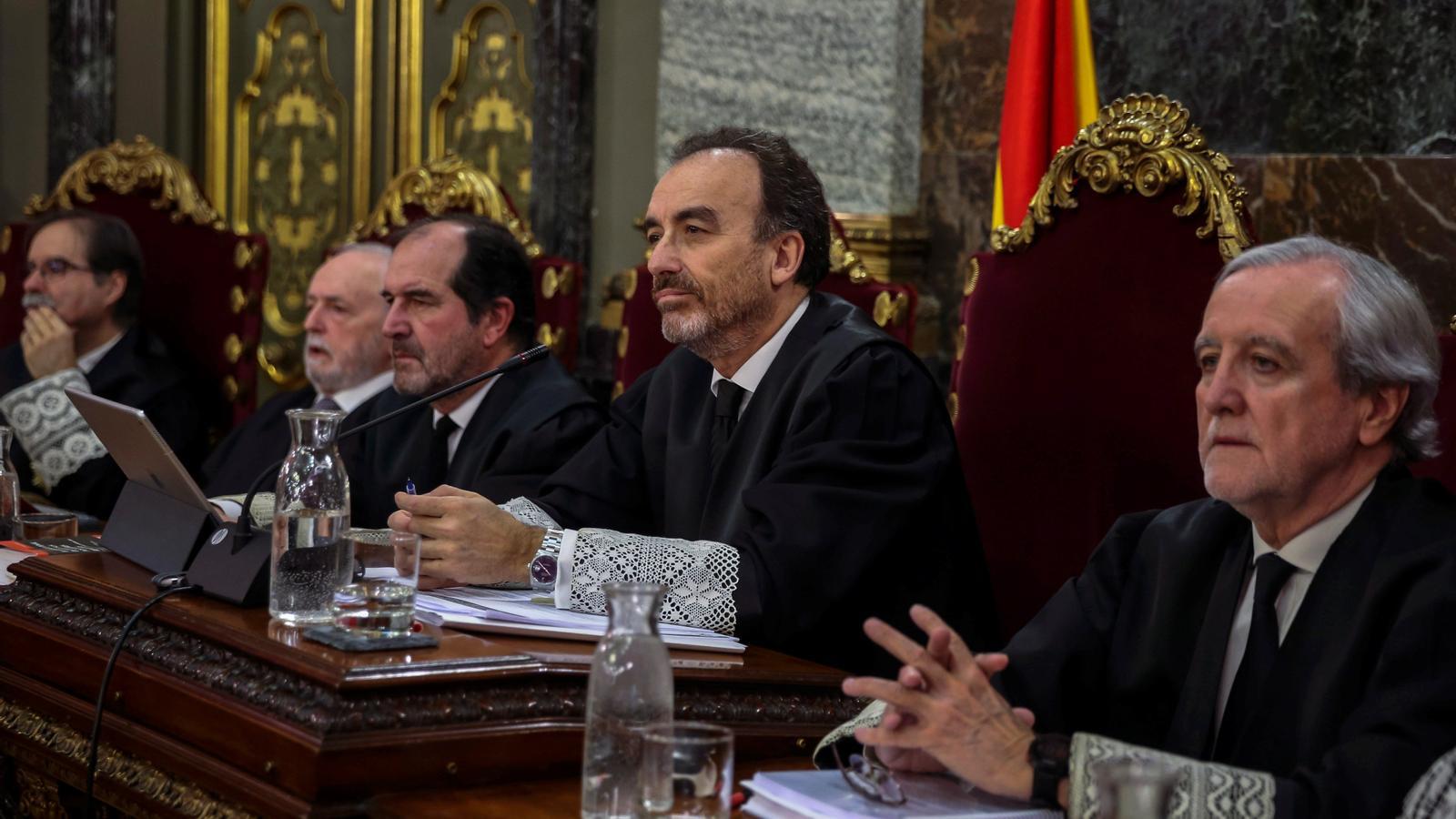
But we must differentiate between the two lines of action of the Supreme Court. These days it has been amnestying disobedience and aggravated public disorder, two crimes that it never doubted would fall within the scope of the law. “It is fully covered, without nuances and without distinction,” acknowledged Manuel Marchena on September 30, 2024, regarding disobedience. The criminal chamber did have reservations about the compatibility of the amnesty with the Magna Carta, which is why it took the law to the Constitutional Court with an appeal that – it is true – caused the processing of all cases to be suspended. On the other hand, Manuel Marchena and Pablo Llarena have maintained from the first day that the embezzlement attributed to 1-O cannot be amnestied and, for two years, they have not budged an inch from this premise. Not now either.
It was twenty days after the amnesty came into effect when the investigating judge ratified the arrest warrant for Carles Puigdemont, alleging, precisely, that it is the same law that excludes him. He argued that the members of the Government enriched themselves because they avoided paying the cost of 1-O out of their own pockets and that, therefore, they could not be amnestied because the law excludes embezzlement committed to obtain financial gain. It was a reasoning – twisting the interpretation and spirit of the law – that sources of the highest solvency from the Supreme Court assure ARA that “does not change” with the Luxembourg ruling. For this reason, we will have to wait for the Constitutional Court to resolve the appeals for protection and order it – if that is the case – to apply the amnesty to embezzlement. Until then, whatever happens on other fronts, there will be no changes.
In fact, this same week, the High Prosecutor's Office of Catalonia has argued that the ECJ ruling does not affect the embezzlement case of Josep Maria Jové and Lluís Salvadó: it alleges that it contains “pronouncements of a generic nature” on the amnesty, but it does not see a “complete identity” between what has now been resolved and the question posed by the High Court of Justice of Catalonia.

The struggle to expunge criminal records
Outside the usual spotlight, there are names that are also waiting for the Supreme Court to make a move to definitively cancel their criminal records, a process that was also paralyzed due to the unconstitutionality question promoted by the high court. One of them is Carme Forcadell, who was president of the Parliament in 2017 and has now made the third attempt for the high court to extinguish her criminal liability.
Sources from the defense consulted by ARA explain that – surprisingly – she still has a criminal record for sedition, a crime that was repealed in December 2022. At the time, they asked the Ministry of Justice to cancel the records – which is the usual procedure that should be followed – but it was denied, alleging that not enough time had passed. And her subsequent request to the Supreme Court received no response. “I was a civil servant in the Department of Education and I couldn't be because I have a criminal record,” Forcadell lamented to ARA four months ago.

Josep Rull and Quim Forn – who were not convicted of embezzlement – made the same request and continue to wait. For their part, for example, Carles Mundó – who was Minister of Justice on 1-O, was convicted of disobedience and did not have to go to prison after the sentence – completed his sentence in 2021. Criminal records for disobedience expire after three years and, therefore, he has not needed to request that the law be applied to him. In fact, it is the same reasoning the TSJC used in the 9-N case: it denied amnesty to Artur Mas, Joana Ortega and Irene Rigau by arguing that “there were no longer criminal records pending cancellation”.
Marta Rovira, awaiting the Barcelona High Court
A separate case is that of Marta Rovira, who was general secretary of ERC from 2011 to 2024 and went to Switzerland in March 2018. Pablo Llarena's order of July 2024, which maintained the arrest warrant for Carles Puigdemont, also lifted the search and capture order for Rovira because she was only charged with disobedience. Eleven days later, thanks to an error by Manuel García-Castellón that forced him to close the investigation into the Democratic Tsunami, she was able to return to Catalonia.
Two months later, her defence referred to the precedent of Anna Gabriel to remind Judge Llarena that the competent court to definitively archive the case was the Barcelona Court. But it was not until last May, almost two years later, that the criminal chamber of the Supreme Court agreed to refer the case to Catalonia. Following the ECJ ruling, Marta Rovira's lawyer again requested the application of the amnesty and, from September, the Barcelona Court – which has already forwarded it to the parties – will have to decide whether to bury the case.
