The Supreme applies amnesty: ends the case of eight independentists
The high court definitively buries the case of the Parliament's table, which was acquitted four years ago

-
CAT -
CAST
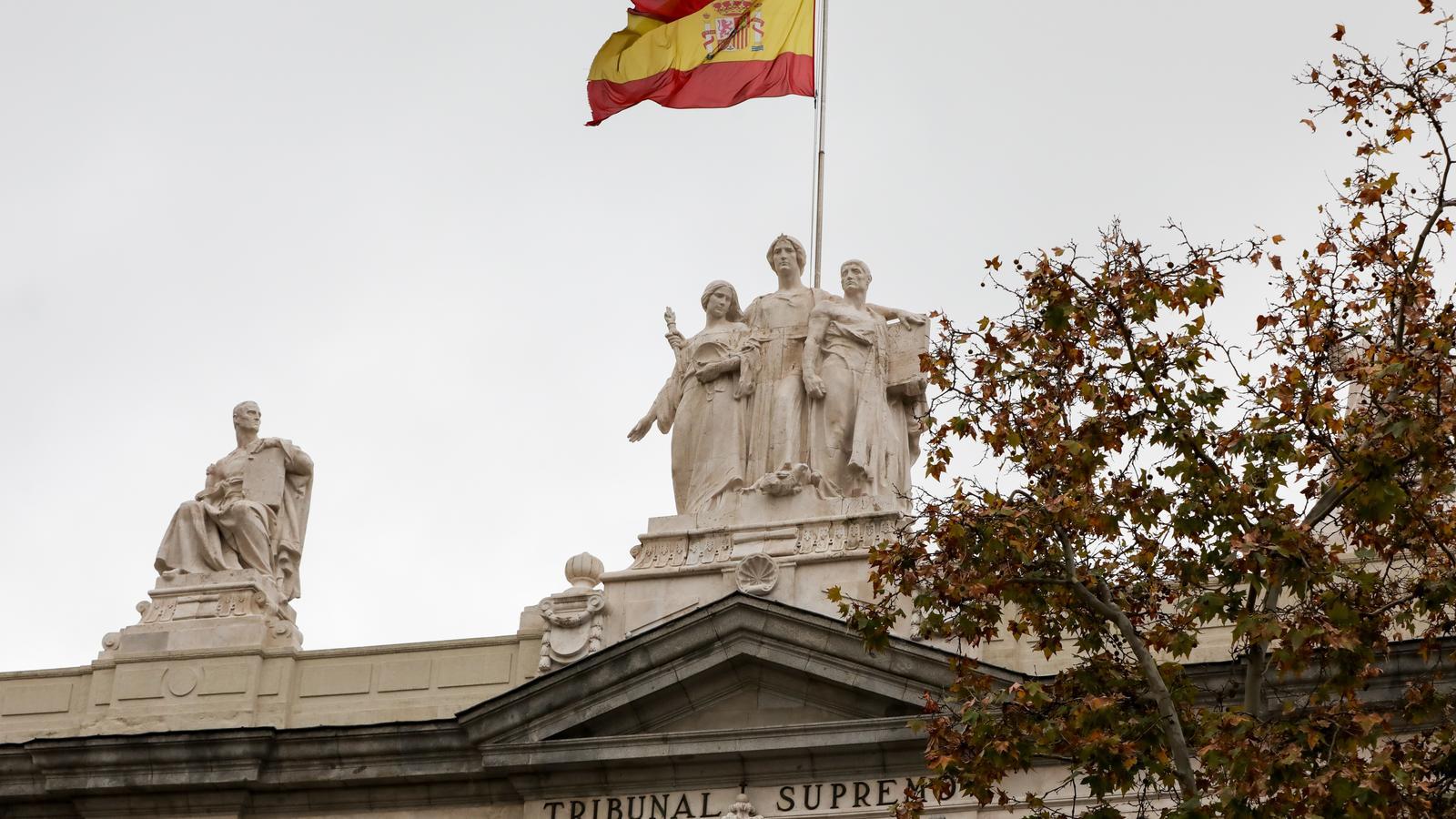
MadridThe Supreme Court has applied the amnesty law to eight pro-independence supporters - grouped into four cases - who were pending it. The decision comes a week after the judgment of the Court of Justice of the European Union, a ruling that the high court tacitly decided to await. Formally, it had suspended the processing of the four cases following the question of constitutionality that it presented in July 2024. The Constitutional Court's ruling, which did not favor him, arrived in October 2025, but nine months have had to pass for the Supreme Court to have made a move. “The facts that gave rise to this procedure would not offer any doubt as to their subsumption in article 1 of the amnesty law. [...] Consequently, the objective scope of application is met,” conclude the four interlocutory decisions. They are three protesters convicted of aggravated public disorder in the protests following the verdict in the trial of the Catalan independence process, a mayor which attributed the competencies of the schools to make possible the 1-O and the four members of the Parliament's table – with Roger Torrent at the head – who were acquitted of having disobeyed the TC rulings.
It is not the first time the Supreme Court has applied the amnesty. The first to do so was Pablo Llarena on July 1, 2024. Although denied amnesty to Carles Puigdemont for the crime of embezzlement, he did admit that disobedience fell within the scope of the law and, therefore, he exonerated the former president of the Generalitat, as did Toni Comín, Lluís Puig and Marta Rovira. “It is appropriate to declare that the scope of application of the law extends to actions and omissions susceptible of constituting the crime of disobedience,” he concluded. Now the resolutions are signed by Manuel Marchena, Carmen Lamela, Andrés Martínez Arrieta, Leopoldo Puente and Antonio del Moral.
“Based on the resounding ruling by the CJEU, it was already inevitable that, finally, the Supreme Court would do what it should have done from day one: apply the amnesty law,” ERC celebrated in a statement. And it requested that this step be repeated “immediately with the rest of the cases.” Along the same lines, the leader of the Republicans, Oriol Junqueras, has called for “the amnesty to be applied to all pending cases, all political rights to be restored, and the return of the exiles to be allowed.” The Supreme Court's decision comes two days after the Constitutional Court closed the first file on amnesty: applying the doctrine, it has dismissed the unconstitutionality appeal filed by the Junta de Extremadura, which was the last of the sixteen that reached it, along with the six questions of unconstitutionality. On September 22, it will begin to examine the amparo appeals of the leaders of the Procés.

Two demonstrators from Girona
The case of Abdessabour al-Youbi and Mohcine El Mesbay was what the Supreme Court used to torpedo the diligent application of the amnesty. Both were sentenced to one and a half years in prison for aggravated public disorder in the protests of October 2019 in Girona, following the verdict of the trial of the Process. Al-Youbi filed an appeal for cassation and, before resolving it, the high court sent the amnesty to the Constitutional Court for the first time in a ruling that described the Process as a "coup d'état" on several occasions.
Specifically, they were convicted of throwing stones at the courthouse located on Ramon Folch Avenue. The sentence states that they were part of a group of about 300 people who threw
A demonstrator from Barcelona
The third is Oriol Calvo, a young man from the Poble-sec neighborhood, who was sentenced to one and a half years in prison for the post-sentence protests of 2019 in Barcelona. Initially, he was convicted of attacking authority and aggravated disorder, but the High Court of Justice of Catalonia (TSJC) acquitted him of the first offense. The sentence, which is based solely on the testimony of two Mossos agents, detailed that he threw stones at the police line. His defense replied that he was in the "wrong place" at the "wrong time". He was one of the seven young people who were about to go to prison before the amnesty law.
Maties Serracant, former mayor of Sabadell
Maties Serracant (CUP) has also been acquitted, who was mayor of Sabadell from July 2017 to June 2019. Weeks before October 1st, he attributed to himself the powers over the authorization of the use of schools because he was the one who gave the green light to use them for the referendum: he was aware that this could generate responsibilities for the councilors in charge and he wanted to exempt them. He was sentenced to a fine of 1,800 euros and four months of disqualification for a crime of disobedience.

The Parliament's board of Roger Torrent
Finally, the Supreme Court has also applied the amnesty to the sovereignist members of the Parliament's board for the legislature after October 1st: Roger Torrent, Josep Costa, Eusebi Campdepadrós, and Adriana Delgado. All four were acquitted in November 2022 because the TSJC considered that it was not proven that they “wanted to disobey the mandates” of the Constitutional Court when they accepted the processing of resolutions on self-determination and against the monarchy.
Subsequently, the Public Prosecutor's Office appealed the acquittal to the Supreme Court. However, later, with the amnesty coming into force, the public ministry admitted that they should be amnestied. Despite this, Josep Costa opposed it, alleging that the facts were not a crime and that criminal justice has no jurisdiction over the “votes, opinions, or expressions of will” of parliamentarians. After the news became known, in a tweet, he belittled the resolution: “I don't give a damn. If I don't recognize any authority for them to judge me, I don't recognize it for them to acquit me or grant me amnesty either”.
An outstanding case: the Granollers Three
Despite the four new developments, three young people are still awaiting the Supreme Court's decision: the Tres de Granollers, who were convicted of throwing stones at a van of the riot police of the Mossos d’Esquadra during the riots in the center of Barcelona on October 1, 2020, during the third anniversary of 1-O. They were among the first to be amnestied, but a police officer filed an appeal with the Supreme Court to prevent it.
They were sentenced to three years in prison, and one of them received an additional six months and compensation of 76,600 euros for having run over an agent, who fell to the ground and broke his fibula. He is the one who tried to overturn the amnesty, arguing that this injury – which the three independentists have always denied – might not be included in the law.
Furthermore, agents of the National Police and the Civil Guard also announced that they would do the same against the three young independentists who were convicted for the Holi protest against the demonstration of the police union Jusapol on September 29, 2018. However, they did not manage to formalize the appeal, and therefore, the amnesty became final.
