Carme Forcadell: "I am not going to Madrid nor will I return to Spain, I have very bad memories"
Former President of the Parliament of Catalonia and of the ANC

-
CAT -
CAST
BarcelonaCarme Forcadell i Lluís (Xerta, 1955) presided over the Assemblea Nacional Catalana, from 2012 to 2015, and the Parliament of Catalonia, from 2015 to 2018. Interviewing years later someone who has held relevant positions during such a turbulent period in the country allows for a more free and perspective review of collective adventures and personal experiences, such as the 39 months she spent in prison. Forcadell does not forgive those who belittled her or those who imprisoned her, she does not travel to Spain, and she does not rule out, if the circumstances of unity and determination arise, returning to the front line one day.
This week marks eight years since you entered prison. Does it feel like yesterday or like another lifetime?
— Look, it depends. I always say: next year I won't think about it anymore and I always end up thinking about it. There are times when it doesn't seem like another life, when it seems like yesterday. I suppose like everyone who has had to go through a difficult stage.
Is this the worst thing that has ever happened to you?
— Yes. My father died, in 2006, with Alzheimer's. That was very serious.
But with the death of a father, if things go as they should, you already count on it. With prison, no.
— I had never thought I would go to prison. You count on going to the hospital, that perhaps when you retire you will go back to studying, but never with prison. When they send you there, it's a very hard blow. You don't know it and everything that is unknown is scary.
It has been five years since you were released from prison. In that time, have you been able to forgive someone you thought you would never forgive? For example: have you forgiven those who imprisoned you?
— Forgiven? No. No, no, no. The Supreme Court put me in jail, and they would love for us to still be in jail. They got us out because they had no choice, but if they could have, we would still be there. The proof is that, in the part they can control, which is applying the amnesty law, they don't apply it. I could forgive someone who has wronged me if I see they repent, if they make a change. But that's not the case.
What would happen if you met Manuel Marchena, the president of the court that judged you?
— I don't think I'll find him, because I'm not going to Madrid –lest they stay with me again– and I don't think he's coming to Catalonia.
Is this joke that you are not going to Madrid, or is it for real?
— It's true.
Only to Madrid or anywhere in Spain?
— I go to the Catalan Countries and the Basque Country. I don't go to Spain. When we were in Madrid, we had a very bad time. People shouted at us, insulted us. When we went out in those Civil Guard vans, at full speed, people looked at us badly. If we were stopped, they hit the window. I have bad memories, you know what I mean? So, I have no need to go. Man, if I had a friend in Cáceres who was very sick and asked me...
But, if everything goes as it should, won't you return to Spain?
— No.
This week you posted a tweet remembering the eighth anniversary of your imprisonment. Reading the responses hurt me. Many people do not forgive you for backing down. How do you live it?
— I post a tweet and never look at the replies. It's not from now, it's from many years ago. But I understand people, because I also thought, that we had it within reach.
The price you have paid is very high. In your case, three years in prison.
— Yes, 39 months, I have it recorded. But people felt very sad and very disappointed. There are things that were done well and things that were done badly. And every time I think about it, I see that what we were going to do is very difficult. Perhaps we sinned by being naive, by thinking it would be very easy. I can assure you that we did everything we could and more. And if we didn't do more, it was because we couldn't, and because we were afraid, because we had everything to lose. And I'll tell you something else: these people say it on Twitter, but they never say anything to your face. I have never encountered anyone, anyone, Albert, anyone, either on the street or anywhere else, who has ever said anything to me. On Twitter, everyone is very brave.
Where is Ithaca, now?
— Ithaca is in the same place it was, what happens is that it costs us more to get there. It seemed that the island was a little further beyond Mallorca and it turns out that no, it is touching Turkey.
Do you think you will see the independence of Catalonia?
— Man, I would like to.
It's not the question, if you would like.
— Sometimes I am optimistic and I say yes. History, sometimes, takes leaps and accelerates. I always explain that on July 10, 2010, we took to the streets to defend the Statute and seven years later we voted for independence. If these circumstances arise again, it could be. I don't see it as impossible. The Berlin Wall fell, but three days before no one knew it.
Now you are in like the third or fourth row of public exposure. Is this because you learned your lesson or because it's someone else's turn?
— I think it's time for others now. I've been involved in politics my whole life and only lived off institutional politics when I was president of the Parliament. I continue to be involved in many organizations, but I'm not on the front lines or doing institutional politics.
This will not happen again?
— If independence is pursued, and it is pursued, I will consider it. But it must be pursued. For now, no.
I thought the “no” would be more radical.
— Do you know what happened? That I also said I wouldn't run in an election in 2015, and I did. I was president of the Catalan National Assembly...
Yes, man: “President, put the ballot boxes out!".
— Exactly, this sentence will haunt me for the rest of my life.
And another one I remember perfectly: “Mr. Carrizosa...
— “...why is he asking me for the floor?”. It will also haunt me, this.
Speaking of Mr. Carrizosa, and not just him: what did you learn from those who didn't think like you during that Procés era?
— Look, there were people in Ciudadanos who were very good people. It's also true that they were removed very quickly.
Are you saying you couldn't be from Ciudadanos and a good person?
— It depends on what you mean by a good person. I'm not saying you should do charity work, be a good citizen, a good mother, a good colleague... But everything they did to us, everything they did in this country, everything they did to the Catalan language... Before Ciudadanos entered, in the Parliament of Catalonia everyone spoke Catalan. They were born to destroy Catalan education and the language. It is in this sense that they are not good people.
Beyond Ciudadanos, from the parties that did not want independence, did you learn something, did you better understand the complexity and diversity of this country?
— Yes, evidently. Within the socialists and within the Comuns, there were people who perhaps were not independentists, but who did defend the right to self-determination. I believe that we can understand each other with these people.
Did you already come politicized from Xerta or was it when you arrived at university?
— I think I became politicized by language. I came from a town where everyone spoke Catalan. It was curious, because the teacher, inside the classroom, spoke to you in Spanish, and in the playground, in Catalan.
Which is quite the opposite of what happens now.
— Exactly. And when I got to university, I didn't understand why many students didn't speak Catalan. They could speak it, but they didn't speak it. It was like an indifference they had towards the language. They defended whales, they were from Greenpeace, all ecologists, but Catalan, nothing at all.
What family did you come from?
— No, no, peasants. Not politicized at all. Only from time to time my grandmother, who had lost a son in the war, would shout or say an outburst, but in general, politics were not discussed.
Is the mother alive?
— Yes, he is 97 years old. And I have two grandchildren, too. One was born when I was in jail, in September 2019.
Were you able to go see it?
— The Supreme gave me two hours of leave to go to the hospital.
Are you better as a grandmother or as a daughter?
— I don't know, maybe as a grandmother, because my mother is in the village and my grandchildren are here. Therefore, I see my grandchildren more than my mother. I try to go as much as I can, though.
I wanted to ask you if the 70 years you turned last year were an impact but, come on, with a mother of 97...
— I, since I turned 40, haven't had another birthday. 40 impacted me a lot and I decided to stay there, that I wouldn't have any more birthdays.
What would you like to happen to you now?
— Wow, I would like Catalonia's independence, you don't need to ask me. Personally, I'm going through a period in my life right now where I'm doing very well. I'm not on the front lines, I'm not suffering, because I've suffered a lot in recent years. Now, therefore, I'm calm, I do what I want, I'm in many organizations, but they are all things I like. What would I like? That they give amnesty.
What is your current legal situation?
— Since I am not convicted of embezzlement, unlike those who were in the Government, I do not have the disqualification to hold public office. I could run for elections, but I could not work. I was a civil servant in the Department of Education and I could not do so because I have a criminal record.
You were talking about these years of suffering: what was the moment you suffered the most?
— When my eldest grandson, who was a year and a half old at the time, had to be operated on because he had swallowed a pistachio and was choking. I was in jail, hysterical. I had a horrible night. And another moment is when a colleague committed suicide in front of my cell.
Didn't you suffer as president of the Parliament?
— I suffered a lot, but it was bearable. I already knew that not all that glitters is gold.
Do you think you were disrespected at any point?
— Yes, I think so. And much more because she was a woman. I was disrespected in the hemicycle, but also in the spokespersons' room, in the table meetings.
In what sense?
— Because they raised their voices, they shouted, they looked at me with contempt: “What do you know?”. And the most serious thing is that no colleague said anything. That hurt me even more. There was no one who said “you are going too far”.
None of yours or theirs?
— Of no one. Of no one. I don't know if a moment came when they already considered it normal.
Who has been the best president of the Parliament?
— I don't know. I think President Rull is doing well now.
And the best president of the Generalitat you have known?
— Complicated, huh? You're asking me a complicated question. I think President Pujol was a very good president in the early years. It's just that the others have been around for a very short time. President Aragonès, President Quim Torra, President Puigdemont, President Artur Mas was around a bit longer... But at the beginning, President Pujol laid the foundations for Catalanism, for education, for TV3...
The actor Sergi López said the other day that October 1st was very big, very emotional, and that it is the seed of something that can grow again.
— Yes, I completely agree. At the beginning of the Assembly, we all shook hands and didn't ask ourselves what you think, what the other thinks, we were all fighting for the same thing. Now we have reached a point where if you don't think exactly like me, you are a botifler, you are a traitor. This cannot be, we will not move forward like this. We have to redirect the situation, we have to re-stitch the country. The country is broken. If we were able to do October 1st, which is very significant, we must value it and we must prepare ourselves again for a similar situation. But to do that, we must go together. And be clear that no one will help us. I remember they used to say, "The European Union will not allow it." The European Union allows everything. Even if you don't think like me, we cannot be insulting each other.
What is the image that comes to your mind of maximum emotion from all that time?
— On September 11, 2013, when I was informed that the Via Catalana had been a success and we had filled the entire country. That day I cried.

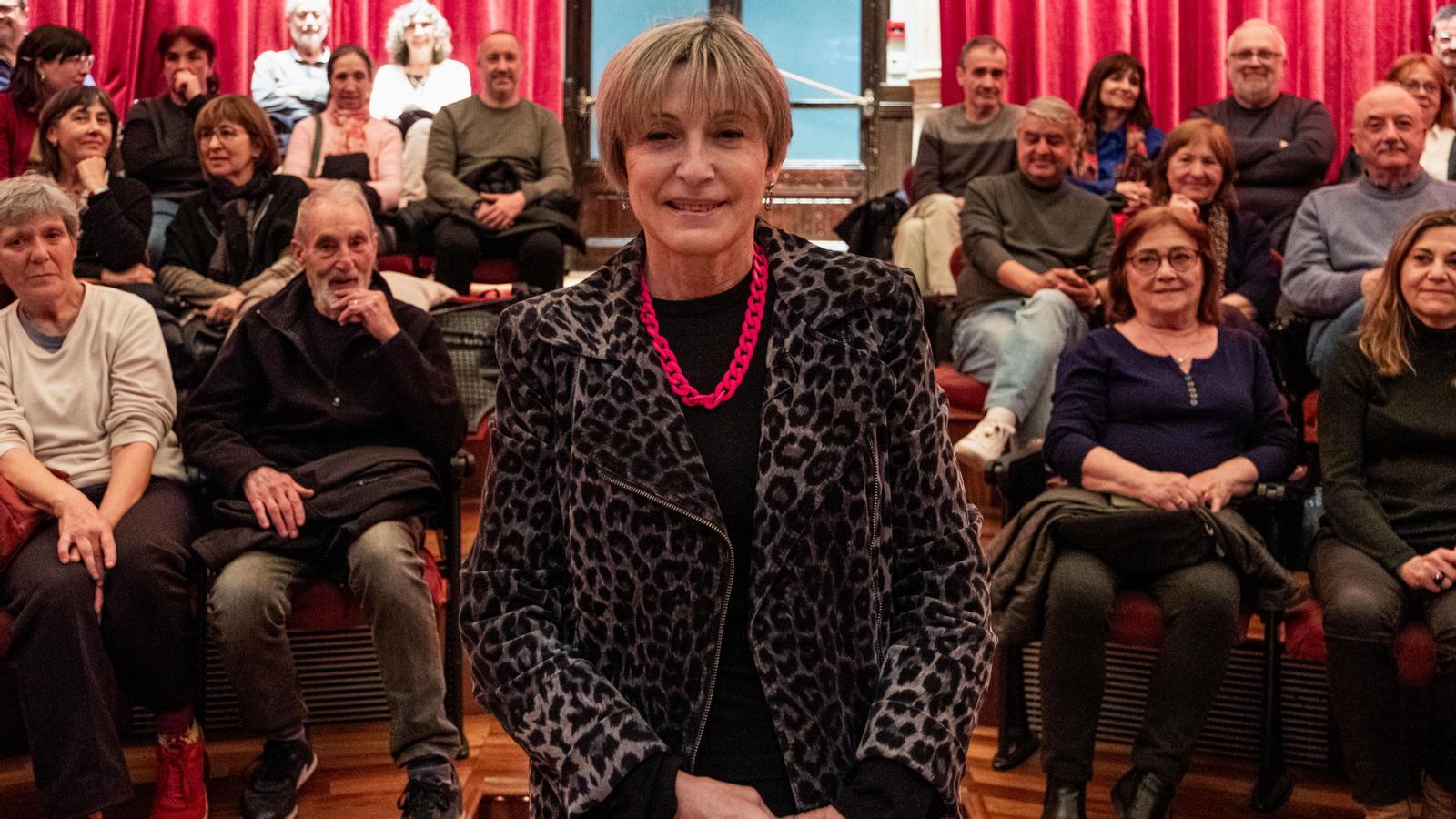
The conversation with Carme Forcadell is part of the 2 x CENT interviews we record once a month in the rehearsal room of the Orfeó Català at the Palau de la Música Catalana. One hundred readers and subscribers of ARA come without knowing who the guest will be. They arrive on time and, instead of sitting in the Palau's bar while we don't open the doors, they wait in line standing, as if they were at an airport about to board. A girl from the audience tells me that she asked ChatGPT who the interviewed person would be. The artificial intelligence reminded her that it was always a surprise, but after the girl insisted, the application ended up giving her three possible names: Silvia Pérez Cruz, Oriol Mitjà, and Pol Guasch. Carme Forcadell enters, she is greeted with a long applause, people ask her for photos, thank her, and even tell her she smells nice.
