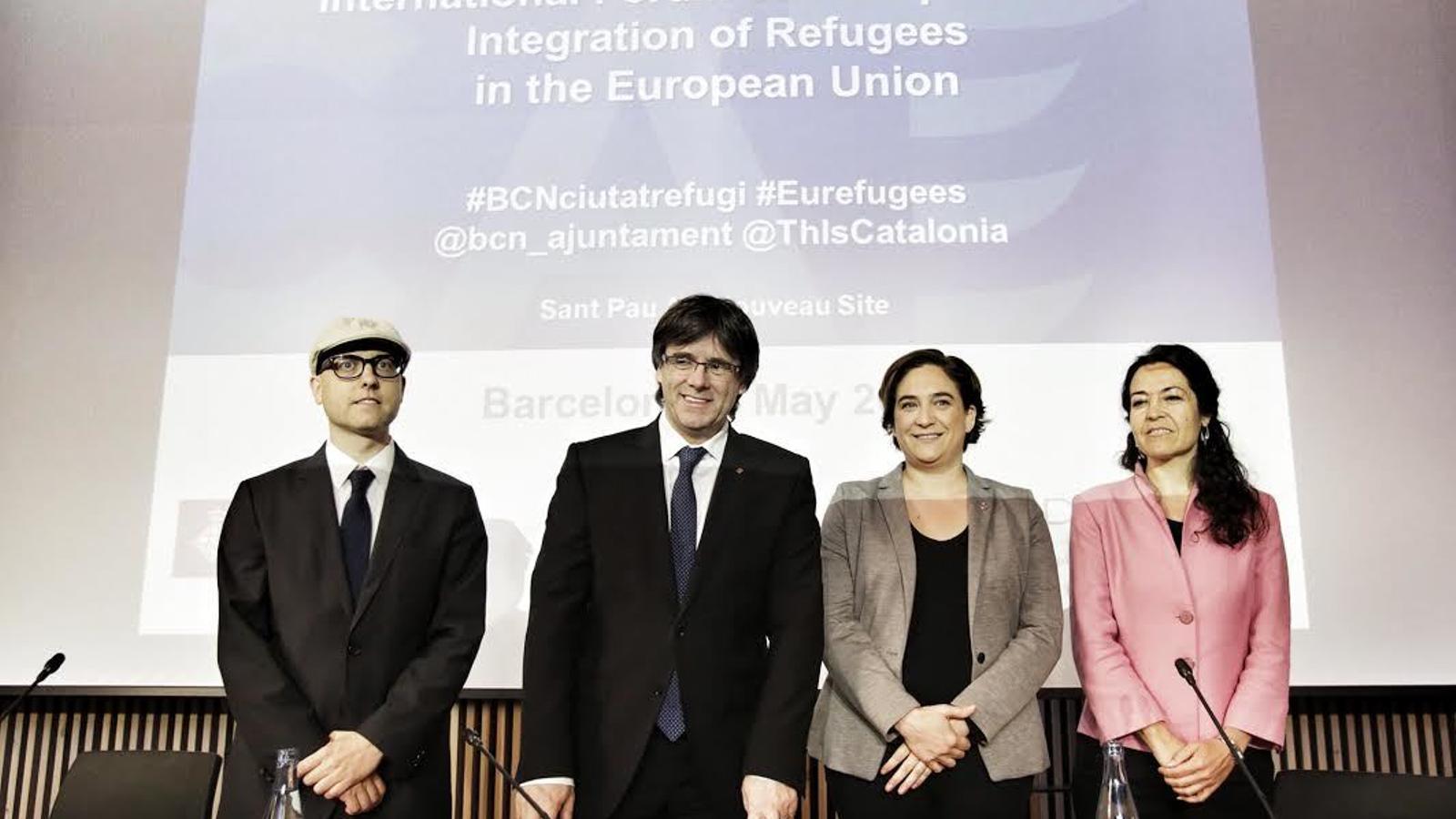
What do Rufián, Puigdemont and Colau have in common?

-
CAT -
CAST
BarcelonaIn current politics, hyper-leadership proliferates, but what is valued most is a personal brand that exceeds the party brand. This is what characters as disparate as Gabriel Rufián, Carles Puigdemont, Ada Colau, or Juanma Moreno Bonilla have in common.
In Rufián's case, it is evident that his personal brand goes far beyond ERC, among other reasons, because he has dedicated himself to working on a profile of his own, far from the straitjacket that party initials always impose. For a party, having one of these profiles is both a risk and an opportunity. The risk is falling into contradictions, and the opportunity is reaching new voters. In the case of ERC, the tensions experienced in recent months with Rufián's campaign in favor of the unity of the Spanish left are evident. But unlike other cases we will see now, the correlation of forces between Rufián and ERC is quite balanced. Simply put, if Rufián were to leave, ERC would lose political capital, but it would not collapse, because the party brand is consolidated.
In the case of Junts and Carles Puigdemont, the correlation of forces is very unbalanced in favor of the former president in exile. This makes Junts currently extraordinarily dependent on its leader, and there is a well-understandable vertigo regarding the decision he must make when he returns. If Puigdemont decided to throw in the towel, Junts would find it very difficult to fill his place, apart from the fact that it would open Pandora's box of differences between sectors and families. Conclusion: Puigdemont cannot disassociate himself from Junts now.
Colau is another transversal leader whose brand value exceeds that of any left-wing organization. For this reason, if she finally takes the step, it is possible that she will choose to create a new brand. The formula can work electorally, but it usually has a short life, as happened to Yolanda Díaz's Sumar.
What do these three characters have in common? What unites them is their aversion to the internal life of parties. They are not apparatchiks, they are free spirits, and as such, very difficult to control and, consequently, especially interesting for journalists.
The details

The President of the Council of Europe, António Costa, defended the housing policies of Barcelona's mayor, Jaume Collboni, this week. He did so at an event in New York at the residence of the city's mayor, Zohran Mamdani, with these words addressed to Pedro Sánchez: "Thank you, Pedro. Barcelona, world champion".
She does not like it to be called "Spanish doctors"
The President of the Community of Madrid, Isabel Díaz Ayuso, does not like it when the media talks about, for example, "Spanish doctors" when they are from Madrid. This week she tweeted to complain that RTVE did not specify that two doctors from La Paz were from Madrid. But then it turns out that the doctors in question were from Granada. Has Ayuso become a Madrid nationalist?
