Óscar Puente resigns as Minister of Transport: "For political dignity"
The socialist leaves the position after giving explanations to Congress for the tragic train accident in Toledo

-
CAT -
CAST
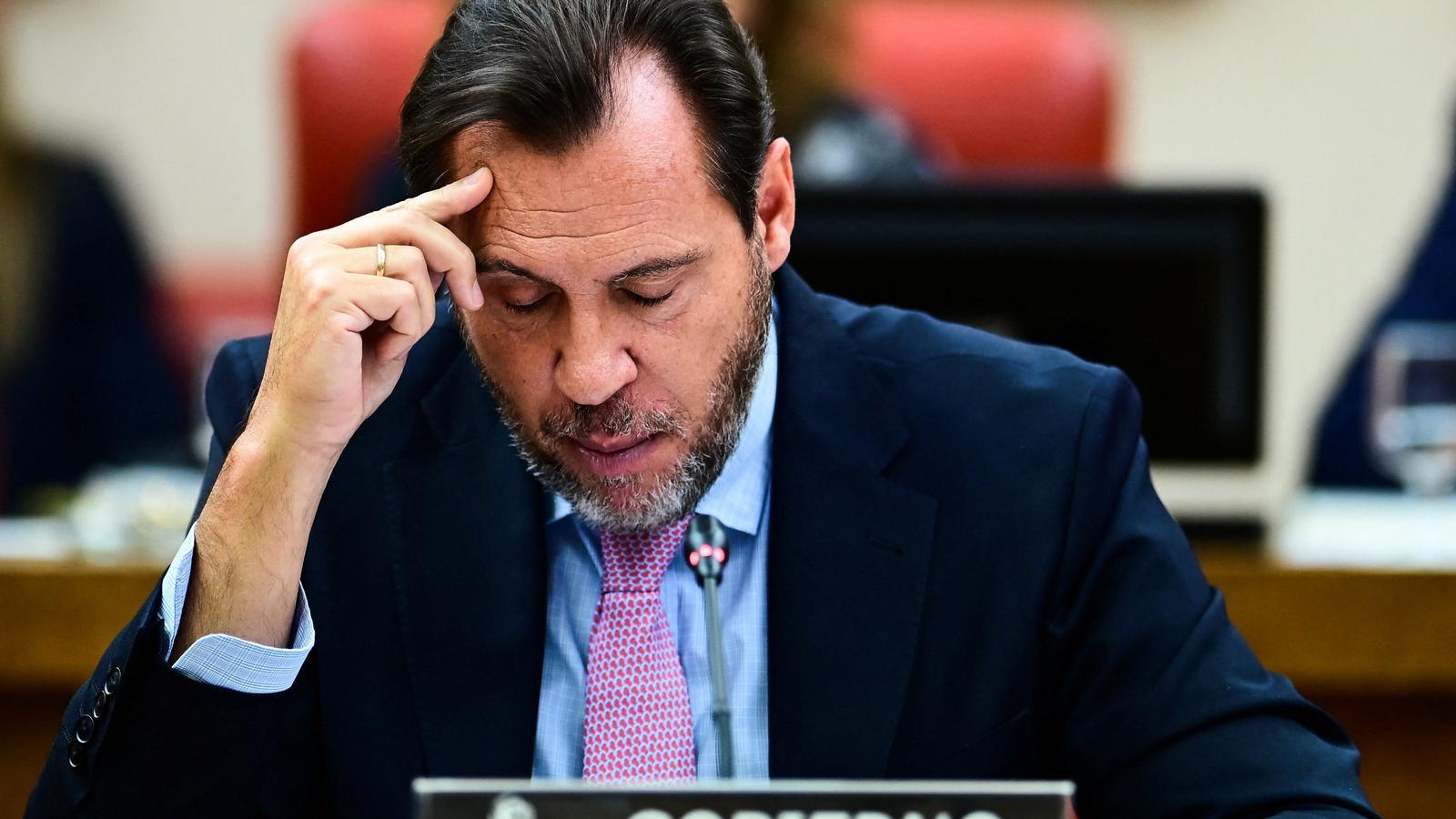
MadridMajor surprise in Congress. The Minister of Transport, Óscar Puente, has announced his resignation live, although it will not become effective until his final dismissal is published. He also announced that he will not be part of the PSOE's electoral lists for November 29th. "Out of political dignity, coherence, and empathy for the victims [of the train accident]," said Puente, visibly moved. The head of Transport announced this after appearing at his own request to give an account, precisely, of the tragic train accident in Urda, in the province of Toledo, which has left 69 victims dead, while at the same time opening a crisis of confidence in the railway and high-speed rail in the State. Sources from the Spanish government defend that he has carried out an exercise of "political responsibility". "He stood up and faced it," they reiterate.
The decision to resign, said Puente, was taken a few minutes after the accident. Specifically, while he was heading to the Adif control center in Atocha. Puente, however, had not communicated it to anyone: only to his family. In fact, he conveyed the decision to the Spanish Prime Minister, Pedro Sánchez, minutes before announcing it to the Spanish lower house, as revealed by Puente himself once the appearance had ended. For all these reasons, the resignation left many open-mouthed, especially because until this Tuesday the minister had been defending that he had to remain at the head of the portfolio.
"He stood up and faced it, provided solutions, and then took a step aside. [...] Thank you for so much, colleague," Sánchez valued via X. The Spanish Prime Minister stated that politicians like him "dignify the country". "We are not all the same. While some lecture, others give their all," he said, making an implicit reference to the PP. In fact, these days Puente had reproached the populars for a lack of responsibility when they demanded his resignation, especially due to the role the PSOE had during the Angrois train accident, in Galicia, in which 79 people died.
After giving explanations for more than four hours, and under the watchful eye and scrutiny of the spokespersons of the political formations in Congress, most of whom demanded that he step aside – only the PSOE defended the minister –, Puente started his last intervention by focusing it on "political responsibility". "Mine", he said. "A Minister of Transport of a country like Spain cannot continue in office with two accidents of this gravity in less than a year, no matter how different the reasons for one and the other may be", added Puente. In January, the socialist faced the train accident in Adamuz, in Córdoba, in which 46 people died. Ten months later, the investigation into this disaster remains open. The derailment and collision of two trains also affected the Madrid-Seville high-speed line.
The head of Transport has defended that he made the resignation public this Wednesday once the "most urgent work" had been done in Toledo: attending to the victims, being able to provide information for the investigation of the accident – which is already under judicial secrecy – and taking the first measures to reinforce safety on high-speed rail. "[The decision] Is good for the country and for democracy. [...] A democracy in which the citizenry demands dignity", Puente defended.
The PP is already pointing at Pedro Sánchez
Puente's appearance in Congress started at five in the afternoon, and the disqualifications from the right and the far-right did not prevent it from turning into a den of reproaches. The minister arrived at the Spanish lower house's constitutional hall alone, with a handful of documents under his arm and a very serious expression. As the hours passed, his loneliness became evident: all parties pointed toward his resignation, except for the Socialists and EH Bildu.
PP spokesperson Ester Muñoz held him responsible for the accidents in Toledo and Adamuz, and the decibels of her tone were only the prelude to those that later marked the intervention of Vox deputy Pepa Millán: "Can you sleep?", the far-right spokesperson snapped at him, leaving the room before the appearance had even finished.
"He didn't resign himself, Tezanos [the president of the CIS] made him resign," claimed the PP after learning the news. The Popular Party, however, is looking even higher: "Responsibility cannot be delegated, and Pedro Sánchez cannot hide behind Óscar Puente," point out PP sources. "116 deaths demand truth, explanations, and responsibilities at the highest level," they insist. When the appearance concluded, Muñoz said that the resignation "arrives 116 deaths late."
This Tuesday at noon, they did not anticipate at La Moncloa that Puente would step aside. Neither did they plan to dismiss any other high-ranking official, neither from the ministry nor from Adif, the Spanish railway operator in the spotlight after the accident. Puente himself had assured that "nobody" within the central executive had asked him to resign, not even the minority partner, Sumar. On the other hand, Ada Colau, the leader of the Broad Front in the State –the platform that brings together this space on November 29th–, had indeed demanded it bluntly: "Out of empathy and humanity" with the victims, she had reiterated this Tuesday in aninterview in El Mundo. "I want to thank Óscar Puente for the dignity of a difficult gesture," she indicated at night. Another person who made a gesture was Gabriel Rufián (ERC), the first deputy who stood up to give Puente a hug when he finished speaking: "You have been a great minister," he whispered in his ear.
"Up to the match"
However, Puente took advantage of his last intervention to ask the public for support for the PSOE and in particular for Pedro Sánchez, whom he thanked for his trust throughout this time. "I know it is a sad moment for him. I encourage all progressives to help him. He deserves it," he said. The Minister of Transport had become a loyal squire to Pedro Sánchez, his doberman. He had established himself as one of the most poignant and media-friendly profiles of the PSOE and at the same time one of the most hated by the right and the far-right.

Before finishing, in fact, he did not hesitate to throw a dart at the opposition: "We are facing a crucial moment as a country. It is a moment of collective pain, but that must not paralyze us, and much less hand over power [to the right]," said Puente. "A government of these characteristics will be disastrous," he assured.
The latest explanations
In Congress, and after a minute of silence in memory of the 69 fatalities, Puente gave an account of the events of the day of the train accident, just a week ago. He specified some nuances regarding the information provided so far, but did not reveal any major new developments. The minister promised collaboration with the justice system –there is an ongoing investigation under seal– and defended that the Madrid-Seville line, which this year also suffered the Adamuz accident, where 46 people died, "is not an abandoned or forgotten infrastructure". Nor is it, he said, the train in general: "In 2012 the investment was 30%; now it is 91%". At the same time, he detailed roughly the measures approved by the government to reinforce high-speed safety, although he said it is already safe, as well as the financial aid for those affected and the victims' families.
