Noelia Karanezi: "We Catalans must lose the fear of inconveniencing"
Screenwriter and communicator

-
CAT -
CAST
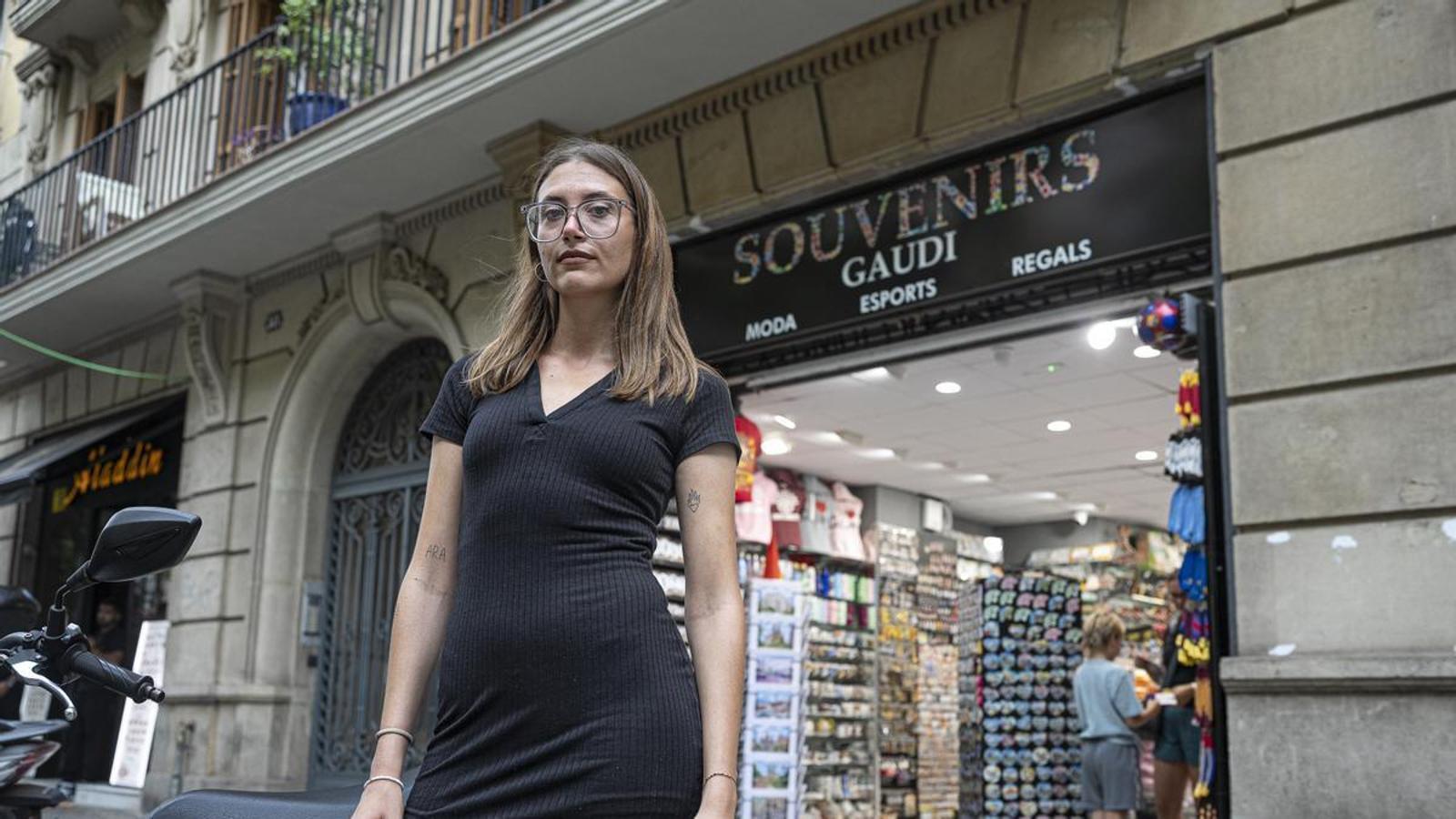
Her Instagram profile is represented by a photo of Audrey Hepburn in Breakfast at Tiffany's, a film that she assures me she has seen more than seventeen times. Karanezi began to stand out by commenting on current events through tweets and short videos, and has ended up being a scriptwriter for La competència and a member of Nexe Nacional, a group of left-wing nationalists born after the Procés.How did you become politicized?
— It seems unbelievable, but Twitter! It has become very polluted now, but for someone like me, who comes from a lower-class family, the internet can be a help to search for and delve into many things that I would not have been able to know otherwise.
The terrible social networks have been making you more nationalist and more left-wing!
— In my house there was practically no political conversation. My grandfather came from Soria very young and his father was a Falangist, but he integrated into Catalan identity. My mother was not a militant or a theorist either, but I received her values through practice.
For example?
— We all went to vote on October 1st: we intuitively felt the cause was just, but we did not have the historical knowledge to understand where it all came from. Seeing my grandfather moved and committed helped me understand that you do not need to be an ethnic Catalan or start from an initial conviction, but rather that you can pave the way as you understand reality. On Twitter, I took that path.
How does the conversion mechanism work?
— I remember a series that had been made for TV3 that mixed Catalan and Spanish, and out of inertia I defended the position that television should always represent reality as it is. And on Twitter I started reading counterarguments and I got angry. Later I realized that, if they bothered me, it was precisely because they were right. I discovered that certain ideas I took for granted—such as that languages coexist freely without problems—had been banally instilled in me, but that they are a trap. Having suffered them firsthand, I started to think about how the mechanisms of mental colonization work.
Which tweeters did the most to drag you down?
— Manel Vidal and company, that which we have called "Twitter Catalonia". I liked it to be clear and direct. I was tired of people who went around in circles explaining to others the reasons why they were wrong. I think that the basis of politics is much simpler and easier to understand.
Can communication make a difference?
— One must know how to point out the root of problems concisely to hit the nail on the head. The right wing and Spanish nationalism make videos on the internet like hotcakes. And I detected that the Catalan left makes heavy, dull videos, with a militant language, that are not addressed to normal people.
Is the great problem of the left its communication?
— And that in recent years it has always placed the national aspect in the background with respect to the socioeconomic axis. What worries me most is that it has ended up generating the diffuse feeling that both things are incompatible, when the reality is that one cannot implement left-wing policies without the nation's instruments.
You ended up campaigning in a think tank that aims to "ideologically rearm Catalan independence."
— We distinguish greatly between the old and new world. We believe that one cannot pretend to fix everything that did not work during the Process. It is necessary to cut off at the root the idea that politicians just keep going and will eventually figure it out without anyone from the outside being able to demand that they have not fulfilled their mission or that there are ideas that have been shown not to work and must be changed. We want to plant new ideas to leave the Process behind, to scatter seeds so that more people can experience the same thing I did when I joined Twitter.
Is it a generational issue, then?
— No. The conflict is political trauma and we have all lived through it, whether we are 18 or 65 years old. For me, it has to do with the inability to mature emotionally. In a country that is not actively at war, but is colonized and occupied, a survival mechanism is activated that hinders our normal development. It helps me a lot to ask the question "How would a normal, adult person who does not live under this pressure react?" Then you realize that we must be capable of facing the conflict. We Catalans must lose the fear of inconveniencing others.
Do attitudes change as you would like?
— The boy whom the police beat up for carrying an independence flag at the Elche stadium is a perfect example, because he fought back. Instead of regressing to the era when we blamed the Urquinaona youths for protesting against an injustice and certain people cried "poor dumpsters," it seems we have learned that we must not blame those who defend themselves. Thanks to him, Barça has changed a tribute to the Spanish national team into a vindication of the 'estelada'. We are better prepared than before so they don't pull one over on us again.
You went through Canal Malaia, a digital platform to promote content creators in Catalan on the internet. But I would say that similar projects have been proliferating for a few years now and it seems very difficult to make a breakthrough.
— I have reached the conclusion that it is better for this to exist than for nothing to exist at all. The bar is so low that we must start with a fact as elementary as the language circulating more and more on the internet.
And what makes there be so many failed projects?
— It sounds like false humility, but my intention when I started creating content in Catalan was not to become famous, but to contribute to a cause. This has been greatly perverted when certain people have seen in initiatives for Catalan on the internet an opportunity to accelerate their individual reputation that leaves the mission in the background. Simply put, it is necessary to continue working to make good formats presented by people who keep this in mind.
Speaking of good formats: what is the day-to-day life of a scriptwriter at La competència?
— It is intense. But perhaps we don't dedicate more than two hours each morning to writing. What is needed is to constantly form a vision, to know the basic elements of current events, and once you have that, it's about casting your inner world against the day's news. The beauty of it is that you can put all kinds of ideas into the mouths of the Òscars because their characters work like puppets that allow you to say things that cannot be said on other programs or stations.
What have you learned from working with humor?
— That humor serves to talk about the world, which is its most political aspect. And the other is that the world serves to make humor and, simply, have a good time.
This summer you were posting photos enthusiastically with an old record by Guillermina Mota. How have you built your Catalan identity?
— Very emotionally. The country's symbols have not attracted me because they are Catalan, but because they are beautiful. I come from a Spanish-speaking and very Spanish family, and every thing I discover about Catalonia serves to fulfill me. There is Catalan identity everywhere for those who have the eyes to see it.
