Vox will not be able to undo the amnesty even if it governs
Experts warn that repealing the norm would not have retroactive effects and frame the discourse as a propaganda tool
-
CAT -
CAST
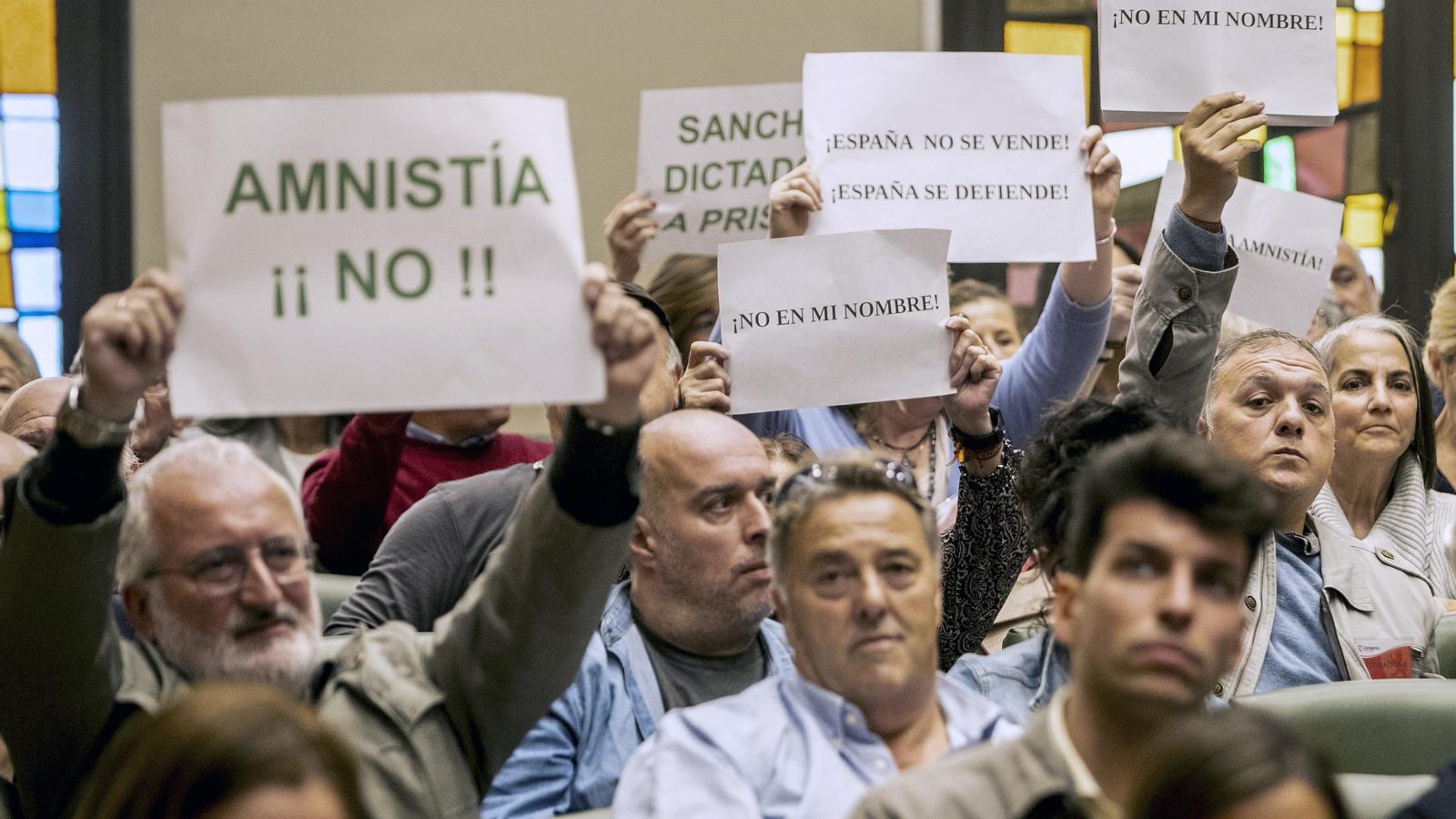
BarcelonaSince it was put on the table, Vox has made the amnesty law one of its main battle horses, promising actively and passively that, if it comes to the Spanish government, it will "reverse" and "repeal" the norm immediately. The People's Party has also joined this idea, and its leader, Alberto Núñez Feijóo, in a dynamic that, analyzing the archives, is common among the populars: promising the repeal of PSOE laws to end up keeping them intact once they come to power —as happened in the past with the abortion law or same-sex marriage. Despite the constant insistence of the far-right on this supposed repeal, the threat clashes head-on with an insurmountable wall: the architecture of the rule of law. According to experts consulted by ARA, Vox's promise is legally unfeasible and the elimination of the law would have practically no effect on the accused. In fact, the party itself admits to ARA that it is aware of this legal wall.
The main obstacle to Vox's aspirations is found in the Magna Carta itself. As Rafael Rebollo, professor of criminal law at the Autonomous University of Barcelona (UAB), explains, "regardless of what Vox or the PP say, there is a precept, which is Article 9.3 of the Constitution, which implies that laws can never be limiting of individual rights retroactively". In this way, even if the party achieved a sufficient parliamentary majority in Congress to repeal the organic law, "the repeal would never have retroactive effects by constitutional imperative and would not affect the beneficiaries of the amnesty".
Now then, what about those indicted to whom the courts have not yet applied the grace measure at the time of a hypothetical political repeal? Before a Supreme Court that, according to Rebollo, "will do everything possible, imaginable and unimaginable, not to apply the law in certain cases", given that the magistrates of the second chamber already consider it "an arbitrary decision by the legislator", procedural doubts may arise generated by this limbo in which the judges want to leave pending cases. Ramon Ragués, professor of criminal law at Pompeu Fabra University (UPF) clarifies the issue and closes the door to any negative effect: the measure would equally favor the indicted pending. The expert recalls that amnesty acts as a clear cause for the extinction of criminal responsibility — incorporated, by the amnesty law itself, into article 130 of the Penal Code — and emphasizes that, according to the Supreme Court's jurisprudence, "once a cause enters into force that eliminates criminal responsibility, even if it is later repealed, the person consolidates the situation that benefits them".
No provision of the legislature, therefore, could modify it, and to illustrate this, Ragués draws a direct parallel with the law of 'only yes is yes': "Due to a legislative error, certain sexual offenses were mitigated, and when the Code was reformed to toughen it again, the Supreme Court ruled that while the reform had been in effect, a legal situation had been consolidated and this could not worsen." Therefore, Ragués concludes, because the law has been in force for a time, acquired rights under the favorable norm have already been consolidated and must be applied equally, making Vox's proposal "legally absurd".
In conversation with ARA, the spokesperson for Vox in the Parliament, Joan Garriga, acknowledges sharing this same legal opinion and openly admits that the repeal "cannot be retroactive." For this reason, despite insisting that they will repeal "through an organic law, the amnesty law," Garriga points out that their proposal also includes promoting a reform of the Penal Code to "reinstate the crimes of sedition, of calling and holding illegal referendums, and the toughening of embezzlement." All this to send a symbolic message that seeks to "reverse the possible political pacts between separatism and the socialists," states the spokesperson.
More speech than law
At this point, if the promise is merely a wet paper, why does Vox insist so much on it in its public discourse? Carles Ferreira, professor of political science at the University of Girona, points out that this whole offensive should not be understood as a public policy proposal, but as "a tool of political propaganda" and communication. "What Vox is looking for here is not that the amnesty is not applied, but to send a message of forcefulness against independence and the events of 2017", highlights the expert, "especially keeping an eye on the PP, the party with which they compete for all votes". In the same vein, Ricard Vilaregut, professor of political science at the UAB, emphasizes that the objective of this discourse has no vocation for practical application, but is designed exclusively to mobilize "their own" and to "trap" PP voters.
The far-right, explains Ferreira, is fighting a battle for conservative "credibility" to show that the populars flinch in the face of the left. "Vox presents itself as the guarantee to repeal sanchismo", points out the political scientist, recalling when they called the populars "cowardly right". Ferreira highlights that most voters do not care about the "technicalities" of whether the repeal is applicable, as theirs is a "vote of self-expression" and "protest". Vilaregut reinforces this by pointing out that today "politics is about perceptions" and "data has been displaced". For the professor, Vox sends messages like "magnetic waves" that resonate quickly; even if the voter senses that the repeal has no practical effects, they are attracted by the frontal opposition. In conclusion, the voter seeks to express that they are "angry" or reaffirm their "anti-independence identity". This emotional need is satisfied, regardless of the legal path of the proposal.
