The Supreme Court maintains for November 29 the suspension of the vote of those naturalized by the 'grandchild law'
The Spanish government will try to appeal the decision, which affects 163,020 people, to the Constitutional Court

-
CAT -
CAST
MadridA setback from the Supreme Court, once again, for the Spanish government. And, this time, on the eve of the November 29th elections and with a matter as delicate as the electoral roll. The high court decided this Monday to reject the State Attorney's appeal against the suspension of the right to vote for those naturalized through the so-called grandchildren law. An additional provision of the 2022 Democratic Memory Law that allows descendants of Spanish exiles to access nationality. In this way, it maintains the precautionary measures, requested by Iustitia Europa, which were issued on September 10th and which prevent these new citizens from voting unless they individually prove that their predecessors actually left Spain for political reasons. In practice, ahead of the November 29th elections, this will affect 163,020 people who registered in the Electoral Roll of Absent Residents (CERA) until August 1st of this year, according to the electoral administration, and who had been granted nationality through this route – the date on which the census closes for the next general elections.
Let's take it step by step. First, it is necessary to recall the origin of this judicial conflict: the legal precept in question is the eighth additional provision of the Democratic Memory Law and, above all, the administrative instruction that subsequently developed it. While the rule establishes that descendants of exiles for political, ideological, belief, or sexual orientation reasons can be Spanish, the subsequent order issued by the Spanish government presumes that the relatives of those who left Spain between 1936 and 1955, in the midst of the dictatorship, are descendants of exiles.
The entity Iustitia Europa and Vox appealed to the Supreme Court against this regulation before the call for the 29-N elections, and on September 10th the high court issued precautionary measures siding with them: it suspended the registration in the CERA and the electoral effects of the people who had accessed nationality through this route. It considered that only those who prove that they are truly descendants of exiles for political reasons and not just relatives of people who left Spain between 1936 and 1955 – as the ministerial order stated – have the right to vote. In other words, the high court interprets that the Spanish government went beyond what the law determined when it issued the order.
However, if all this was already delicate in itself, the early election announced by the Spanish president, Pedro Sánchez, caused the different parties to the proceedings to demand that the Supreme Court clarify what would happen to the electoral roll for the elections, since the one in force for the elections is the one from August 1st, prior to the high court's first decision to issue interim measures. The State Attorney's Office requested that the interim measures be set aside and that everyone who was on the electoral roll at that time be allowed to vote, but the Supreme Court has decided otherwise.
The arguments
In order to preserve the electoral process, the Supreme Court argues that before granting the right to vote to Spaniards who have accessed nationality through the Democratic Memory Law, it is necessary to clarify first whether they fit the criteria established by the rule or the administrative instruction. In this sense, it reproaches the administration for not having provided it with more information to make these distinctions since September 10th. That is why the Supreme Court decides to maintain the veto it already issued before the electoral call: it considers that if it does not, there is a risk of "irregularly constituting" the census. "The general interest of preserving the purity of the electoral process must prevail," it argues.
In the interlocutory order, the high court distinguishes three different moments of the right-to-vote process to define the scope of the precautionary measure. The Supreme Court separates the moment of the acquisition of nationality through being a descendant of an exile, from the registration in the CERA and from the final assignment to an electoral constituency. Thus, it only suspends the registration in the external census to delimit its electoral effects.
Both the Public Prosecutor's Office and the State Attorney's Office had requested that the precautionary measures be lifted given the "material impossibility" of reviewing the nearly 170,000 files affected by the measure adopted by the Supreme Court. A matter that the high court ignores and attributes to the lack of responsibility of the administration itself. In fact, it labels as "surprising" that the electoral administration cannot individually identify under what circumstances the affected individuals accessed nationality, taking into account that a month ago, on September 10th, when the Supreme Court issued the first precautionary measures, it asked to differentiate between the new Spaniards who had proven to be descendants of exiles and those who had simply accessed nationality because their ancestors left Spain between 1936 and 1955.
However, not everyone within the Supreme Court shared the decision. There is a dissenting opinion, from magistrate María Alicia Millán, who disagrees with the majority and believes that the call for November 29th should have led to a rethinking of the precautionary measures regarding the Democratic Memory Law. She argues that the elections introduced a "new and decisive element" and that the deprivation of the right to vote in imminent elections is an "irreversible" measure. "Under these circumstances, the preservation of the effective exercise of the fundamental right to political participation should have prevailed over the maintenance of a provisional measure sustained by a legal controversy still pending final resolution," she concludes.
Unrest in the Spanish government
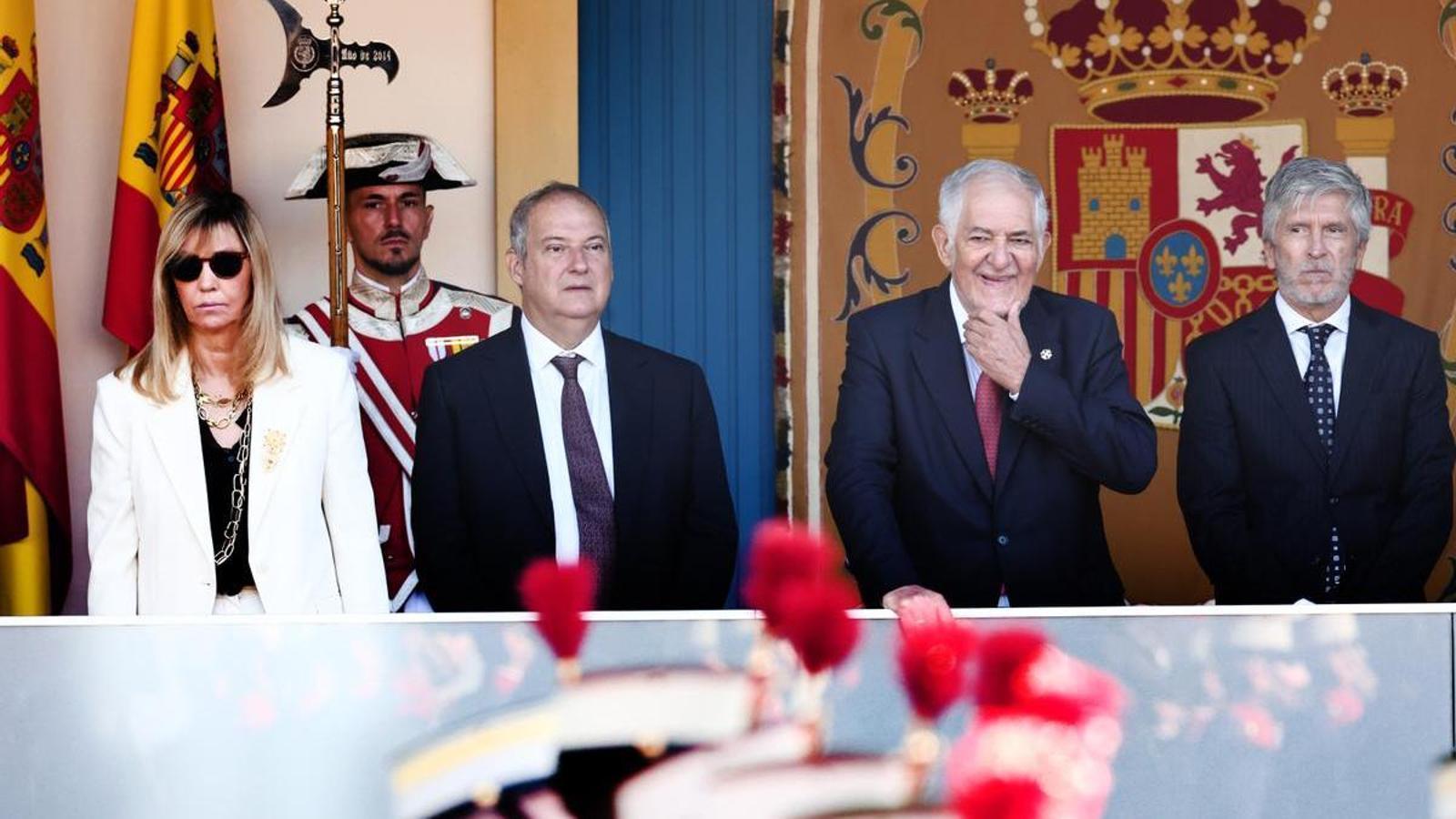
The Supreme Court's decision has irritated the Spanish government. Many ministers and the president himself were at the Royal Palace reception in Madrid on the occasion of October 12 when they received it. In fact, sources from the executive branch assure that the State Attorney General's Office will study whether it can appeal the decision to the Constitutional Court, as it considers that there is an infringement of fundamental rights. Anyone affected could also do so, to whom the Supreme Court has given five days to submit allegations. "It seems that the right to vote is not so relevant to some," government sources add.
In an informal conversation with journalists at the Royal Palace, Pedro Sánchez argued that being Spanish implies having the right to vote and that there cannot be first- and second-class citizens. For the PSOE, this decision by the high court will mean that the "grandchildren of those exiled by Francoism will not vote and those of the Francoists will." Conversely, the leader of the PP, Alberto Núñez Feijóo, has publicly celebrated it, as has Vox, which believes that justice has been served to guarantee clean elections. "In an election, there can be no doubts about the census," stated Feijóo on X. After the November 29 call, justice is forcefully intervening in the electoral process, and from the socialist ranks, they assume that it may not be the last time.
