Verónica Estay Stange: "You can be a torturer during the day and arrive home and be a good father"
Relative of a torturer and of victims of the Chilean dictatorship

-
CAT -
CAST

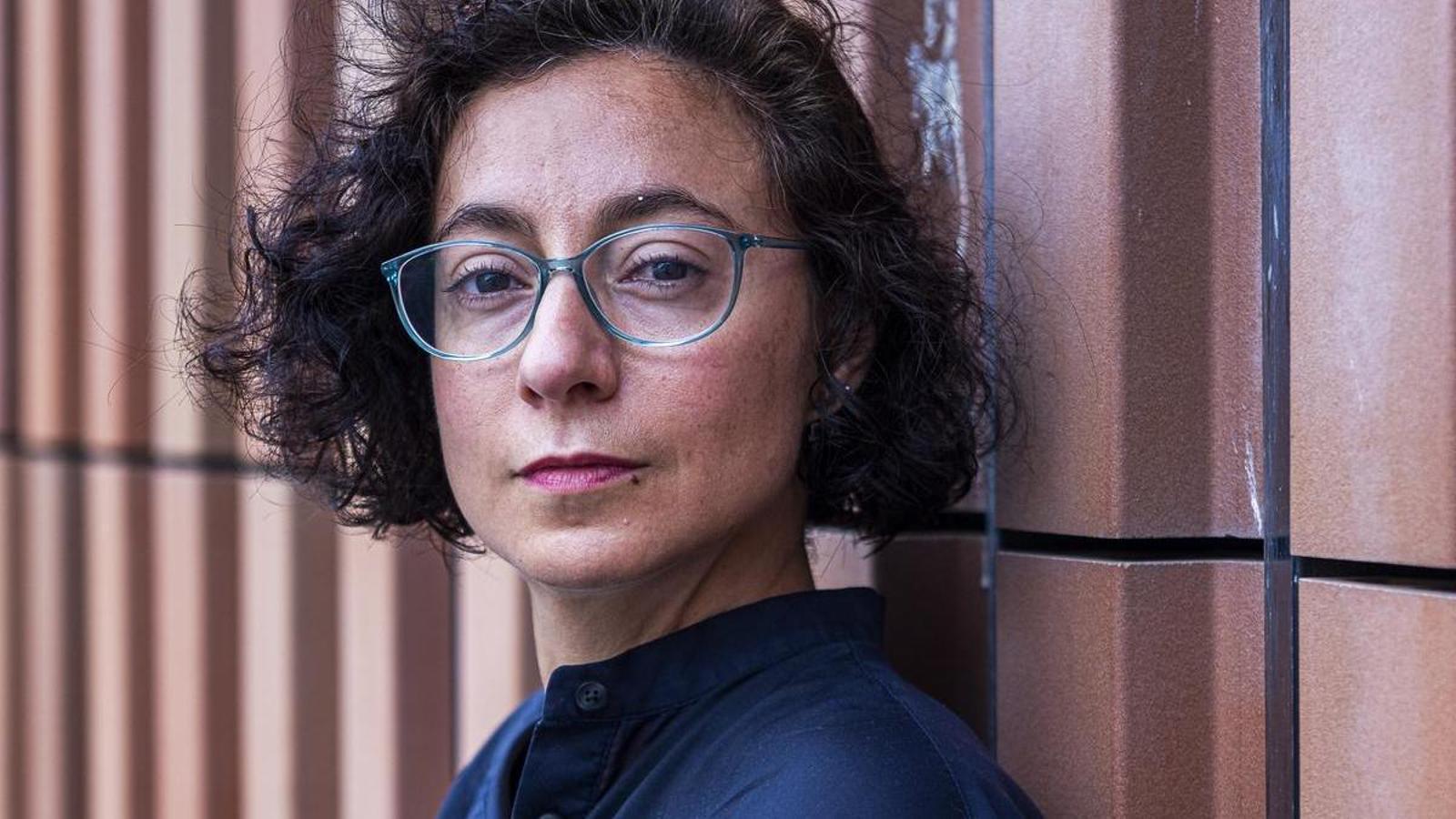
Life is a mixture of lightness and gravity. Since the biography and academic life of Verónica Estay Stange are serious enough, she likes to have a cheerful and dreamy photo for her WhatsApp icon, lying on the grass at a friend's house on the outskirts of Paris, where she lives and works as a professor of semiotics at the University of Paris Cité and the Paris Institute of Political Studies. She is a co-founder of Historias Desobedientes (a collective of children and relatives of those guilty of crimes against humanity during Latin American dictatorships) and is the real-life protagonist of the play Don't look, which can be seen at the Biblioteca de Catalunya.
Who was your uncle, Miguel Estay, alias El Fanta?
— At the beginning, a militant in favor of Allende, like my parents and many young Chileans who believed in the possibility of a peaceful socialism. Responsible, serious, and charismatic, he trained in counterintelligence in the Soviet Union and came to hold an important hierarchy in the Communist Party.
Until...
— Three years after the coup d'état, he was imprisoned, denounced by a party superior. Under torture, he began to collaborate with his captors and there he began to transform into a character radically opposed to the previous one. He even participated in 1985 in an emblematic case in Chile, the Degollados Case [the kidnapping and murder of three Communist Party militants]. Therefore, he was the committed militant and the criminal.
You are the niece of the only civilian sentenced to life imprisonment for crimes against humanity in Chile, but you are also the daughter of communist militants who survived prison and torture and went into exile in Mexico. How can that be?
— The almost caricatured dimension of my family illustrates what Chilean society was like at the time, which experienced a radical and irreconcilable polarization.
Which of the two things weighs more?
— It depends. I, of course, have always considered myself more of a daughter than a niece, because I was raised by my parents with their values. But for people who do not know me, I am more of a niece, because there are not so many recognized and convicted criminals against humanity, and, on the other hand, there are more militants, survivors, and victims.
You went so far as to want to visit your uncle in prison. Were you not afraid?
— No. What scared me the most was not meeting the monster everyone was talking about, but a human being, who, furthermore, was my uncle and my cousin's father. And I was right.
In the play, we discover that you have a relationship with your cousin. She condemns her father's crimes, but at the same time, she loves him as a daughter. Can one be a torturer and a good father?
— Yes, and it is the most painful and complex part of the criminal's figure. There is even a psychic defense mechanism, splitting, that both victims and victimizers can develop. It is a cleavage that allows both entities to coexist in the same person over time: you can be a torturer during the day and arrive home and be a good father. This, in turn, forces children who are aware of what has happened to dissociate and accept that in them resides both the child who loves the father and the citizen who condemns the criminal. It is an irresolvable contradiction that you can only accept and navigate.
Can you empathize with your cousin, who did not break off her relationship with him?
— It was difficult, but it was even more so when I could not help but empathize with him. It was terrible. If I showed myself to be completely cold, I was like him, because the lack of empathy is what leads them to be criminals, but if I empathized with him, I was also like him: it was a dead end. A colleague who had been imprisoned and tortured told me: "What you feel does not make you more or less committed".
And what did you feel?
— It was hard for me to accept that, at some point, I felt sorry for him and thought that I could have loved him like an uncle.
Was it justified? Did he/she regret it? Would it have been of any use to you?
— He expressed no remorse. On one hand, I found my uncle moved to tears and opening his arms to me. And, on the other, when we spoke about the horrors of the crimes he had committed, he gave a speech completely devoid of affection, following the manual of denialist discourse: deliberate lying, justification, trivialization... Everything very well put together.
Did your parents ever forgive El Fanta?
— I don't think they put words to what they felt for him. My mother only explained the facts to us and my father, when I dared to ask him, as an adult, why he didn't talk about it, told me: "I have structural differences regarding him. We belong to two very different worlds." Period. I know they never saw him again, I don't know if because they didn't forgive him or if it's that they couldn't handle that pain.
And have they forgiven you? Because it must also be painful for the daughter to reopen the wound...
— Also, as in the case of El Fanta, I tend to think not: we no longer have a relationship. I entered adulthood with great fanfare, questioning everything. I went on explaining my path to them, when I started to militate, I met my cousin, we formed the collective... They tried to understand it up to a point where, simply, it was not possible to maintain the relationship. It was a break as radical as the one that had occurred before.
How sad. Why did you need to dig into the family past?
— What I call the malady of post-memory. The children of survivors, criminals, or witnesses to great mass crimes also carry this experience, in their own way. In my case, there was a need to know and understand. Perhaps it had to do with the construction of identity. It was a personal search that, over time, became political. And it is well known that if there is a secret within the family, a child or grandchild will go digging into it, because the secret seeps out through every pore.
The question, then, is: how can the wound be closed? Because here we also have children and grandchildren of the victims of the Civil War who have not even been able to bury their dead and mourn.
— I believe that family ruptures like mine are a consequence of the dictatorship, of extreme violence. For me, closure in the family sphere happens through words. But that is not enough, on a social scale: if there was wrongdoing, there must be sanction; if there was victimization, there must be reparation. This is how historical balance is restored. For human beings, it is unbearable to have an incomplete narrative. And not having the body of a disappeared person is an impossible grief.
