The National Court finally authorizes the immigrant camp at the port of Ceuta
The State sees as good a regulatory change in the EU to "streamline" procedures in the face of migration crises
-
CAT -
CAST
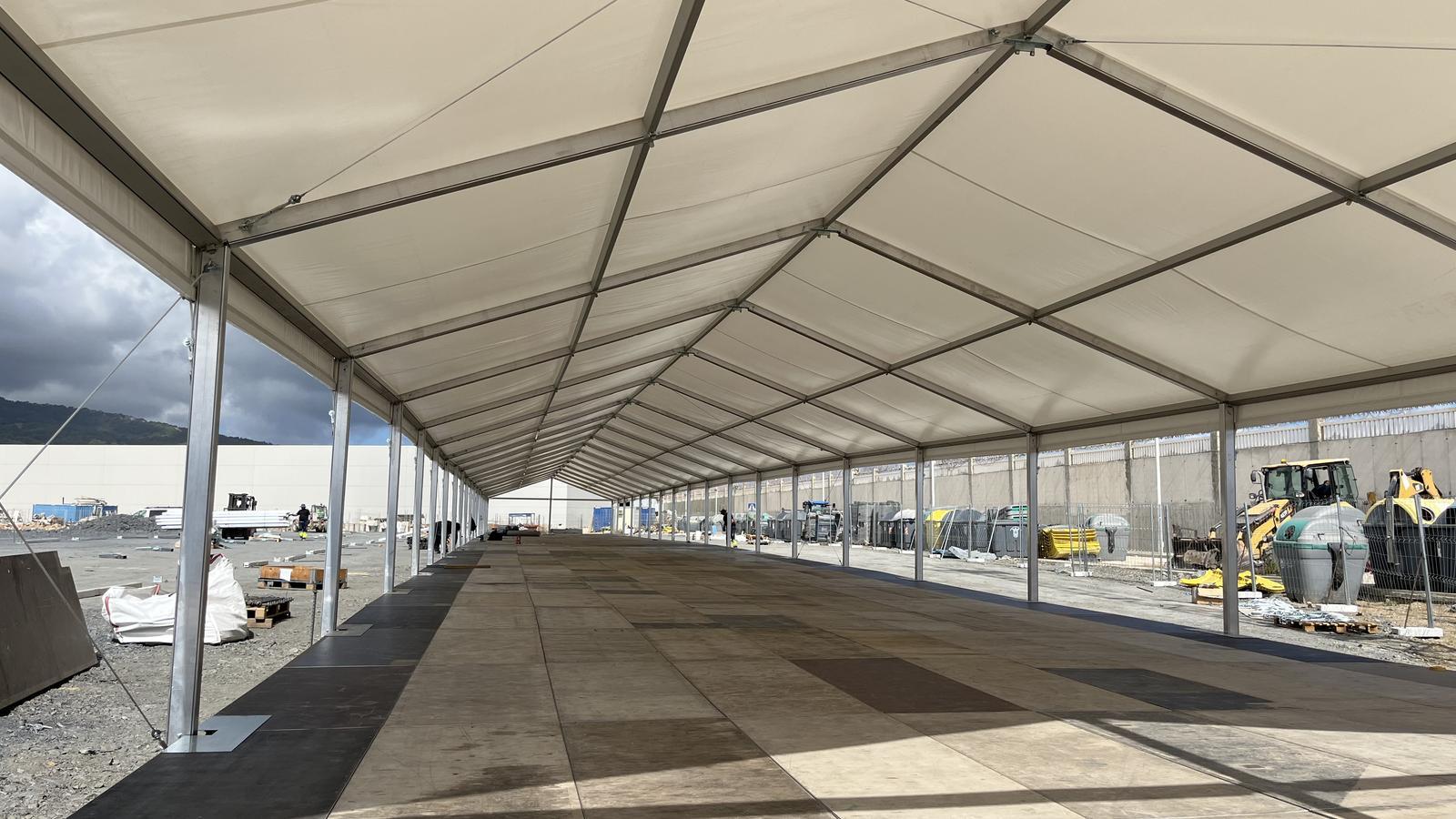
Barcelona / MadridThe Spanish government has a clear path to relocate immigrants to the facilities at the port of Ceuta. The National Court has finally decided to deny the temporary suspension of the camp's installation, as requested by a police union citing security reasons. It will be the Ministry of the Interior, the judicial order explains, that will be in charge of establishing the security conditions for the police officers and also for the immigrants. This Wednesday all alarms went off when the National Court accepted the suspension of the camp on a "highly precautionary" basis, but it took only a few hours to change its position. Sources from the Spanish government celebrate the speed of the judicial decision in view of the social urgency on the streets of Ceuta and point out that the forecast was that more than 1,700 people could be installed there today. "We reiterate that the port grounds are the most suitable and have all the security guarantees to carry out the operation," they explain from the state executive. The Minister of Territorial Policy, Ángel Víctor Torres, in charge of the crisis, celebrated the decision in a video: "It is magnificent news because it will allow us to start the files and for the migrants to be returned if they do not have the right to stay," he said, assuring that this will bring Ceuta closer to "normality". Wednesday's decision, even though it was temporary, caused "perplexity" for the Spanish government, and the Minister of Transport, Óscar Puente, put words to this sentiment on Thursday. "There are those who want us to perform magic," he stated in an interview with TVE, recalling the lack of space in the city so that the immigrants who are still living there in poor conditions can have their basic needs guaranteed. The head of Transport has warned of the lack of alternative locations to place the camp: "Going to the port is not a whim."Puente has not refrained from criticizing the wavering of the Ceutan government regarding the camp and has accused it of "profound disloyalty". "Mr. Vivas, beyond defending Ceuta with words, has not collaborated with the Spanish government at any time," he lamented, referring to the Ceutan president, and delved into the clash between the state government and that of the autonomous city. "There are individual people who seem to have heeded Mr. Aznar's call for whoever can do something to do it," added the Minister of Digital Transformation and Public Function, Óscar López, in an interview with Cadena Ser, in reference to some "corrupt" magistrates. "It is becoming increasingly difficult for me to find arguments to defend that there is impartiality in all decisions," added the President of the Generalitat, Salvador Illa, in an interview with RNE.
New legislation
Amid the tension between the government of Ceuta and the Moncloa, Pedro Sánchez's executive has asked the European Union (EU) for new legislative measures to "streamline" procedures in the face of migration crises like the one the city is experiencing. Specifically, the procedures linked to the expulsion of migrants and the application for international protection. This is the request, without further details, that the Minister of the Interior, Fernando Grande-Marlaska, and the Minister of Inclusion, Social Security and Migration, Elma Saiz, have conveyed to the European Commissioner for Migration and Home Affairs, Magnus Brunner, during a meeting this Thursday in Madrid, the first to be held in the Spanish capital since the entry of thousands of people on July 30 and 31. The demand comes one day after the President of the European Commission, Ursula von der Leyen, appealed during her State of the Union address for a new "European framework" to respond to exceptional migration emergencies like the one in Ceuta.Brunner, who comes from the Austrian People's Party, has consolidated himself as one of the voices of the EU's hard line on migration and has been forceful regarding the protection of external borders and the return of migrants, also in the case of Ceuta. This very Thursday, the European Parliament defined the crisis in Ceuta as an "invasion" despite the vote against it by the socialists. In fact, the person who did not miss the opportunity to meet with the commissioner was the leader of the PP, Alberto Nuñez Feijóo, who asked him to exert the "appropriate pressure" so that the crisis does not become entrenched.

In a statement made public after the meeting, the Spanish government defends its management of the crisis: "The measures adopted are bearing fruit, but the consequences of a crisis of this magnitude cannot be resolved immediately," remarked Marlaska after the meeting, who boasted that "more than 90% of the migrants" were expelled hours later.Meanwhile, it remains unclear how many migrants continue to survive on the streets in Ceuta. It is known, as revealed by the Spanish government, that there must be between 700 and 1,000 children.
Permanent presence of Frontex
On the other hand, the Spanish government thanks Europe for its help and intends to expand it. The Minister of Foreign Affairs, José Manuel Albares, has announced that the permanent presence of Frontex (the European Border and Coast Guard Agency) will be requested in both Ceuta and Melilla, as well as a permanent seat on the European Committee of the Regions and a special funding allocation that recognizes the uniqueness of both borders. In the framework of a forum organized by El País, Albares also took the opportunity to appear less forceful against Vivas and even spoke of "harmony" with him and with the president of Melilla, Juan José Imbroda, after sending them the package of measures with a European focus that the Spanish government will adopt. The person who traveled this Thursday to Melilla was Feijóo, who is making efforts to exemplify that the autonomous cities are a priority for him. "We celebrate 539 years of Spanish identity, history and coexistence," said Feijóo on X before traveling to Melilla on its official day.
