Sánchez points to Ceuta for the situation of the minors: "Let them ask Vivas"
The Spanish president and Feijóo accuse each other of "making chronic" the situation in the autonomous city
-
CAT -
CAST
MadridA month and a half after the massive arrival of immigrants in Ceuta, the crisis in the autonomous city continues to shape the agenda and the attacks in Spanish politics. However, as has happened in previous major catastrophes that Pedro Sánchez's executive has had to manage in coordination with PP-led regions, such as the DANA in the Valencian Community or the summer fires in Madrid and Castile and León, the debate is turning into a clash of competencies. A clear example is the situation of the immigrant minors who are still in Ceuta, of whom there are currently 2,084 registered and between 700 and 1,000 wandering the streets. Regarding the delicate situation a month and a half later, Sánchez was blunt: "Ask [Juan Jesús] Vivas about it," he said in statements upon leaving the Congress hemicycle. In other words, the Spanish president is pointing directly at the government of Ceuta.
Moncloa, therefore, is going on the offensive against the Ceutan president, Juan Jesús Vivas, as sources from the Spanish government consider that he is no longer concerned with recovering normalcy but with defending the PP's talking points. The Popular Party members have launched a barrage of criticism against Sánchez for this response, and party sources have accused him of shirking responsibility in a "frivolous" and "insensitive" manner. "Spain is not with him. Without principles, without shame, amoral," criticized the PP spokesperson in Congress, Ester Muñoz, on X.
While the PP maintains that the problem is the lack of agility of the Spanish government in returns, the executive's thesis is that Alberto Núñez Feijóo wants to use Ceuta to wear down Sánchez and that, for this reason, he is committed to "chronicling" the crisis. In this sense, sources from the Moncloa recall that the guardianship of minors is the responsibility of Ceuta and that the Spanish government already approved 25 million euros of additional funding at the beginning of the crisis and is enabling places for their reception. For this reason, they pose a question: "Why don't they ask for their transfer to the peninsula?" A request that is a power of Ceuta, but which bothers the communities governed by the PP and Vox.

The Moncloa puts forward the example of Navarre, governed by the Socialists, who have begun to host unaccompanied minor girls in a situation of special vulnerability. It is, therefore, a temporary solution while the files are being processed, in which it must be agreed whether family reunification is possible – the collaboration of Morocco is needed – or they remain under the guardianship of the State administration. The PP, on the other hand, considers that transferring minors to the peninsula "does not solve the problem" and will only serve to generate a pull factor and cause even more to arrive. The Popular Party members demand "the immediate return of all" with an administrative reinforcement of the procedures to do so.
From the Moncloa they reply that, "if they believe it is legal to expel them," then the government of Ceuta itself, which is the one that "has jurisdiction over the minors," should do it. Until now, as explained this Tuesday by the Minister of Territorial Policy, Ángel Víctor Torres, only ten files have been able to be processed, since there has also been another clash with the autonomous community. The new EU Pact on Migration and Asylum requires that there be a legal representative for the minors in all procedures, and the two administrations were competing over who had to provide them. Finally, the State has advanced 2 million euros while waiting for the courts to define the competencies.
Sánchez-Feijóo face-to-face
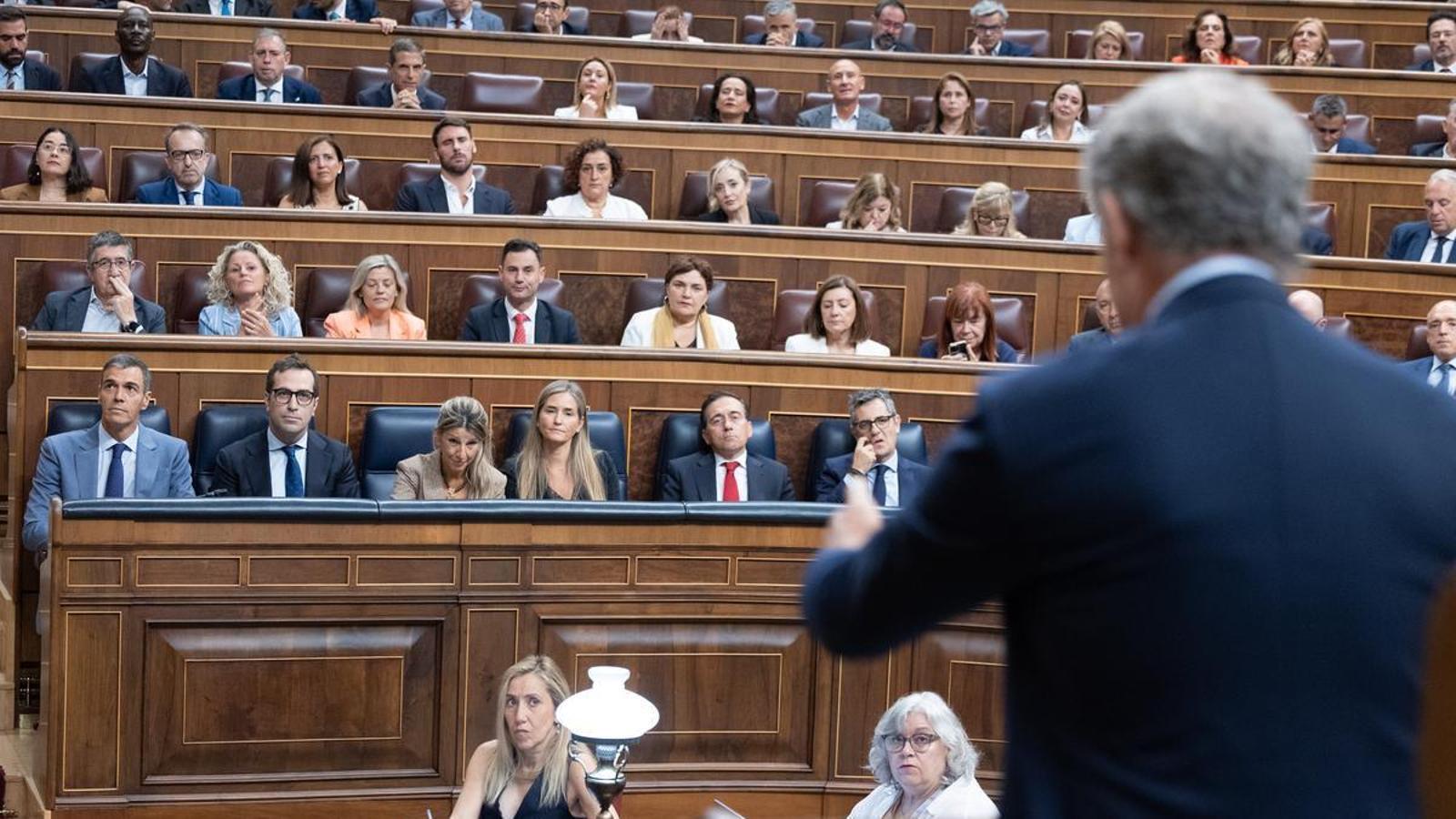
Ceuta has also been central in the control session this Wednesday inside the hemicycle. "Your patriotism is a pure facade, it's something you put on and take off," the Spanish president reproached the opposition leader regarding the PP's criticisms of the crisis management. "While the European Commission congratulates and recognizes the efforts of the government of Spain, the only thing you do is put sticks in the wheels to solve the problem of Ceuta," he added. Feijóo, for his part, reproached Sánchez's "silence" about his relationship with Morocco and will dedicate the next few days to hitting the ground to "demonstrate the PP's commitment to the autonomous cities." This Thursday and Friday he will be in Melilla and next Monday in Ceuta.
Sources from the Spanish government insist that legally they cannot do what the PP is demanding and recall that after the 2021 crisis there were convictions for prevarication for returning minors in an express manner. They assure that their goal is also the return of all immigrants, but that it must be done following the legal procedure, which implies an individualized file for each one. In the Congress votes, the PP supported a Vox initiative precisely against the distribution of minors, but voted in favor of the decree for aid to the autonomous city.
