The seven lives of Pedro Sánchez
The Spanish president begins the campaign with all the forecasts against him, like so many other times

-
CAT -
CAST
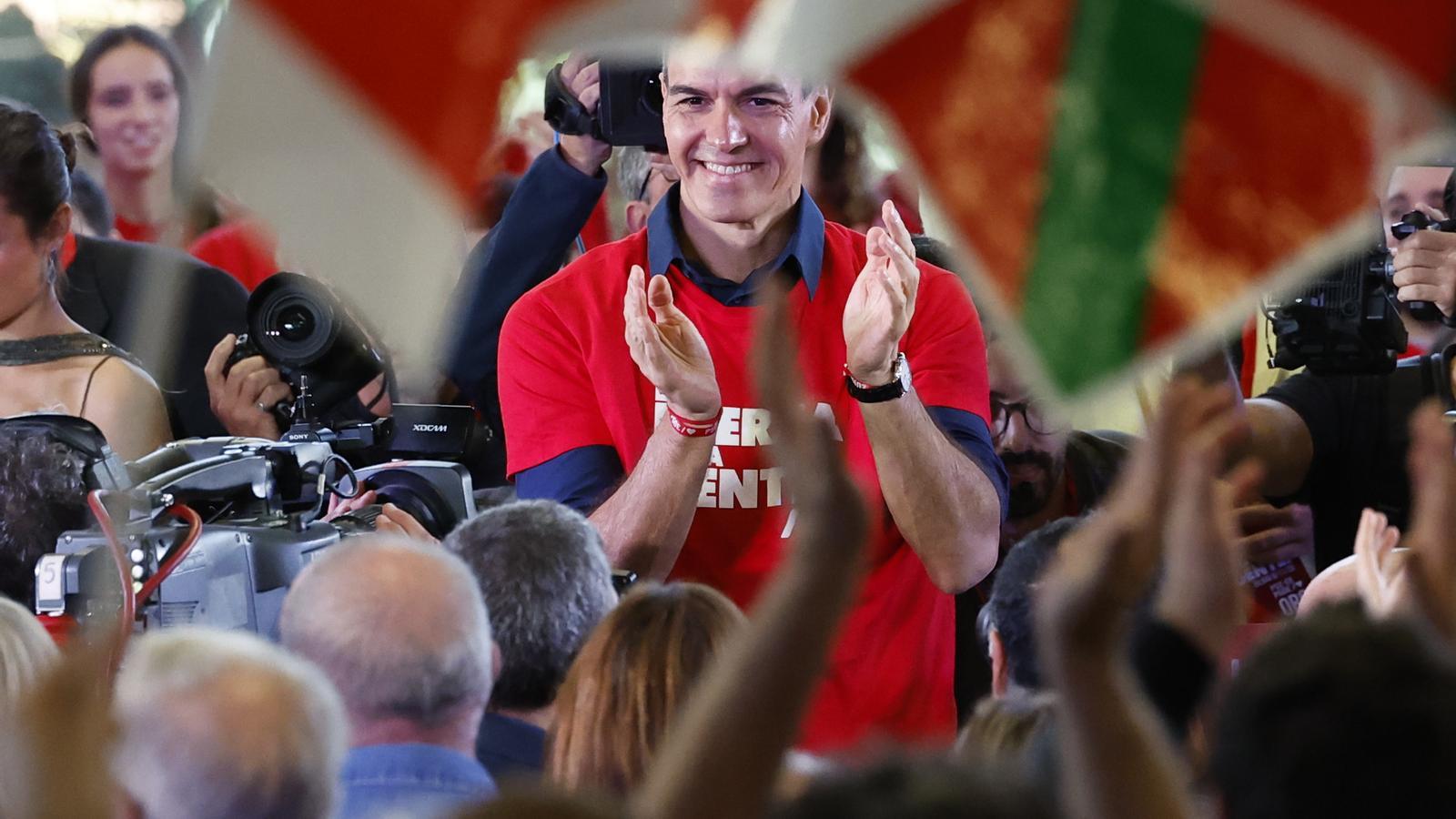
BarcelonaThe first life of Pedro Sánchez as a political leader began on July 13, 2014. With the support of the powerful Andalusian federation of the PSOE, he prevailed in the party's open primaries and arrived at the general secretariat replacing a historical figure like Alfredo Pérez Rubalcaba. Apparently, he was supposed to be Susana Díaz's straw man. Twelve years later, she is a senator and talk show guest and Sánchez resists leaving the Moncloa, now as the second longest-serving president of Spanish democracy. Resilient like few others, Sánchez has consistently exceeded expectations whenever it seemed his star was no longer shining. Along the way, however, he has accumulated significant scars that have forced him to be reborn at least six times. So many, that it is likely he has run out of a safety net to face the elections on November 29. The seventh –and final?– life of Pedro Sánchez is officially put to the test starting this Friday with the start of the electoral campaign.
Most polls predict a comfortable absolute majority for the PP and Vox, broader than what the demoscopy pointed to three years ago. Back then, Sánchez was able to build a spirit of comeback that allowed him to resist even though, one by one, the regional governments and the main city councils of the State –with the exception of Catalonia and Barcelona– were turning blue. But, of course, his right-hand man, José Luis Ábalos, had not yet been sentenced to 24 years in prison for corruption, nor had his left-hand man, Santos Cerdán, been charged for alleged illegal commissions. Neither were there known suspicions about sewers within the PSOE to dismantle judicial cases, nor was Sánchez's wife, his brother, and his political reference, José Luis Rodríguez Zapatero, being investigated. There were no more than 100 fatalities in two train accidents on the high-speed line, nor had more than 70,000 immigrants arrived in Ceuta by bypassing border controls from Morocco.
The Spanish government claims that all the social achievements it has been promoting for eight years would come to nothing if the right and the extreme right were to come to power. The minimum wage hikes, the caps on rent price increases, the ban on evicting vulnerable families, the increase in pensions, the laws that consolidate the rights of the LGBTI collective or that of euthanasia, the law of democratic memory, the drastic reduction in unemployment, the growth of the economy, the no to war, the amnesty law... The recipe of the candidate for the presidency, Alberto Núñez Feijóo, is based precisely on “repealing Sanchismo” and starting a “national reconstruction”.
The Maricarmen decree –which was revalidated this Thursday in Congress– and the general strike called basically against real estate speculation –or against the opposition, according to what the PP and Vox insist– provided a better scenario for the left, in decline since before the legislature began. In fact, without the votes of Junts and the PNV, Sánchez would not even have repeated as president three years ago. The need to seduce so many and such diverse partners is one of the reasons for the sense of paralysis in the socialist administration, which has not brought to Congress any of the budgets it was obliged to bring by law.
The worst result for the PSOE
Probably, on November 29th the PSOE will save the furniture electorally and those who will suffer the consequences will be the parties to its left. And the fact is that one of the things that have been consolidating since Sánchez came to power is that the socialists have grown –or have maintained themselves– at the expense of left-wing voters, while the space was shrinking.
The first life of Pedro Sánchez, however, was different. In the 2015 elections, the socialists obtained their worst results in democracy, only 90 seats, far from the 123 of the PP. But the resounding fall of Mariano Rajoy –he lost 63 deputies– gave Sánchez options for redemption. So he decided to use the second life that had opened up before him to attempt a bizarre move, which he has since perfected over the years: getting antagonistic parties to agree in order to reach the presidency. Sánchez allied himself with Albert Rivera –who later repudiated him–, hoping that Pablo Iglesias would support a PSOE and Citizens government as a lesser evil to one from the PP. Podemos rejected the proposal and Spain fell into the first electoral repetition in its history.
With expectations even lower and the polls predicting the sorpasso of Podemos over the PSOE, Sánchez repeated as a candidate, worsening the results from a few months earlier (85 deputies), but kept the socialists in second position with a slogan, the no to Rajoy, which was soon amended by the party. The third life of Sánchez had the most dramatic end: expelled from the general secretariat and betrayed by his own colleagues.
The unexpected fourth life
And this is where the story becomes so implausible that, ever since, it is impossible not to believe that Sánchez might have an ace up his sleeve even if he is wearing a swimsuit. Confronted by the PSOE leadership, with Susana Díaz as the main favorite to take the reins of the party, he travels the country by car, visiting all the socialist groups with Ábalos and Cerdán (literally) as co-pilots. Against all odds, Sánchez returns to the socialist general secretariat in May 2017 and begins to weave relationships with other parties, waiting for the favorable moment to end a Rajoy who was accumulating corruption cases while the sewer system smelled so bad it could not be hidden. The independence movement was eager to bring down Rajoy after the repression during the October 1st referendum. In mid-2018, the conviction of the PP in the Gürtel case opens the doors of the Moncloa to him, thanks to a motion of no confidence voted for even by the PNB, which had only just approved the PP's budget a month earlier.
With 85 deputies and without the capacity to gather practically any majority, Sánchez waited for an excuse, the failure of the 2019 budget with ERC, to call elections and shoot the PSOE up to 123 seats. But, again, he was unable to convince Podemos, at a time when Rivera had already turned his back on him, deploying the narrative that the PP and Vox now share regarding the socialist leader: “The Sánchez plan is to perpetuate himself in power”. Over time, his rivals have branded him an “autocrat” and Vox labels him a “dictator”. Defeated in a new investiture, he puts an end to his fifth life. The elections are repeated and Sánchez declares that he “would not be able to sleep peacefully” if he included Podemos in the government. The sixth life begins precisely with Podemos inside Sánchez's executive branch and, later, by yielding first to pardon the leaders of the 'Procés' to secure the support of ERC and, afterwards, to the amnesty to add Junts.
Everything is ending precipitously: he is losing the support of Junts and Podem in the chamber, judicial cases are piling up around him, and crises give him no respite. Since the calling of elections he has lost his spokesperson, Montse Mínguez–because her partner's real estate dealings made her a liability for the government's pro-housing discourse–, and the most media-prominent minister, Óscar Puente, due to the second railway tragedy of 2026. Sánchez's seventh political life could be the shortest of all. He has fifteen days to try to extend it.
