Sánchez will not withdraw the decrees: "The vote of Junts will portray them before entire generations"
Sumar is considering requesting the public roll-call vote at this Friday's extraordinary plenary session

-
CAT -
CAST
MadridA bucket of cold water for the Spanish government, the left-wing parties and the housing rights movements that this Thursday night continue to be camped out at Puerta del Sol and Plaça Catalunya. Junts demands that Pedro Sánchez's executive withdraw the anti-eviction decree or they will vote against it, but Moncloa has slammed the door shut: "The progressive coalition government will not withdraw either of the two housing decrees," government sources stated this Thursday night, after learning of the decision made by the Junts members. Junts will also vote against the decree with the automatic extension of contracts.
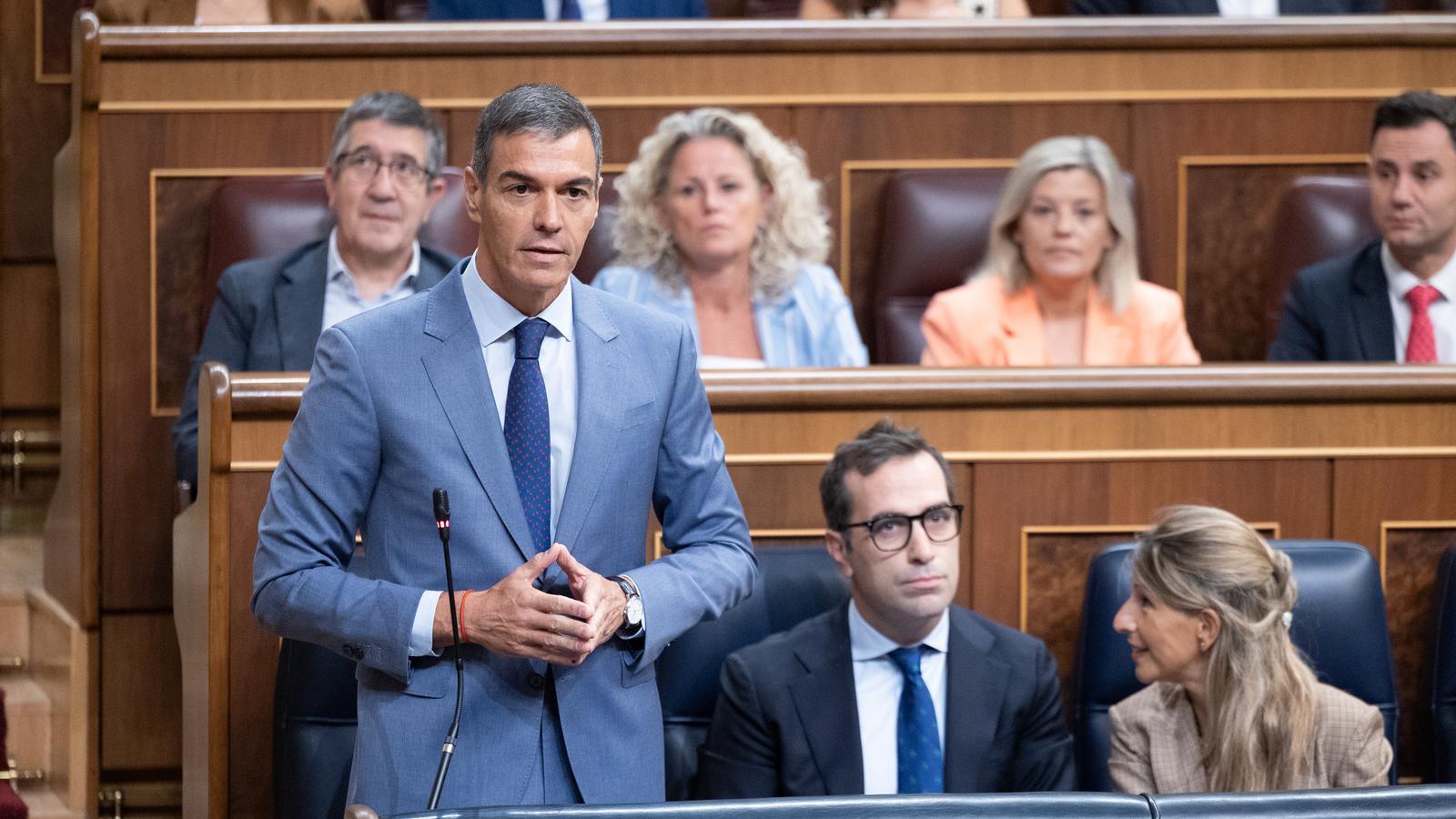
"The time has come for the PP, Vox and Junts to retract and demonstrate whether, in terms of housing, they are with the citizens or with the speculators. With the middle and working classes or with the elites," stated the same sources. Words that Pedro Sánchez later made his own: "Their vote will portray them before entire generations," the Spanish president declared through the social network X.
The standoff, therefore, is set just a few hours before the extraordinary plenary session begins in Congress, where a second decree must also be voted on, regarding the automatic extension of contracts and compensation for tenants. In this case, however, in addition to Junts, the PNV will also vote against it, so it was already known that the text would not pass. In fact, the hopes of the government and the left-wing parties were placed on the first decree with protection measures for the vulnerable, but also tax incentives for landlords.
Pressure on Junts
The Moncloa not only puts the three parties in the same bag, but also maintains pressure on Carles Puigdemont's party: "Spain can no longer wait. It needs solutions and a bold housing policy," they defend from the Spanish government. In the Moncloa, they do not accept Junts' challenge. In fact, they defend the decrees and their measures: "They are effective in curbing speculation, focusing on vulture funds [...] and stopping evictions without putting small owners at risk."
"Withdrawing the decree would mean withdrawing the rights that are currently published in the Official State Gazette (BOE) from many citizens [...] I believe that between now and tomorrow [Friday] Junts can reflect that it is best that we continue with the processing and development of this decree," said the Secretary of State for Housing, Leire Iglesias, in statements to RNE.
General strike?
The Spanish government's arguments, however, have not convinced the leadership of Junts, which shares the concern of employers' associations and sector lobbies, such as the Property Chambers of Catalonia, regarding the Spanish government's laws, starting with the lack of protection for small property owners. In fact, it is not the first time that Junts has turned its back on policies of this nature. This time, however, social pressure on the streets had escalated following the eviction of Maricarmen, an 87-year-old resident of Madrid. Her case is precisely what drove the Spanish government to approve the two decrees.
The Tenants' Union has not ruled out that this could trigger a general strike—they have already appealed to the majority unions, CCOO and UGT. For the moment, a demonstration is scheduled for this Friday in front of Congress. Amidst this context of social tension, there are those who also point to a "turning point" and a calling of early state elections. "If [Junts] carry out their threat, elections," argued the deputy spokesperson for Más Madrid in the Assembly, Emilio Delgado.
"They have 12 hours to reflect if they do not want to be responsible, along with PP and Vox, for people continuing to be evicted," noted the housing spokesperson for Sumar, Alberto Ibañez, in statements to the Cadena SER this Thursday night. Ibañez also anticipated that they are talking with other parties to hold a public roll-call vote, that is, deputy by deputy, in Congress: "This decision to vote against cannot come free for them. Junts deputies must bear the cost," he asserted.

The Minister of Transport, Óscar Puente, has also spoken out through the social network X, as is customary. Puente, however, did not point directly at the members of Junts: "If the decrees had not been split up, there would have been doubt as to whether Junts would have managed to approve any measure separately. Now there are none left. Therefore, those who defended: "one decree and let them retract" failed once again. Now they have indeed retracted, and for real," said Puente. This week, left-wing parties, especially Podemos, have been critical of the PSOE for having decided to approve a second decree with the automatic extension of contracts (so-called indefinite contracts) and compensation for tenants. Podemos, for example, has accused the government of "cheating".
