Putin escalates the nuclear threat: “The point of no return can arrive unexpectedly”
The Russian president insists that they "do not threaten anyone", but that if they are attacked they "will have to respond"

-
CAT -
CAST
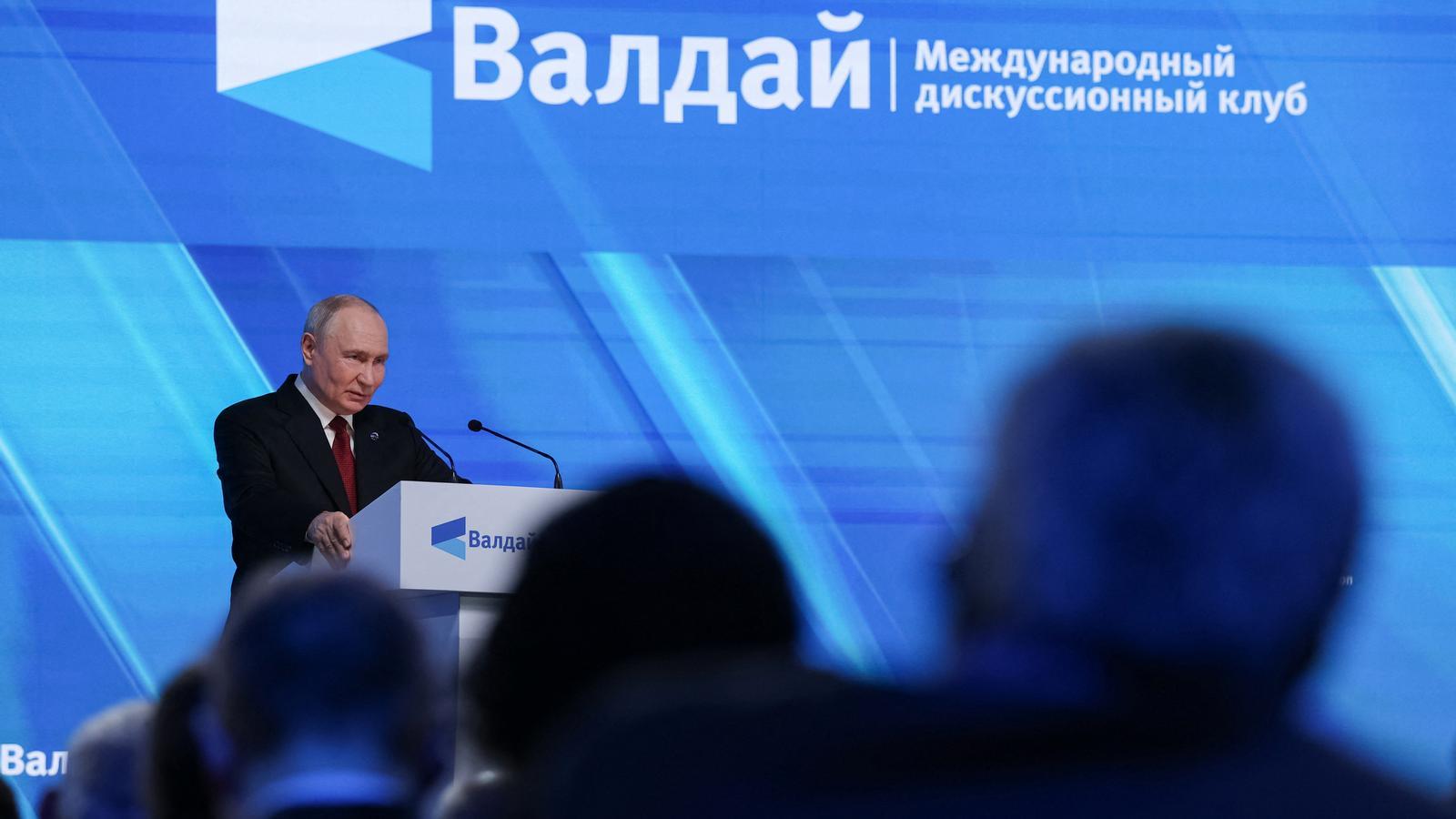
MoscowVladimir Putin insists on resorting to nuclear rhetoric to threaten the West. After the alarm generated by the letters that Russia sent to NATO warning of the possible use of atomic weapons if European countries blocked the Russian region of Kaliningrad, the Kremlin leader has escalated the tone of the threats. “The point of no return, the moment when nothing can be changed anymore, can arrive unexpectedly for everyone,” he said from the Valdai Forum, the stage he uses every year to set Moscow’s position on foreign policy.
The Russian president has dressed his speech in a feigned concern for the risks of nuclear proliferation. “Can we be sure that these weapons will never be used? Of course not. We all know that famous phrase: if at the beginning of the play there is a rifle hanging on a wall of the stage, sooner or later it will end up being fired. We must keep this in mind and avoid catastrophic scenarios in which humanity finds itself on the brink of catastrophe,” he declared, using a quote from the Russian writer Anton Chekhov. Putin believes that community leaders are driving this escalation out of “arrogance and overconfidence” and that this is leading the planet “towards the abyss.”
The Russian president claims that he “has no intention of attacking anyone, neither in 2029, nor in 2030, nor in 2050.” Instead, he considers that it is Europe that is preparing for a war with Russia and that, therefore, Moscow is forced to consider how to react to it: “We are not intimidating anyone, but if they attack us, we will have to respond.” And among these responses, he pointed out that he will consider resorting to “the entire arsenal,” including the atomic one, because it is the “competitive” advantage he has given the numerical superiority of the European armies.
Although it has been Russia that has put the nuclear card on the table, it believes that it is NATO that “pushes to tense the situation, raises the stakes, often bluffs and crosses red lines in the hope of subduing and intimidating the adversary, and bending them by force”. The reality, however, is that it is not the first time that Moscow has resorted to threats of this kind. Every time the countries of the Atlantic Alliance have taken steps to increase military support for Ukraine, the Kremlin has responded by brandishing the atomic scarecrow. Already in 2023, when Volodymyr Zelensky's partners reaffirmed their commitment to military aid to Kyiv, Russian diplomacy warned of alleged Western plans to blockade Kaliningrad and also at that time threatened to respond. And in 2024 it revived the nuclear discourse again when, for the first time, France commented on the possibility of deploying peace troops in Ukraine.
Periodically, Russian military intelligence publishes reports on alleged Western threats, without providing any evidence, which are used to present the Kremlin's aggressive rhetoric as defensive. In February, to go no further, Russian spies claimed to have indications that France and the United Kingdom were pulling strings to provide radioactive bombs to Kyiv. An accusation that Paris and London denied.
Nuclear language is the daily bread of the most radical sectors of Russian power, as well as some of the academics and propagandists with the most media following. Even so, it is symptomatic that this week the state news agency RIA was forced to remove a column by a journalist who predicted a new “special military operation” against the Baltics given the possibility that these governments were hosting atomic weapons on their territory. That is to say, the Kremlin understands that deterrence has limits that should not be crossed.
European factories, a legitimate target
Putin feels comfortable in the ambiguity of hybrid warfare accusations, a practice he does not recognize, but admits would be justified. In this sense, he considers that NATO countries are already waging a war with Russia through Ukraine. This opens the door, from his point of view, to placing European arms factories that supply Kyiv as a legitimate target. “We will not say that they should be attacked immediately, but we will assess this threat,” he concluded.
In his confrontation with the West, the Russian president has also warned that he does not rule out expropriating foreign companies in the event that “hostile” countries nationalize Russian companies. “We are creating the conditions so that if they steal our companies we can respond symmetrically,” he indicated, in reference to multinationals such as Nestlé or Auchan, which the Russian authorities have placed “temporarily” under state control.
