BarcelonaJudicial timelines dictated that the final session of the trial against the national police officers who blinded the eye of the activist Roger Español would be held on October 1st, seven years after the day of the referendum in which the pro-independence activist was mutilated. The session began with a delay: it was suspended until one in the afternoon because the accused inspector had alleged "a health problem" and resumed when he returned from the hospital. All this has caused the trial to finally end on Friday. Thursday's session included statements from the inspector in charge of the operation, two sub-inspectors, and the officer who fired at Español. However, these statements were overshadowed by the final speech of Español's defense, which even resorted to a sentence by Manuel Marchena and another handed down for the Esther Quintana case, to dismantle the police version of 1-O.
In his report, lawyer Benet Salellas recalled the eventual intent (dol eventual) ratified by a ruling from the Supreme Court magistrate—which confirmed a conviction for two Mossos officers—arguing that "when the perpetrator subjects the victim to a situation in which they do not have the security of control, it is imputed in terms of eventual intent." He also recalled the ruling on Quintana, a victim in the 2012 general strike of an identical mutilation, in this case by the Catalan police, which led to the banning of the projectiles. This resolution considered that there was intent—even though it acquitted the defendants because it did not identify them—among other things because "it reprimanded that shots had been fired at less than 50 meters" from the activist, which was prohibited by the force's protocol, which multiplied the gravity of the action. In Español's case, it occurred at 14.12 meters.
Salellas continued his presentation by explaining that "the accused knew he could cause the harmful result" with a "voluntary shot" which he "disregards"; and that "the result was not unimaginable," among other things because rubber bullets "had been banned by Parliament due to the known danger." In addition, he also added that the firing occurred at less than 15 meters, when normal use should be at more than 50 meters. During 1-O, on Sardenya Street, it was "the only place where rubber bullets were used." All this, according to Español's defense, "to punish" the activist at a time when "there was no danger."
"The police have not obtained images confirming that there was any throwing of cobblestones in the final stretch," Salellas pointed out, appealing to the videos viewed during the trial. And he further added that there is a "in crescendo police action precisely when there is a surge from the protesters." The lawyer also pointed out that only "eight seconds passed between the batons and the volleys" prior to firing rubber bullets – and even an officer confirmed that the orders were simultaneous. The images that were projected also allow us to see that there was an injured person and that they continued firing, which is another key point.
For Salellas, seeing citizens with their arms raised was not "an extreme danger" such as to justify firing in the way that it was done. The lawyer for Irídia, Anaïs Franquesa, further added that the previous mass sit-in was peaceful in nature and that the police disproportionality already stemmed from there and multiplied afterwards. According to the jurisprudence provided by the lawyer, the violence must be "the least possible" in intent and using the "least dangerous means" and "in the least harmful way."
The police version
To defend themselves, the accused have hidden behind the "extreme gravity" of the situation on the day of the referendum, with a "throwing of paving stones" that has not been proven, but also because of the distance of the shots, which they saw as appropriate to the situation. They have also clung to the fact that they used the bounce to fire. Their goal was to avoid prison.
Specifically, the version of the riot gunner, Israel Ramos, was based on justifying his actions by the fact that he was "following orders". However, when asked if one should fire in case of doubt about the distance, he stated: "In case of doubt I would not fire". All the police officers who testified said that they were perfectly trained and that they only learned to perform "the bounce".
In their opinion, it was justified to fire "around 15 meters" and they claim that they took enough precautions, even though the experts demonstrated that the eye injury could have been caused just the same by firing towards the ground. The defense's thesis is that a previous incident would have triggered the desire to punish him.
However, Inspector Ángel Diego Vaquera –number 73,861–, admitted, in turn, that general orders to fire do not mean that they must be executed because there is the "ability to decide not to fire" on the part of each riot gunner depending on the context, "in the face of doubt" and taking into account the "principle of minimum intervention". One of the points that the defense of the inspector and the rest of the agents has tried to stretch is that the Mossos reported that the Spanish police officer did not aim directly at Roger Español.
Pro-independence support for Roger Español
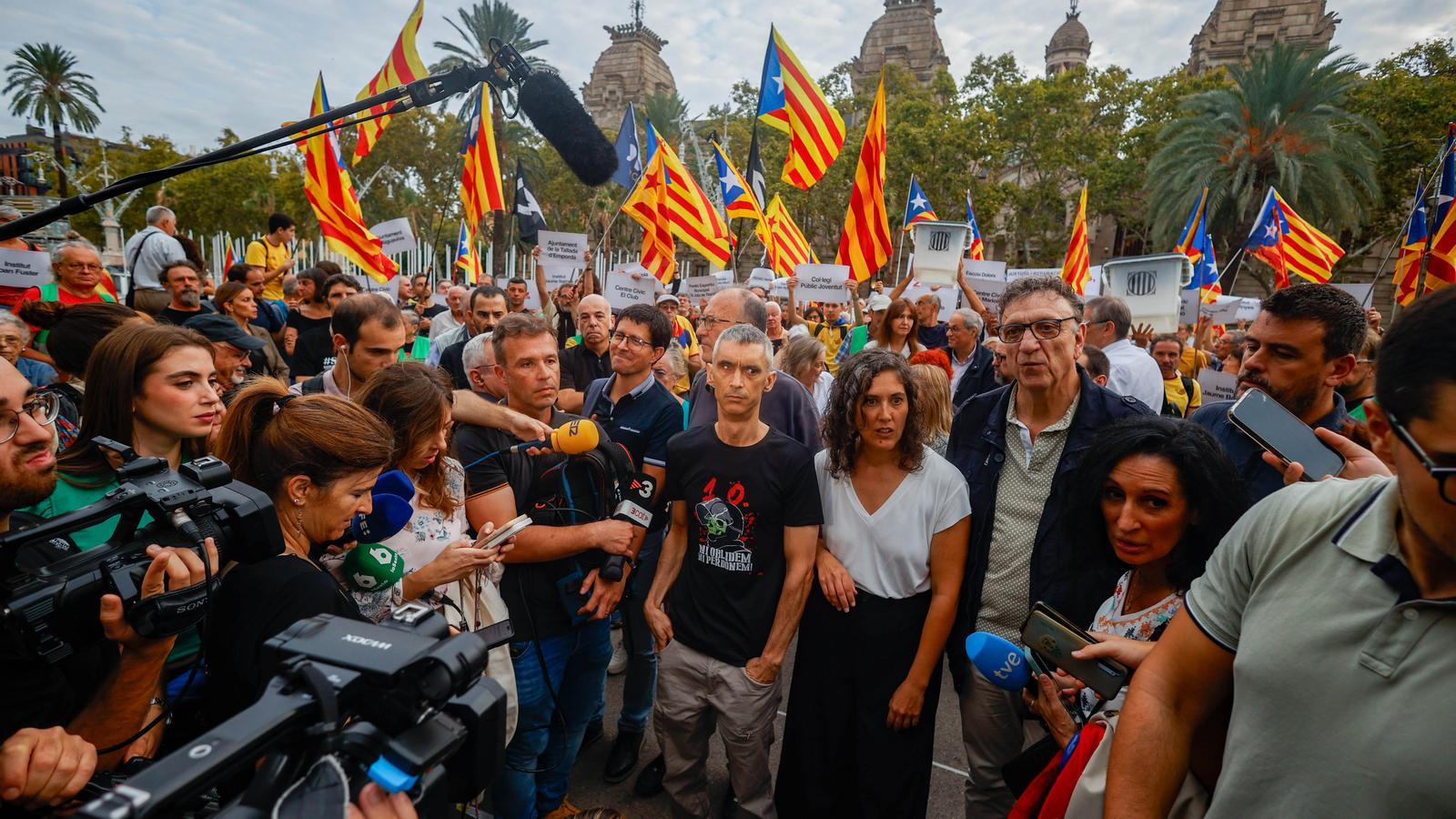
Before the session began, there was a pro-independence gathering in support of Roger Español with Òmnium, the ANC, Irídia, Junts, ERC, and the CUP. In a statement to the media, Español emphasized that he intends for the four accused police officers to be convicted, and therefore, for the "police brutality" of the State to be condemned as well. At the same time, he vindicated the 1-O referendum and called for rubber bullets to be banned, as also stated by Carles Guillot, another mutilated person and founder of Stop Rubber Bullets. Meanwhile, lawyer and director of Irídia, Anaïs Franquesa, asserted that all "expert evidence" had been collected to achieve a guilty verdict.
In parallel, the presidents of Òmnium and the ANC, Xavier Antich and Josep Vila, maintained that the independence struggle "continues" and expressed their support for the activist, as did the general secretary of Junts, Jordi Turull, who stated that "it is regrettable" that justice has still not been served "nine years later".