Employers' association and property lobby exert pressure for the no to the housing decree
The president of the CEOE, Antonio Garamendi, accuses the Spanish government of "invading" private property

-
CAT -
CAST
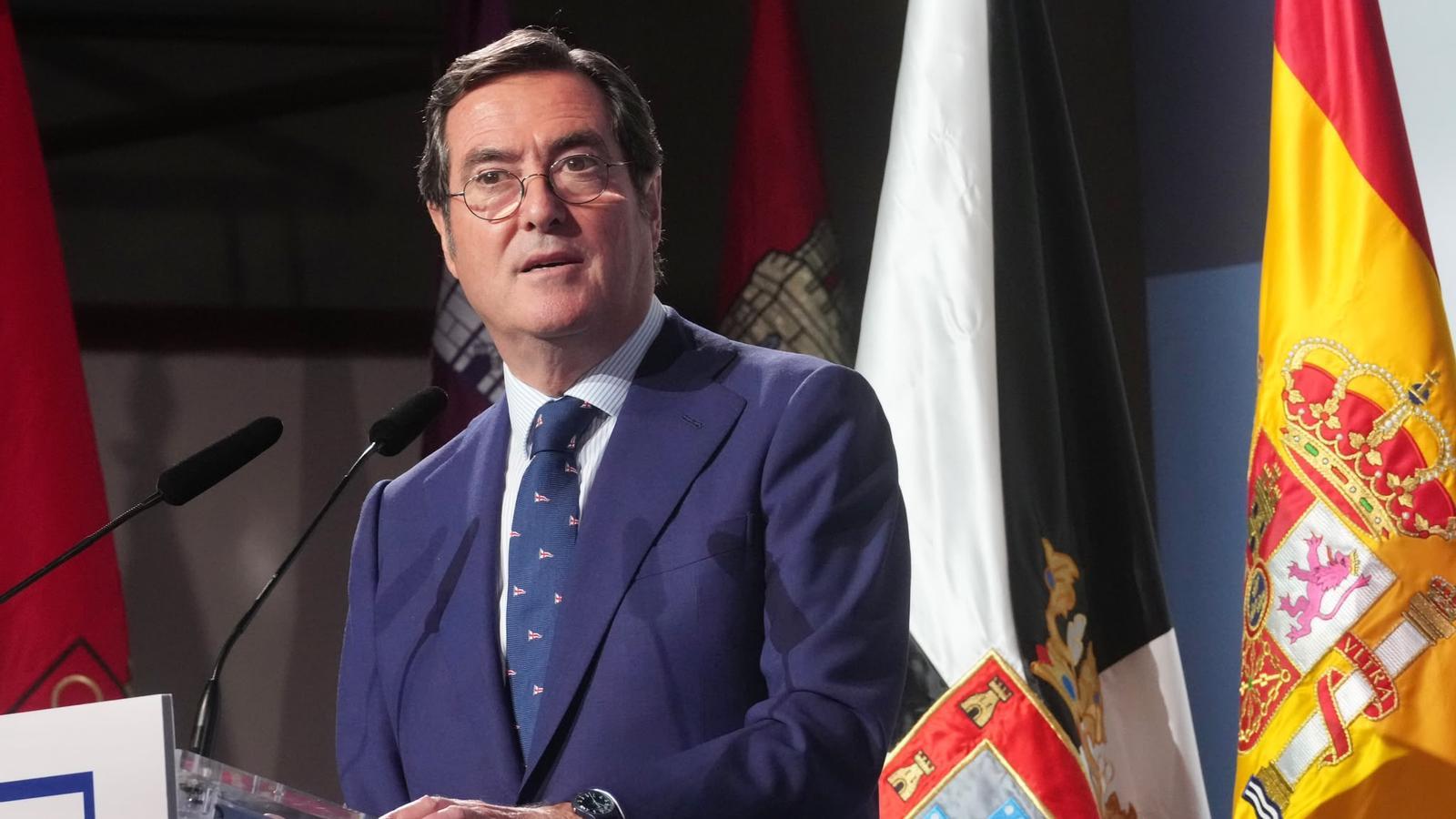
MadridThe Catalan employers' association Pimec showed itself this Wednesday to be in favor of the Spanish government's housing decrees, although it appealed for a "broad and lasting agreement." In contrast, at the Spanish employers' association CEOE –of which Foment del Treball is a part– the tone was quite different. Its president, Antonio Garamendi, has publicly acknowledged that he would vote against them and even placed the proposals and their promoters on the bad side of the story: "Some think they are playing Robin Hood and are not aware that they represent the Sheriff of Nottingham," said Garamendi during his speech at the CEOE General Assembly this Thursday, in which he was re-elected president for four more years.
Of the two decrees, it is known that the text incorporating automatic rental extensions and compensation for tenants will not prosper, while the decree with protection measures for the most vulnerable, such as the temporary moratorium on some evictions, is in the hands of Junts and Coalició Canària, who this Thursday afternoon had not yet revealed their voting intention.
The CEOE has not hesitated to denounce that the Spanish government's regulations leave "on the shoulders of private savings [the owners] the State's responsibility [to find a solution] to the housing problem." "The administration must solve it and not result in an invasion of private property," reiterated Garamendi. The president of the CEOE sees in it, in fact, "more of an electoral than a political character."
This is not the first time that Garamendi has spoken out about the Spanish government's housing policies. The last time was in March, when the extraordinary extension of rental contracts was proposed. For the employers' association, it is a "shame" that decrees are presented written hours before their approval and against the clock to "solve a problem as complex and real" as that of housing. The Bank of Spain asked this week to "tread carefully" with the measures.
The chambers denounce "insecurity"
Those who share the CEOE's thesis are the Property Chambers of Catalonia, which consider that with the decrees there is a "risk of aggravating" the problem. In a statement released this Thursday, the chambers warn that the regulatory framework is "increasingly complex, restrictive and unstable," with growing "legal uncertainty" which they believe will reduce the supply of rental housing. The entities argue that the difficulties of accessing housing must be addressed "urgently," but they also criticize that there is an attempt to "shift responsibilities to owners that essentially belong to public administrations."
At the same time, they criticize that the focus is placed on the regulation of rents, but not on the increase of supply, although the first decree proposes measures to mobilize empty housing, and also to expand the public stock. "If the government itself recognizes that Spain needs hundreds of thousands of new homes, the answer cannot fundamentally rest on regulating existing homes more and more," the statement reads.
The second longest-serving president
Housing has eclipsed the proclamation of Antonio Garamendi as president of the Spanish employers' association CEOE for four more years (until 2030). He did not need elections because he had no rival. With this re-election, he becomes the second longest-serving president of the Spanish employers' association, behind the historic José María Cuevas Salvador (1984-2007), and will surpass the Catalan Joan Rosell i Lastortras (2010-2018), who introduced the two-term limit to the presidency of the CEOE that Garamendi himself abolished three years ago.
Garamendi begins a new term marked by tensions within social dialogue, the use of a sharper tone with the Spanish government, and the absence of tripartite agreements, for which he holds the government and the Ministry of Labor primarily responsible: "It is more apparent than real," he said regarding social dialogue.
