Why does Trump want Japan to have an expensive currency?
A weakening of the yen could make the cost of US debt even more expensive

-
CAT -
CAST
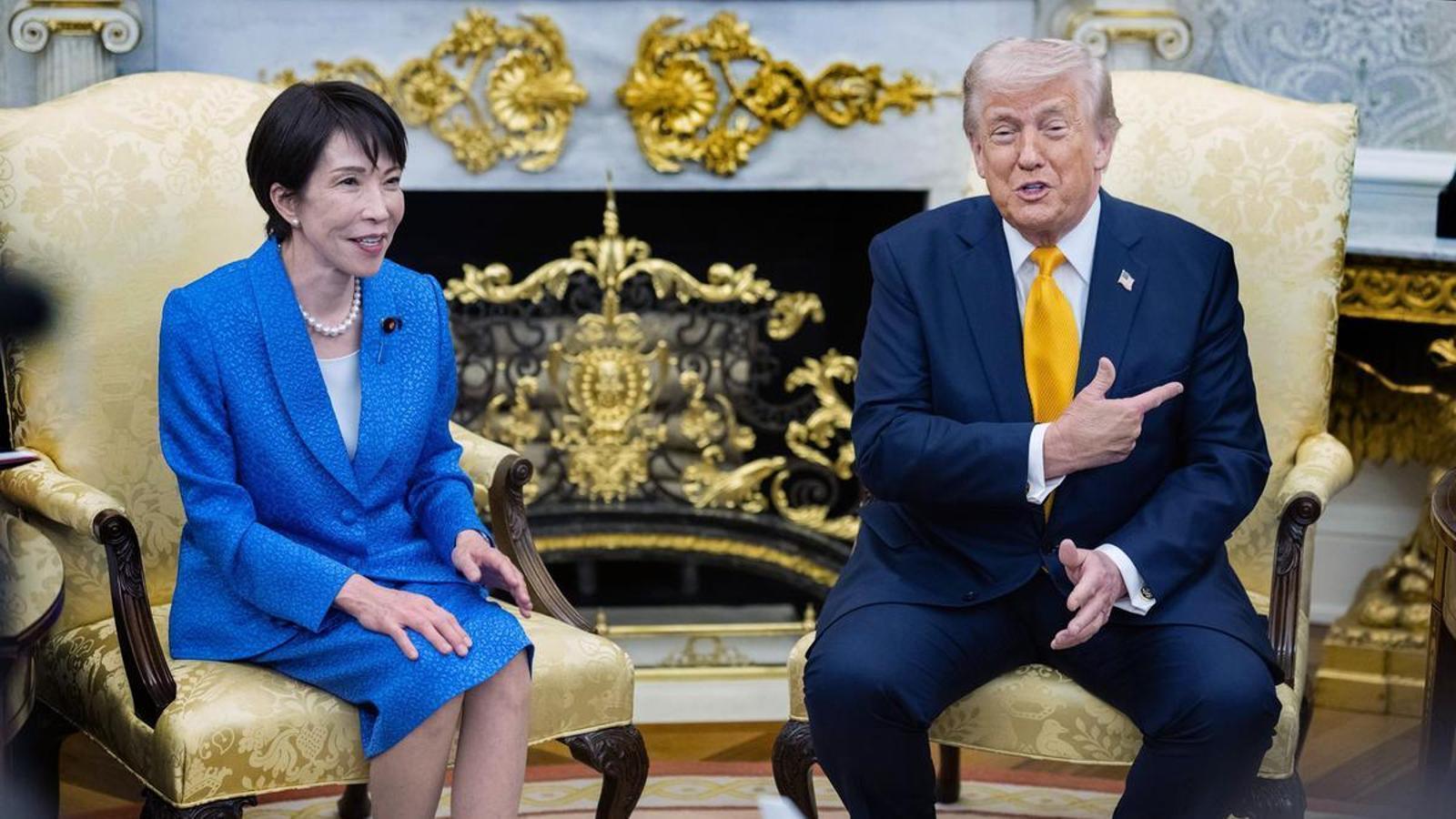
Barcelona"We will always be there for Japan". With these words, the President of the United States, Donald Trump, explained his government's intervention at the beginning of August to curb the fall of the yen, the Japanese currency, in the markets. The declaration of support and friendship, however, has been followed by certain tensions between him and the Asian country's Prime Minister, Sanae Takaichi, as the White House considers that she is not doing enough to stop the decline of her currency.
In 2020, just before the pandemic, one yen cost approximately one cent of a dollar (that is, one dollar was equivalent to about 110 yen) and about 0.8 euro cents. This value has been plummeting and currently stands 30% lower, at 0.63 US cents (one dollar is about 150 yen). The response to this decline, which accelerated in the summer, was a coordinated action between the country's central bank and the United States government to strengthen it.
Between July 30 and 31, the Bank of Japan exchanged some 85 billion US dollars of its foreign exchange reserves in the markets in order to increase the demand for yen and, thus, increase its value. In parallel, the US did the same, but by exchanging a portion of its euro reserves for yen, although Washington did not disclose the amount. The reason why the American authorities sold euros and not dollars was to avoid accusations of artificially fluctuating their own currency in the markets. Despite this, a photographer captured the notebook of Treasury Secretary Scott Bessent in a government meeting with the note: "Things to do. Buy yen. 5,000-10,000 million".
This double intervention caught investors by surprise and was accompanied by statements from both countries that, if necessary, they will take similar measures again in the near future to maintain the strength of the yen. "We believe the trigger and primary objective of the intervention was to crush speculative positions and disincentivize rapid, one-way, and potentially disorderly market movements," asserts Koichi Sugisaki, head of macroeconomic strategy in Japan for Morgan Stanley's research service, in an article published by that same American investment bank. However, what do the US gain from a stronger yen?
Thethree lost decades
From the late 90s until the pandemic, Japan went through the so-calledthree lost decades, during which the value of the yen fell sharply, as there was no demand. With the outbreak of a financial crisis in the country, the economy stagnated, as did prices. Since inflation in Japan was so low (many years even prices were falling) and growth was almost zero, the Japanese central bank kept interest rates very low.

Interest rates are the price that the central bank charges financial institutions to lend them money which, subsequently, they also lend to their clients –that is, to businesses and families– in the form of mortgages or loans. When the economy does not grow enough and prices fall, central banks lower rates in order to make it easier for commercial banks to borrow money and lend it at a cheaper interest rate to consumers, thus facilitating consumption and investment and, therefore, reactivating the economy.
In fact, the low value of the yen since the 90s meant that the currency became an object of desire for certain speculative investments. Thus, since Japan kept rates much lower than the rest of the advanced economies of the world, it was profitable for many foreign investors to take on debt in yen, because the interest in this country was much lower than what they would have to pay if they had taken on debt in euros or dollars. Later, they would exchange the yen for another currency and invest it abroad, obtaining returns much higher than the interest they had to pay back.
This type of operation, which has a speculative character because it allows money to be earned through the simple difference in interest rates, is called in financial jargon carry trade. However, with the reactivation of the global economy in 2021 and the energy crisis derived from the Russian invasion of Ukraine in 2022, inflation returned all over the world, also in the Land of the Rising Sun, and the Japanese central bank raised interest rates again for the first time in 16 years in 2024.
US debt in Japanese hands
A study published in March of this year by the Economic Governance and Control Unit of the Economic and Monetary Union, an economic research team of the European Parliament, placed Japan as the country that has invested the most in United States bonds. Between the central bank, administrations, and private Japanese investors, they control more than 1.18 trillion dollars in U.S. public debt, 12.7% of the total in foreign hands. One of the reasons explaining this large Japanese investment is that, since interest rates in Japan were much lower than in the U.S., American bonds provided a higher return than Japanese ones, and were equally or more secure.
Aside from intervening in the markets by buying yen, the loss of value of the Japanese currency could be stopped in another way: by increasing interest rates to make investments in Japan more attractive to foreigners, which would increase the demand for yen and, consequently, its price in currency markets. As mentioned, the Japanese central bank had already begun raising rates in 2024, so it would not represent a very abrupt change in policy, but at the same time, after decades of low rates, today the Japanese government is the most indebted in the world, so an increase in interest rates, even if low, puts great strain on its public finances.
In the same sense, this scenario would not be profitable for Washington either: if rates rise in Japan, many investors from that country would have incentives to sell their American debt—or other assets denominated in dollars, such as shares of U.S. companies—and reallocate the money into yen in Japan. This would force the U.S. government to pay more interest on its bonds in order to retain these investors.
This is precisely what Trump wants to avoid: a massive sale of US Treasury bonds by their Japanese owners would mean a headache for his government, which is already paying more than 5.2% for 10-year debt securities –the benchmark–, the highest figure in twenty years. Therefore, it is more profitable for the US to keep the yen cheap and thus save itself an additional cost for a debt that already exceeds 40 trillion dollars and for which the Trump government has to pay a higher interest every day.
Thus, both Tokyo and Washington need a stronger yen that allows keeping rates low and, therefore, avoiding headaches with a debt that both countries have at a very high level.
