The institutional clash for Ceuta escalates with the humanitarian crisis in between
The government of Ceuta threatens to go to court and Pedro Sánchez's executive defends "collaboration"
-
CAT -
CAST
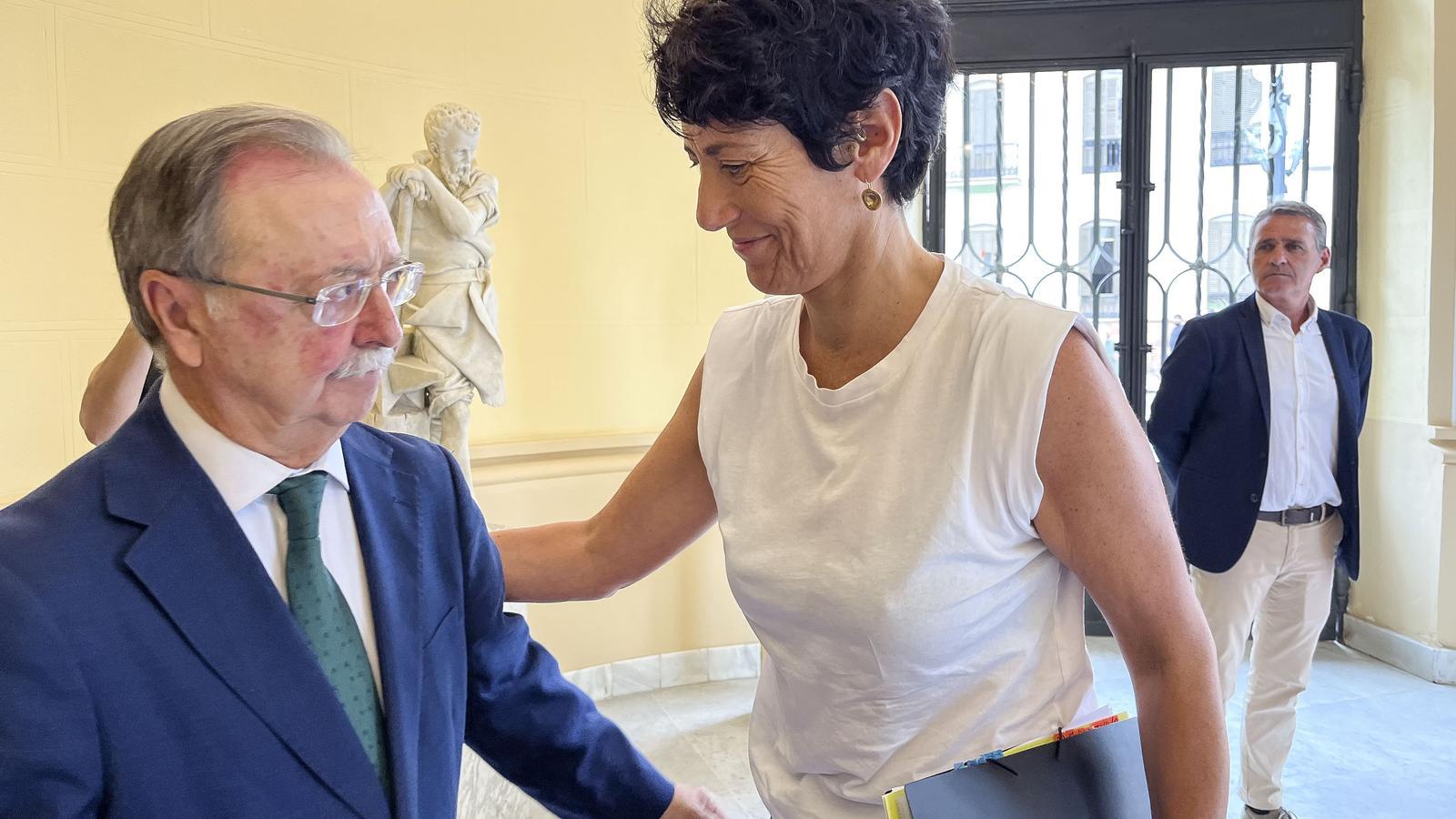
MadridThe political clash over the situation in Ceuta escalates as the humanitarian crisis remains evident in the city. The tension between the government of Ceuta and Pedro Sánchez's executive has increased in volume after the president of the autonomous city, Juan Jesús Vivas (PP), threatened to go to court if Moncloa does not "solve" the crisis within 30 days. A path, currently unspecified, which has the support of Gènova, that has found in the migratory crisis a new vein to wear down Pedro Sánchez. Meanwhile, the Spanish government avoids a head-on confrontation, defending its actions and the "collaboration" between institutions, in the words of the government spokesperson and Minister of Inclusion, Social Security and Migration, Elma Saiz, who this Monday traveled to Ceuta for the first time since the entry of thousands of people on July 30, even though her responsibilities include ensuring a reception network for asylum seekers.
Vivas has been raising his voice for days about the future of the people who remain in Ceuta when he asked that they be expelled "immediately". And he wants the Spanish government, to whom he demanded a single command, to execute it. If Pedro Sánchez's executive does not make a move, Vivas has anticipated that he will report the situation to the highest representatives of the Supreme Court, the Constitutional Court, and the General Council of the Judiciary (CGPJ).
"We will go to other instances to report the situation in Ceuta [...]. My intention is to convey the situation [of Ceuta] to the president of the Supreme Court and the president of the Constitutional Court if they wish to receive me. The Judiciary is the cornerstone of the rule of law. Ceuta is living under a state of emergency," Vivas revealed. It should be remembered that it was the Supreme Court itself that condemned the State for having circumvented the law with some unaccompanied migrant minors who were expelled in 2021, when the last major crisis occurred in Ceuta.
The president of Ceuta has also lashed out at the Spanish government's "inaction" in the face of the migratory crisis. "In the first days of August, [the Spanish government] tried to sugarcoat the reality by stating that [Ceuta] had returned to normal," Vivas denounced. "Then, there has been an almost absolute passivity in taking measures to achieve normality," he added.
From expulsion to welcome?
More than two weeks later, many people continue to sleep in the open, in the warehouses of El Tarajal or on El Trampolí beach, and are demanding that their asylum be processed, as narrated by ARA. "[The Spanish government] has not stopped working for a single moment to help Ceuta," Saiz affirmed this Monday, after meeting with Vivas.
While last week the Ministers of the Interior, Foreign Affairs and Defense focused on the return of migrants – "To the last person will be returned," José Manuel Albares even said –; Saiz has focused on the humanitarian attention of the people who remain in Ceuta and their reception. "The ministers' work is coordinated, effective and permanent [...]. We are providing a response in compliance with legality [...] and with a commitment to humanitarian attention," the minister limited herself to answering when asked whether the executive is now opting for reception, and not for the expulsion of people.

Pedro Sánchez reactivated his agenda this Monday and coordinated a new meeting to monitor the situation in Ceuta with seven ministers, five of whom – those of the Interior, Foreign Affairs, Defense, Health, and Migration – will appear next week in Congress to explain how the crisis has been managed – they have not done so in the Senate, as the PP wanted, which also considers this telematic meeting insufficient and criticizes that Sánchez is still on vacation. It has been eighteen days since the migratory crisis, the deadliest on the southern border since records have been kept, and this is the second time the Spanish government has met.
The head of Health, Mónica García, spoke for the first time this Sunday of a "humanitarian crisis", despite the fact that the situation of lack of protection for many people has been suffered for days. Regarding minors, their reception is an autonomous competence, in this case of the local government of Ceuta. Ceuta's facilities, however, have been collapsed for days.
The PP is pushing for border control
The Deputy Secretary for Institutional Regeneration of the PP, Cuca Gamarra, has closed ranks with Vivas and opined that the 30-day ultimatum is a "frankly logical deadline" coming from someone who "knows the gravity of what is happening." In a press conference at the party's state headquarters, Gamarra said that both the president of Ceuta and the popular leadership will go all out to "recover normality" in the territory. While the popular leader did not specify exactly what judicial actions could be launched, she stated that they will be "whatever it takes." "We will articulate all the mechanisms at our disposal," Gamarra guaranteed.
What the PP has done so far is to register a non-law proposal (PNL) in Congress demanding that the Spanish government "provide all necessary means" with "immediate and urgent action" in Ceuta, which involves activating the national security law for a single command and reinforcing immigration personnel to accelerate immigrant returns and border control.
"Do not disturb the Moroccan"
Vivas hinted this Monday that during this time, and still now, there could be a hidden intention from Moncloa to not address the situation in Ceuta with more speed. He said that one possibility for this inaction is the desire to "not bother the neighbor to maintain what are considered pseudo good relations," he said in relation to Morocco. "This is why there is no firm and forceful action against a hypothetical plan conceived from the other side with the aim of successively striking Ceuta until the definitive fall [of the autonomous city]," Vivas stated. "Hopefully, this is not the situation," he reiterated. So far, Pedro Sánchez has avoided a head-to-head confrontation with Morocco. In fact, the Spanish government has argued that the return to "normality" in Ceuta has been thanks to "coordination" with the Alaouite country.
