Sánchez enters electoral mode: "PP and Vox would be the return of systemic corruption"
The Spanish president reproaches Feijóo and Abascal's people for now allying with Junts after "what they made of the amnesty"

-
CAT -
CAST
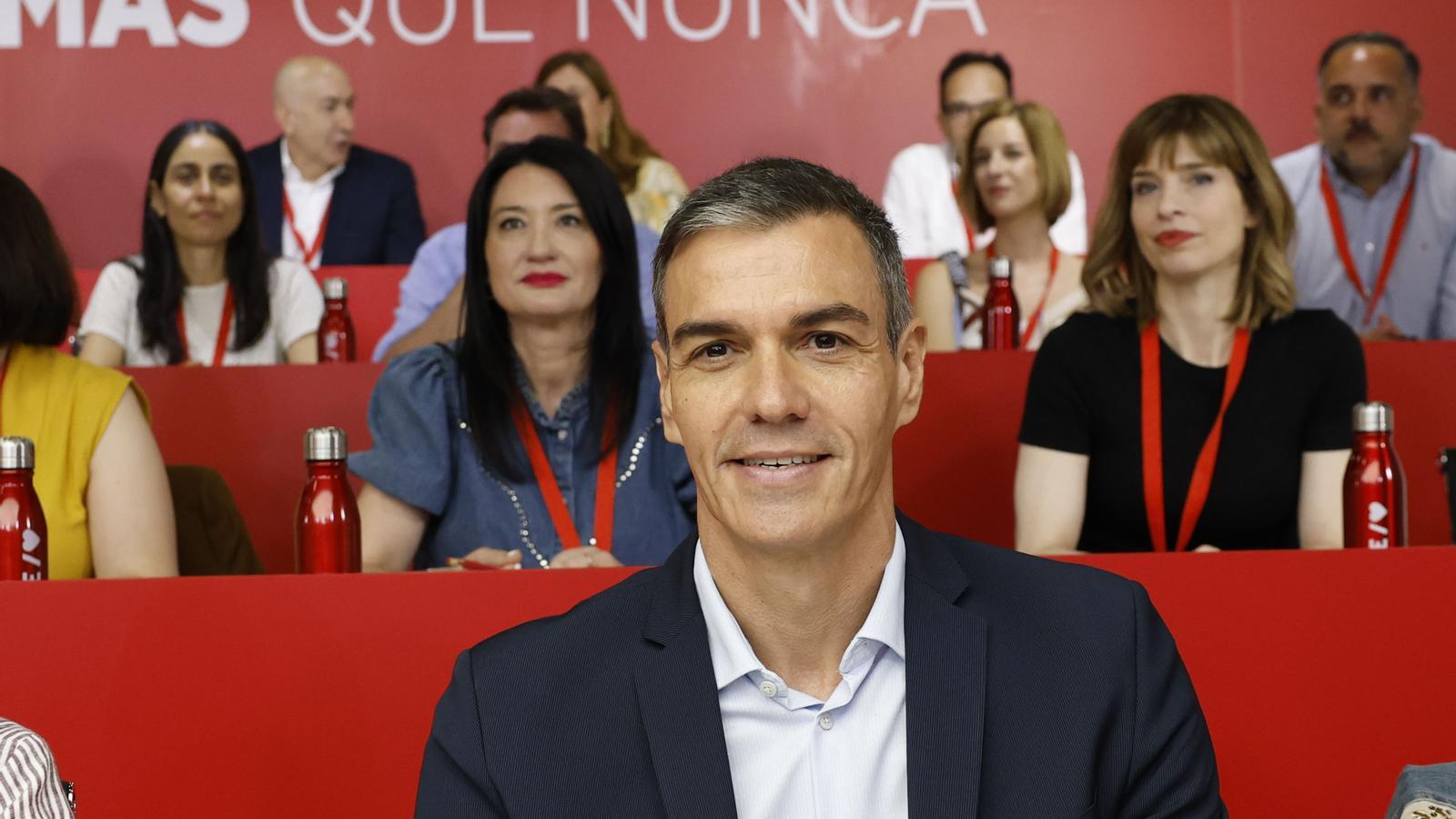
MadridIt is the icing on the cake that Pedro Sánchez was left with after this week's debate in Congress on corruption: testing his strength within the PSOE. The party has met in a federal committee to set the course for next year's municipal and regional elections, and Sánchez's speech has already been in election mode. “The PP and Vox will never be the end of corruption, but rather the return of systemic corruption,” he assured, and said that the only thing that can prevent them from coming to power and repealing public services is the PSOE. In addition, he threw a jab at them for allying with Junts in Congress to demand his resignation this week and he did so with a gesture of complicity towards the President of the Generalitat, Salvador Illa, who was sitting in one of the front rows of the federal committee: “Salva, dear president, the turns that life takes. Because to see the PP and Vox voting with Carles Puigdemont's party, trying to oust us from government with what they mounted with the amnesty [...] and now it turns out they agree.”
He was not the only one to mention Junts. Alberto Núñez Feijóo, from the Catalan PP congress, also referred to it, now asking Puigdemont to take a further step: "Pressing the button that would call elections would be better and more responsible," he said, alluding to a possible motion of no confidence – reports Roger Palós. In the words of Miguel Tellado, the danger is no longer secessionism but Sánchez's government.
However, Moncloa's roadmap is to resist, and neither Junts nor the PNB are willing to support Feijóo in his endeavor now. Therefore, Sánchez, just as he did on Wednesday in the Congress of Deputies – he has given an almost identical speech – has defended the continuity of the government because Spain "is experiencing the best moment in its history", contrasting the "apocalyptic" vision of the situation that the right is spreading. "How can we not continue?", he asked.
In other words, far from throwing in the towel, the message to the outside world has been that the elections will be in 2027 and that they will govern "until next year and beyond": because, according to him, the economic indicators in the State are now better than in 2018, when they ousted the PP from power. Internally, Sánchez has wanted to boost the spirits of his ranks – he has asked them for "courage and determination" – to go out and "win and govern" for the regional and municipal elections. This Saturday, the regulations for choosing candidates will be approved: the territorial federations will have to choose whether to hold the primaries in July, November, or February.
Corruption
Sánchez has also internally addressed those calling for information with full transparency following the judicial cases affecting the PSOE. "This organization has not been illegally financed" and "we have acted forcefully against corruption," said the secretary general, and he once again classified the cases affecting the PSOE, in line with Moncloa's strategy to differentiate between the open judicial investigations, and also the measures the party has taken to prevent corruption, such as the need to make administrative decisions collegially. At the same time, he urged the groups, including the PP, to support his anti-corruption plan, which has been stalled in Congress for weeks.
The Spanish president has placed corruption in the former organization secretariat led first by José Luis Ábalos (already convicted) and then Santos Cerdán. In other words, as a matter of the past with a desire to turn the page. On the other hand, he has defended the presumption of innocence of the former Spanish president José Luis Rodríguez Zapatero and has confined the investigations into his family – his wife and his brother – to political persecution.
In fact, in Zapatero's case, with whom he said he speaks "regularly", he has defended not only the preservation of his innocence but has also denounced the "trampling of his fundamental rights" due to the leak of his conversations and agenda which "have nothing to do with the investigation". "It is improper of a democracy like Spain's", he said, and he also urged the cadres to champion his legacy in social and civil rights, in addition to recalling that he ended ETA.
Page calls for self-criticism
The forecasts of closing ranks with Sánchez have already been met at the entrance of the meeting. Of all the leaders of the federations, the only critic has been the president of Castilla-La Mancha, Emiliano García-Page, who has even hinted that the socialists had been wrong to choose Sánchez as leader. "We must not be afraid to give voice to the citizens," he stated, as he pressures the Spanish president to call elections before the municipal ones. In addition, he has asked for guarantees that the PSOE will not be charged as an organization for corruption.
On the other hand, the other territorial leaders have shown themselves aligned with Sánchez and, in the face of the multiple corruption cases affecting them, have presented the PSOE as a victim: "They have taken advantage of the acronyms and we have suffered reputational damage," lamented Adriana Lastra, head of the Asturian socialists, who left the PSOE leadership precisely at odds with Santos Cerdán. The president of the Generalitat, Salvador Illa, wanted to send a message of strength and "hope": "They will not bend us nor silence us. We are not afraid of anything and we have a lot of hope for the future".
Behind closed doors, he was also one of the first to intervene and, according to sources consulted, gave an "executive" speech and rallied with Pedro Sánchez, while Page continued to criticize Sánchez in private and was harshly rebuked by other leaders such as Óscar López.

The atmosphere this Saturday was very different from a year ago, even though new cases have proliferated, such as the Zapatero case, that of Leire Díez, or the already sentenced corruption of José Luis Ábalos. Last July, the federal committee had to renew the position of Cerdán, who was removed for alleged public works commissions, which caused a great impact on the organization. But, in addition, before the conclave began, accusations of harassment against one of the members of the new team in the organization's secretariat, Paco Salazar, surfaced, leading to his resignation.
Internal movements
The organization secretary, Rebeca Torró, has been traveling the territory for weeks to address the situation and discuss the primary regulations. Internal movements have already begun. The deputy spokesperson, Enma López, has left her position in the PSOE executive and announced that she wants to confront the PSOE leader in the Madrid City Council, Reyes Maroto. "The regulations have not yet been approved," PSOE sources stated on Friday. An indication that in Ferraz they believe it has been rushed. In fact, the minister and candidate for the Community of Madrid, Óscar López, avoided commenting upon entering the federal committee and arrived accompanied by Maroto.
