Who is Sahra Wagenknecht, the woman who can give the first state to the German far right?
The anti-immigration and pro-Russian formation BSW, split from The Left, is against the sanitary cordon to the far right
-
CAT -
CAST
BarcelonaWith a historic result of 44% of the vote, the far-right party Alternative for Germany (AfD) has fallen just three seats short of an absolute majority in the parliament of the state of Saxony-Anhalt. The party, founded in 2013 during the height of the euro crisis, will not be able to govern alone as it wanted, and most parties have committed to the policy of a 'cordon sanitaire' to block its path. But the game of alliances with a small group that has managed to enter parliament still gives it the possibility of accessing power in a federal state for the first time since Nazism.
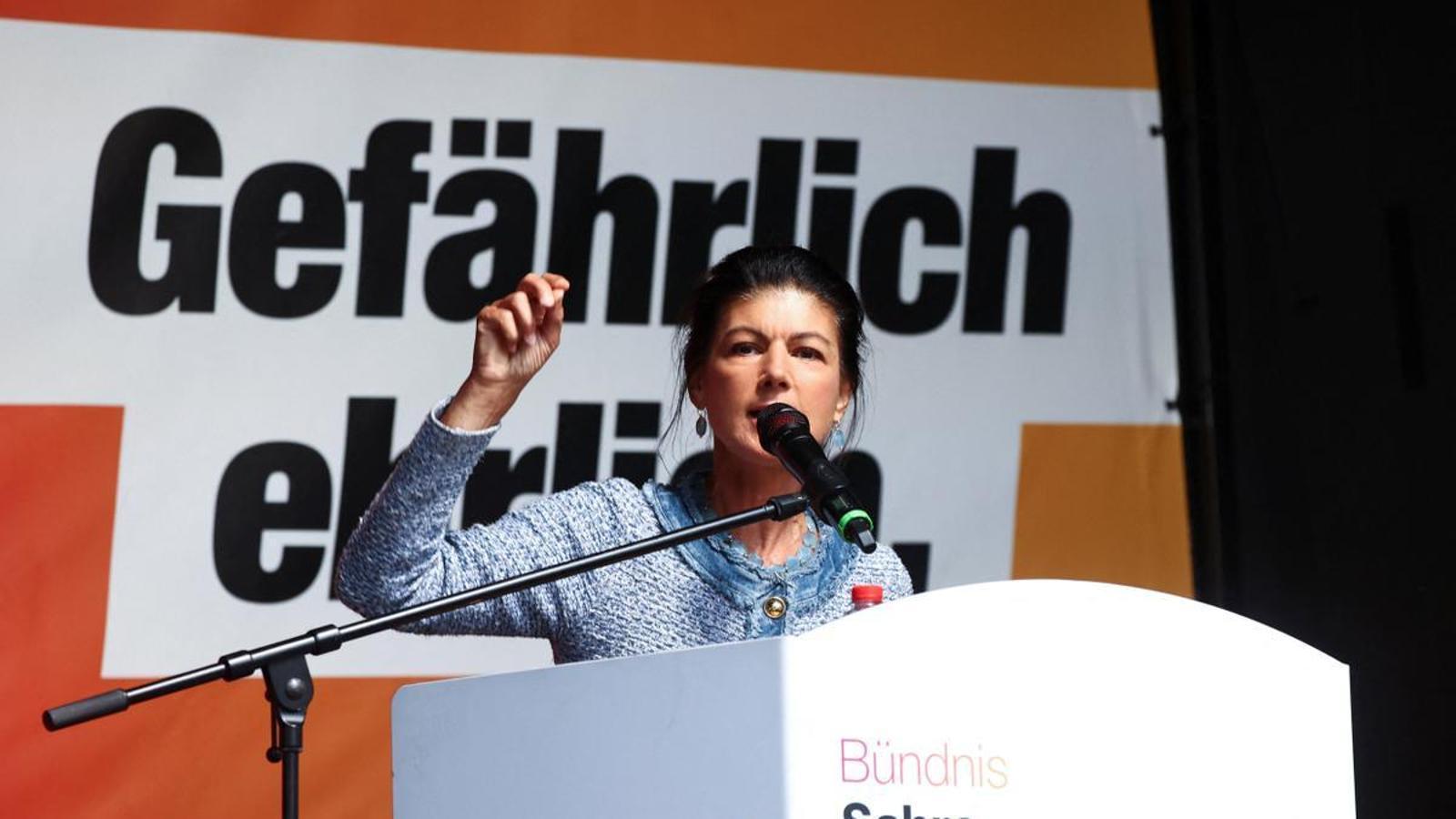
The key is held by Sahra Wagenknecht, founder of the party that bears her name: Sahra Wagenknecht Alliance (BSW). The young party (founded in January 2024), which combines supposedly left-wing economic policies with an ultra-conservative approach to immigration and a pro-Russian foreign policy, has obtained 5.3% of the votes and 5 deputies in the regional parliament. It is a breakaway from The Left, the heir to the Communist Party that ruled East Germany with an iron fist within the former Soviet Union bloc.
"We hope that there will now be majorities in the Magdeburg regional parliament to push for a change in energy policy, end sanctions against Russia, improve education, and undertake a profound reform of public broadcasting," Wagenknecht declared this Monday to the DPA agency. "The BSW comeback has begun," she stated, adding that "the result will give momentum to her party's campaign ahead of the regional elections in Mecklenburg-Western Pomerania and Berlin".
Wagenknecht has ruled out a coalition with the AfD, but not cooperation, a fact that could place her party in a decisive position. "The policy of keeping the AfD out of government has failed. Simply trying to form another coalition to exclude the AfD would be an insult to the voters," she asserted.

After BSW obtained 6.2% of the votes in the 2024 European elections and between 12 and 16% in the federal states of Brandenburg, Saxony, and Thuringia, it remained out of the German parliament in the 2025 legislative elections by a few thousand votes. This broke its upward trajectory. Wagenknecht had said during the campaign that if they obtained representation in Saxony-Anhalt on Sunday, they would not vote in favor of the investiture of the AfD candidate, Ulrich Siegmund, but that they could abstain to facilitate it.
Anti-immigration and pro-Russian
The rise of BSW shook politics in the former East Germany, but also across the country. Its founder defined the party to the German press as "the embodiment of what many parties no longer defend: an enlightened conservatism in the sense that it preserves traditions and security in the streets and public spaces, but at the same time jobs, healthcare, and pensions: the need for security, peace, and justice now have a new political expression in us". A program that aims to attract voters who support a broad welfare state and, at the same time, hold more conservative cultural attitudes. For this reason, the majority of its voters come from The Left or social democracy.
BSW and AfD share many points in their program on immigration: setting limits, deporting rejected asylum seekers, and strengthening border control, for example. They differ, however, in their policy on the welfare state: the AfD wants to cut it and Wagenknecht's party wants to expand it and advocates for increasing the minimum wage and pensions and capping rents. The other aspect that both parties share is their pro-Russian and anti-NATO inclination, and their rejection of German and European support for Ukraine against the Kremlin's invasion. The party has capitalized on anti-establishment, anti-American, and anti-imperialist sentiment, which is stronger in the former East Germany.
