Sánchez conspires to resist at Moncloa against the attempt to "overthrow him with bad arts"
The leader of the PSOE maintains the course "until 2027 and beyond" despite the pressure from the opposition and the judicial cases surrounding him

-
CAT -
CAST
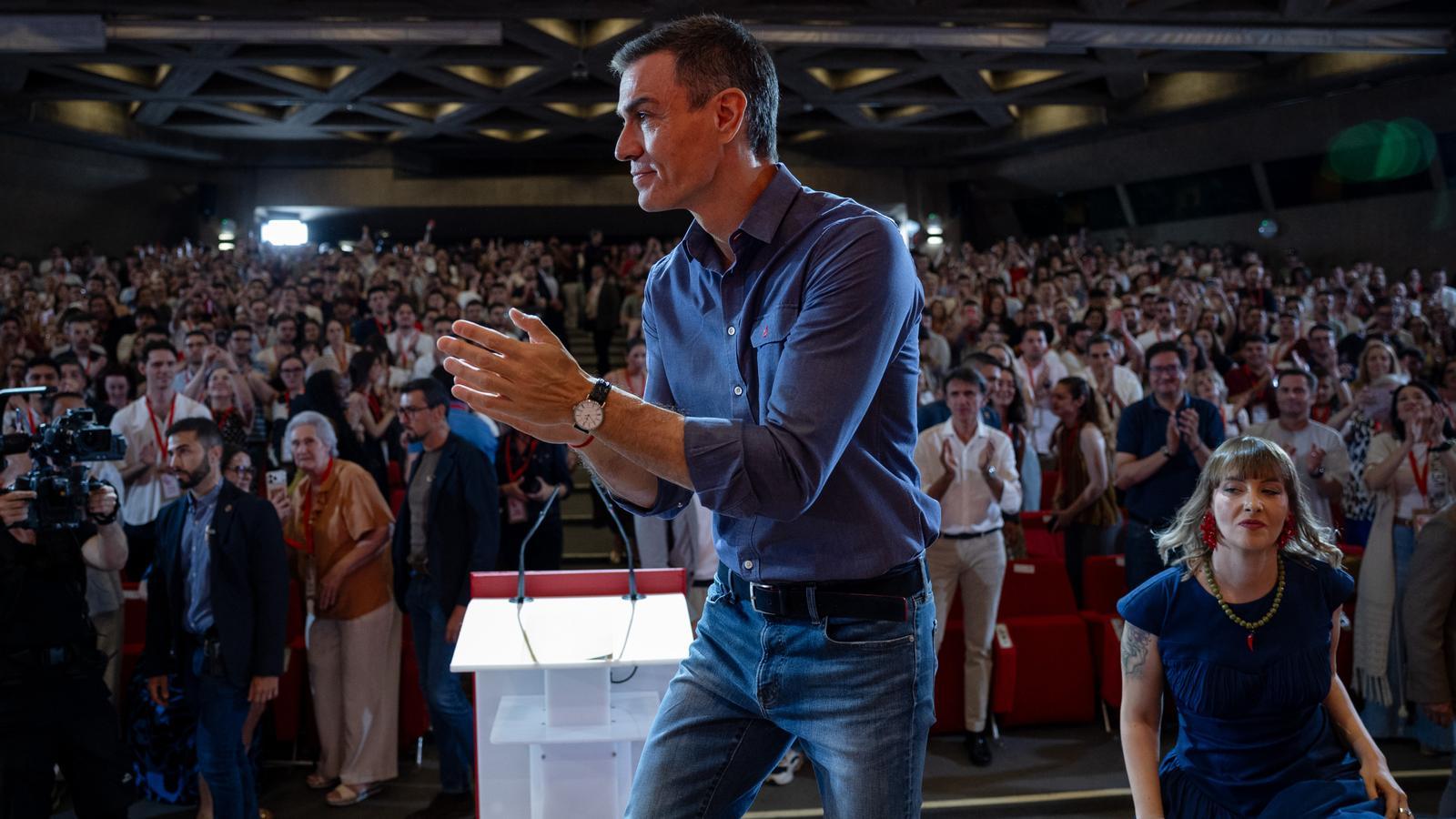
MadridUpon entering the UGT headquarters in Madrid, it was difficult to tell if it was the closing of the Congress of the Spanish Socialist Youth or a nightclub. The machine version of Pedro by Raffaella Carrà was playing at full blast while the leaders waited for the Spanish president, Pedro Sánchez, to enter the hall. A militant stood with a raised rose and two books by the PSOE leader in his hand –Manual de resistencia and Tierra firme–, which Sánchez dutifully signed as he passed by amidst shouts and applause. It is the staging of what the PSOE wants to do after fifteen days of judicial earthquake: counterattack.
Minister Óscar Puente already began on Thursday warning of an attempt to overthrow the Spanish government by "undemocratic methods" and Sánchez continued this Sunday defending his project and sending a message to the right: "Socialists never give up any battle as lost." "We continue with our roadmap. Until 2027 and beyond," he stated, also appealing to the possibility of being re-elected in the next elections if "the Spanish people want it." That is, manual of resistance again and at maximum power, as he accused the opposition of being "liars" and of wanting to "overthrow him with bad arts" after the outbreak of the Zapatero case and the presence of the Civil Guard this week at the Ferraz headquarters for the Leire Díez case. For the PP, this attitude of the PSOE is an "offensive against the foundations of the State," a "danger to democracy," in the words of the general secretary of the Popular Party in Madrid, Alfonso Serrano, this Sunday.
Sánchez, during his speech at the Socialist Youth congress – which, as is customary at rallies, he gave in a denim shirt with rolled-up sleeves –, played with two concepts: "determination" and "time". Determination in the face of attacks from the right (whatever its surname: political, judicial, or media) and time as a request to partners for the transformations he believes the government is carrying out to "take root" in society. At this point, he listed the policies of his executive with the multinational parliamentary majority: Sánchez cited the right to euthanasia, the reform to protect the right to abortion promoted by the Spanish government, the cultural bonus, or the reduction of youth unemployment and temporary work with the labor reform, in addition to the regularization of migrants and the international progressive agenda. He did not explicitly mention the amnesty law – this weekend marked two years since it was approved in Congress –, which put the right wing on alert as soon as the 2023 legislature began and which the judiciary resists applying to the pro-independence leaders: Carles Puigdemont remains in exile almost ten years after 1-O and Oriol Junqueras remains disqualified.
The Spanish president did refer to another anniversary: this Monday marks eight years since the motion of no confidence that ousted Mariano Rajoy following the corruption ruling in the Gürtel case and brought him to Moncloa. In this regard, he wanted to proclaim that much has been achieved since then and that we must continue "moving forward", because, in his opinion, "Spain is experiencing its best moment in 45 years". "We do not deny the problems, but we also cannot deny the balance sheet," he defended. Previously, the new president of the Socialist Youth, Aránzazu Figueroa, the first woman to lead this youth organization, stood in solidarity with her leader, and called him a "beacon" of global progressivism.
Early this Sunday, the PSOE's X account already hinted at the strategy: the socialists have posted a video in which they reclaim their history, from the fight against Francoism to the conquest of public services or same-sex marriage, including "No to war", The flag of "If you don't go, they return"
Salvador Illa has insisted on this same idea from the Festa de la Rosa in Tarragona, where he stood by the Spanish president: "We respect justice. We are not afraid of justice," he said, in addition to warning: "We do not surrender and we do not bend." But not all socialists see it the same way: this Sunday, who was Minister of the Presidency with Zapatero, and a historic leader of the PSOE, Ramón Jáuregui, has called for an "urgent" extraordinary congress to recover the party's internal debate. For now, according to various socialist sources, there is not much criticism to mount an alternative to Sánchez.
The flag of "If you don't go, they return"
Sumar demanded on Saturday "forceful actions" from Sánchez in the face of the judicial cases surrounding him. This was insisted upon by the Minister of Culture, Ernest Urtasun, this morning when he admitted a judicial offensive to bring down the coalition government, but he warned the PSOE that this cannot be an "excuse" not to provide explanations. Sánchez, in this regard, boasted without explicitly naming them of having taken measures when cases of alleged corruption have emerged, alluding to former PSOE organization secretaries José Luis Ábalos and Santos Cerdán, both of his strict confidence. But he also warned that he will act with "forcefulness" against "lies": that is, that they will react to cases when they see no basis, such as that of his wife Begoña Gómez or his brother, who this week has already sat on the defendant's bench.
What's more, he compared his attitude towards alleged corruption cases with that of the PP, explicitly citing the author of the phrase that has caused the most furor this legislature: José María Aznar and his "Quien pueda hacer, que haga". He pointed to their economic policies during the nineties and the 2000s, which he considers led to corruption, especially in urban planning matters, and also their support for the United States in the Iraq war in contrast to his confrontation with Donald Trump. In fact, Sánchez also played the comparison card to defend his continuity in Moncloa: he recalled that it is him or the PP and the far-right Vox, with policies of "national priority" and "xenophobic." A "If you don't go, they return" from the manual that served the PSC so well in Catalonia in 2008. Will it work again?
