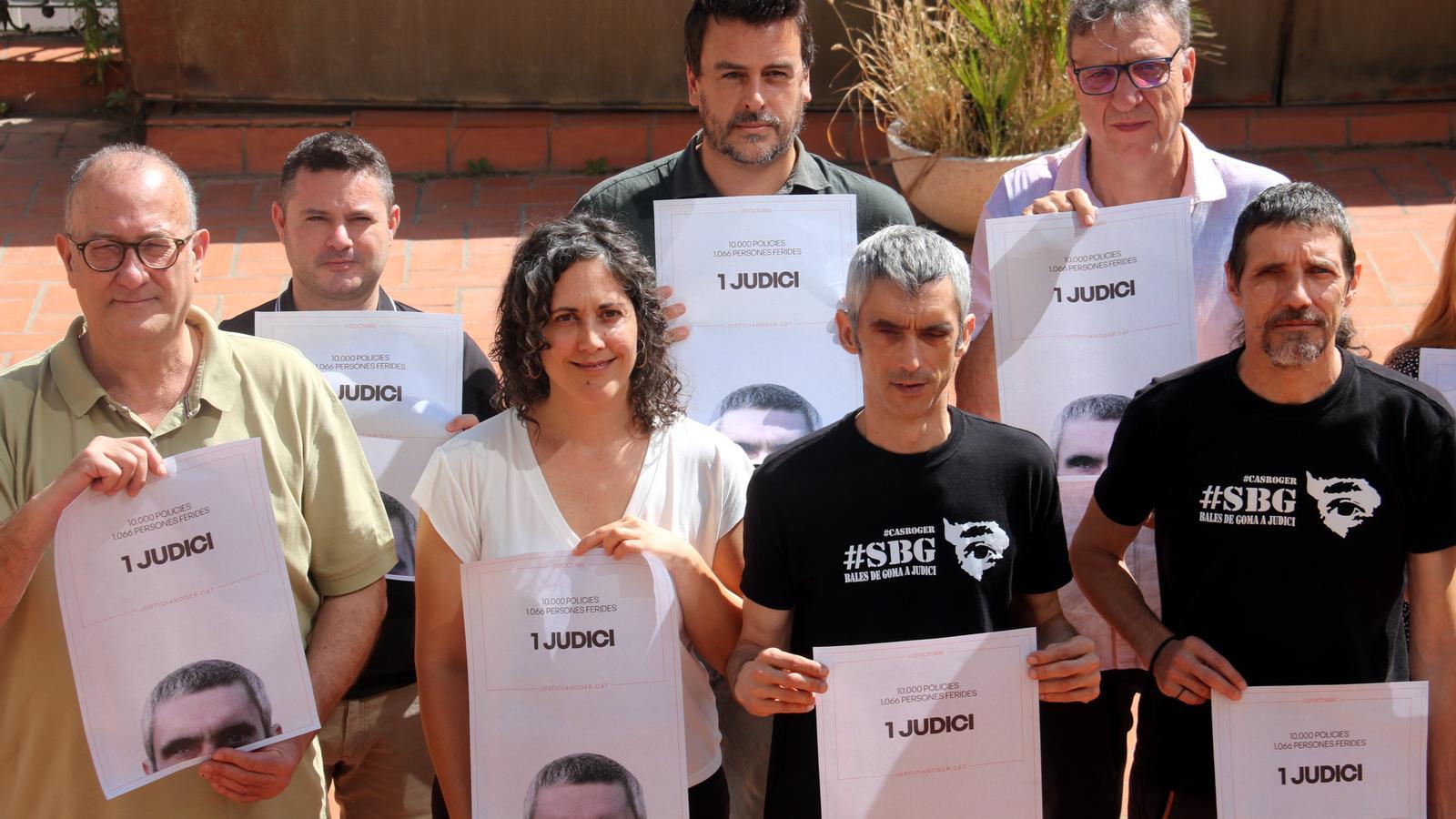
Jordi Évole and Marc Giró sign a manifesto of support for Roger Español at the gates of the trial
The text claims that the agents who mutilated an eye to the activist on 1-O should be condemned

-
CAT -
CAST
BarcelonaMore than a hundred entities and more than 50 personalities from culture and communication presented this Wednesday a manifesto in support of Roger Español, the activist from whom the National Police took an eye during the referendum of October 1st. The manifesto arrives on the eve of the trial that will seat the four agents involved in the operation in the dock, who are the only ones not amnestied out of the 162 indicted police officers.
The trial will be held on September 16, 17, and 30, and will paradoxically conclude on October 1, 2026, exactly nine years after the referendum. Among the signatories of the manifesto are Jordi Évole, Marc Giró, Olga Rodríguez, Juliana Canet, Manel Vidal, Sergi López, Clara Peya, Judit Neddermann, Yolanda Sey, and Jordi Borràs, and the support campaign has been championed by Irídia, Stop Bales de Goma, Alerta Solidària, Novact, Òmnium Cultural, Assemblea Nacional Catalana, and CIIVO.
Nine years after the events, the promoting entities denounce the police violence exercised during the day of October 1st, which caused 1,066 injuries, and claim the need for "truth, justice, reparation, and guarantees of non-repetition." The organizations recall that this is the only case resulting from the police repression of that day that has gone to trial, which they consider particularly relevant in the context of a lack of accountability for the events.
The manifesto denounces that the police violence of that day responded to a "standardized and systematic pattern" with the will to repress fundamental rights, and calls for "those responsible for Roger's mutilation and the violence of October 1st to be condemned," recalling that "only a conviction can guarantee justice and reparation."
Español has made it clear that a conviction would also not alleviate the harm caused that day by the State's security forces. "Even if this trial ended with a conviction, the reparation would not be complete. Four police officers from an operation that mobilized 10,000 officers and caused more than 1,000 injuries are being judged. I feel the responsibility that this trial also represents all those people who have not had access to justice or reparation," he concluded.
Crime of injury and torture
The four National Police officers accused —the officer who fired and his three commanders— are accused of a crime of injury with loss of a main organ and a crime of torture. The public prosecutor's office, on the other hand, considers that the facts do not constitute a crime due to the exemption of "fulfillment of a duty." The investigation has made it possible to circumstantially prove that the officer fired up to three times, and that the shot that caused the loss of the eye was fired from a distance of 14.12 meters, which is totally contrary to regulations. The trial will determine whether the facts constitute a crime of torture —which could set a relevant judicial precedent also in the international sphere—, a crime of injury with loss of a main organ, a crime of reckless injury, or if, on the contrary, there is no criminal liability due to the exemption invoked by the Prosecutor's Office.

