Jewels, carpets and mobile phones: this is how the search in the office of former president Zapatero went
The home was the place where "instructions" of "highest sensitivity" were given, according to UDEF
-
CAT -
CAST
Madrid8:17 AM, May 19. The police arrive with a court order at number 35 Ferraz street, first floor left. It is the office of former president José Luis Rodríguez Zapatero. He is not there, they are opened by "doña Gertrudis" –his secretary, Gertrudis Alcázar–, who is the person who will be present during the entire search. She collaborates with the officers, whom she voluntarily lets in, and they begin to search all the premises: five offices, three empty rooms, two bathrooms, a meeting room, and an office. This is according to the report included in the Plus Ultra case file, which ARA has accessed, which describes the former president's office as an “operational management center” and a “nerve center for receiving and sending instructions” from Zapatero. However, according to the police, when it came to "sensitive" operations, there was another center: the former president's own home.
“The residence is outlined as an ideal space for channeling and safeguarding the strategic planning of instructions that involved a higher degree of sensitivity. The planning and management core would not be confined solely to the office space but would extend to his residence, where he would have greater discretion and control over information,” the report summarizes. It should be noted that, for the investigators, Zapatero was the “leader of a network” dedicated to obtaining commissions in exchange for certain decisions in the public sphere. An influence that, according to the police's thesis, he achieved thanks to his contacts as a former president and collected through a corporate structure organized around Julio Martínez Martínez. One of the arguments to support that his home was an operational center for this network is that he received boxes of wine or issued invoices to Análisis Relevante, Martínez Martínez's company.
With this reasoning, the UDEF asked the judge to authorize a search and seizure at Zapatero's home, but the investigating judge, José Luis Calama, shut the door on it. He alleged that it was not necessary because there were no “concrete and specific indications” that “relevant evidence, instruments of the crime or documentation linked” to the facts could be found there. “The search cannot become a merely exploratory or prospective action”, he replied to stop the UDEF. Furthermore, he added that the “wide media dissemination” and the “notoriety” of the judicial case made it “raisonably presumable” that any evidence would have been “removed, destroyed or transferred”.
The search of the office
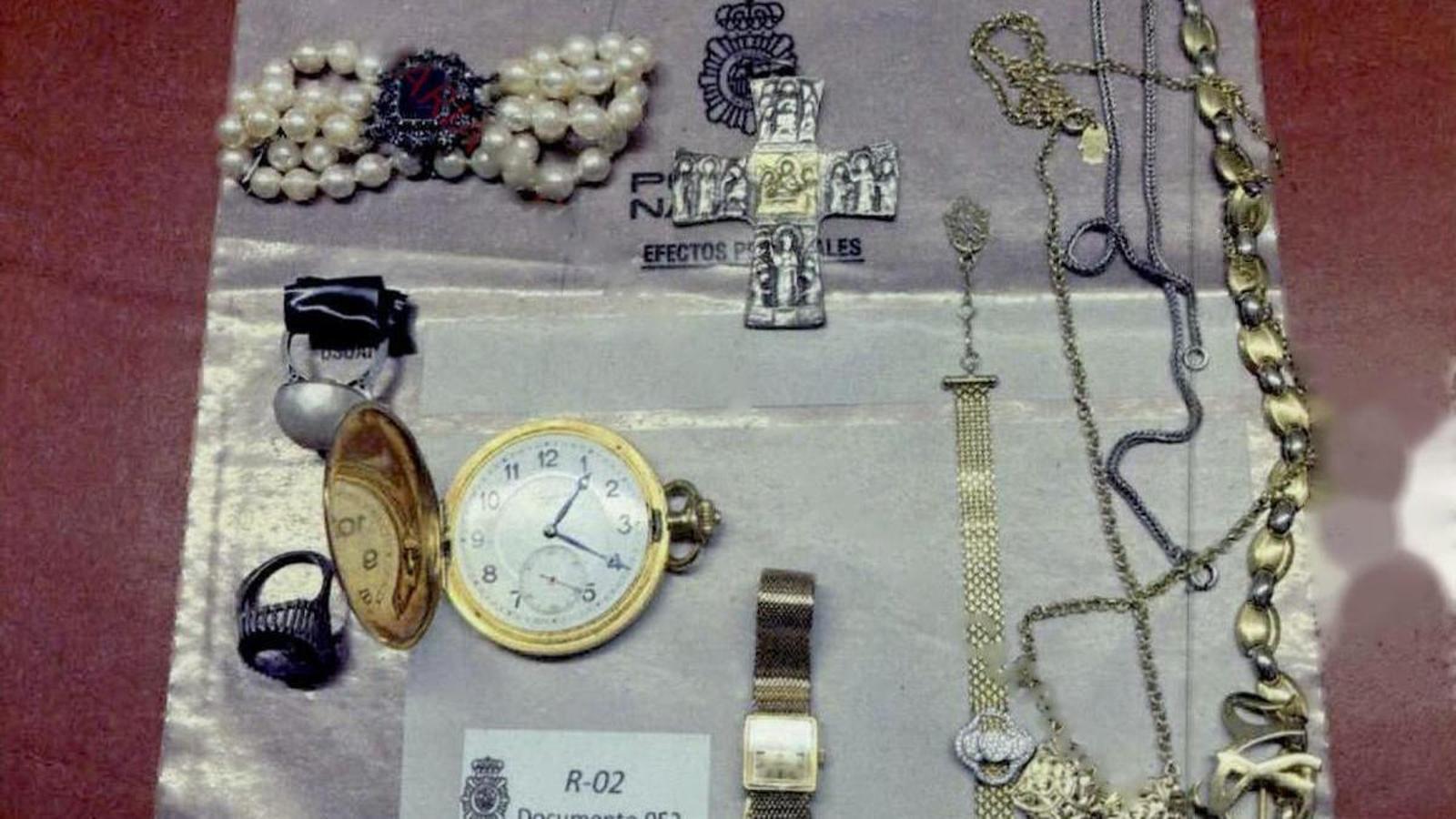
What the judge did see with good eyes was the search of the former president's office. The search report lists all the objects that were seized, including a safe with jewelry and travel gifts. Upon seeing that the agents were focusing on the safe, as the summary states, Gertrudis Alcázar herself, Zapatero's secretary, indicated to the agents that it belonged to the former president's house and that the content was, in part, from an inheritance of the wife of the former leader of the PSOE, Sonsoles Espinosa. From here, the report lists the seized jewelry: a silver necklace with thirteen blue stones, another with two green stones, and a bracelet with two red stones, as well as various earrings and watches that the police meticulously describe in the summary. In fact, they attach photographs, as can be seen below.

Besides the jewelry, the police also took folders that corresponded to different companies for which Zapatero would have made some management: Chinalink Asia, Análisis Relevante (the company in Julio Martínez Martínez's sights), ICD Instituto Diplomacia Cultural, Ernst and Young, Kreab, Almatech, Editorial Planeta and Thinking Heads, which according to the UDEF report paid for services to the corporate network under judicial scrutiny. At the same time, the police have kept several diaries of the former president, in addition to Gertrudis Alcázar's mobile phone, both personal and work.
The summary also includes the search warrant for the home of Julio Martínez Martínez, a personal friend of Zapatero and the epicenter of the case. According to Europa Press, officers found \u200 86,070 euros in bags, furniture from his home, and toiletry bags. Specifically, the police found \u200 10,000 euros in a golf bag, \u200 30,000 in a paper bag, and \u200 50,000 inside a radiator.
Following the searches, the judge investigating the case has signed an order requesting the police to access all emails of the former president and his daughters from the last five years. In parallel, information is also requested from SEPI's email regarding the Plus Ultra rescue.
The reaction of Zapatero and Sánchez
The former Spanish president has reacted to all the information through a spokesperson, Luis Arroyo, president of the Ateneo de Madrid and who already worked with him when he was at La Moncloa. He pointed out in an interview on TVE that it is all "crazy conjectures", and also added that Zapatero is "eager" to defend himself on June 2nd at the Audiencia Nacional. According to him, these accusations are due to the "political context" and to having defended Pedro Sánchez's government during the electoral campaign. In fact, the current leader of the PSOE said this Monday, when asked if he was calm despite the information about the Plus Ultra case: "Yes, of course".
