Harvard students corner Sánchez with questions about corruption, his family and Pegasus
The Spanish president was offering a lecture at the university about the need to act against the technoligarchs
-
CAT -
CAST
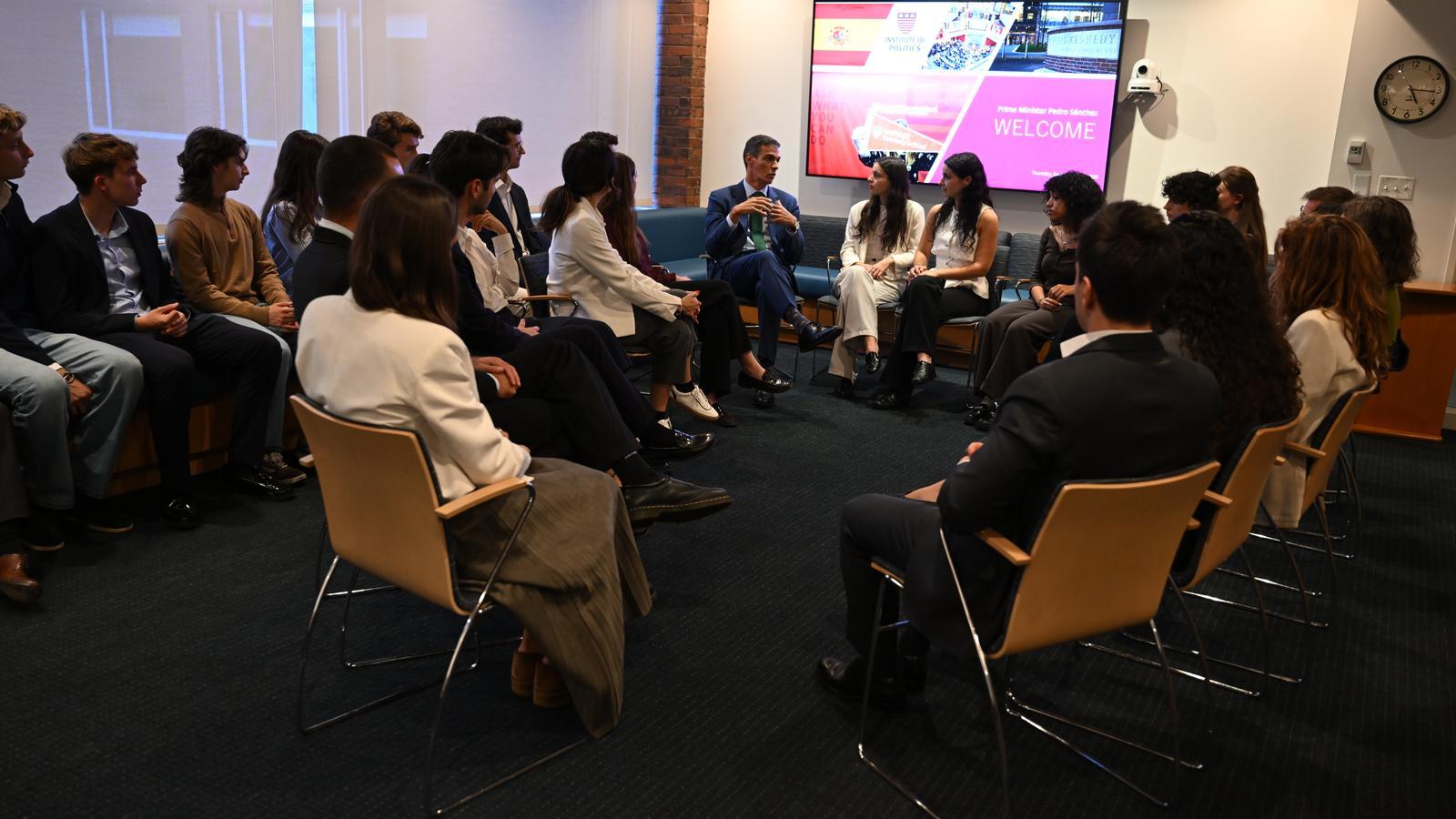
BarcelonaPedro Sánchez's plan to establish himself as one of the beacons of global progressivism during his trip to the United States –during which he confronted Donald Trump and joined forces with New York City Council member Zohran Mamdani– stumbled at his last scheduled event, at Harvard. The Spanish Prime Minister starred early this morning (Catalan time) in a lecture on the need to act against techno-oligarchs, but the students who attended wanted to corner him with questions about the judicial cases involving the PSOE and its circle, the Pegasus scandal, or his government's position regarding Western Sahara and Venezuela.
The casual tone of the head of the executive, who urged people not to believe ("no freaking way", he said in English) the owners of social networks and large artificial intelligence platforms, did not find all the complicity he was looking for among the students of the prestigious University of Massachusetts. After some questions on the subject, he had to face others on uncomfortable topics that, until now, he had not had to address in his official agenda in the United States, marked by the UN General Assembly.
When he was questioned about the cases involving his wife, Begoña Gómez, and his brother, David Sánchez, the Prime Minister claimed that "these are not cases of corruption or scandals." "The opposition and some far-right associations have crossed certain red lines that lead me to reflect," he said, as reported by the Efe agency. And he limited these cases to "personal attacks" against him. "And it is much more difficult because a young student like you already condemns them, because you say that my brother and my wife are guilty, and that is not fair because they are not," he told one of his interlocutors.

In the midst of the crisis in Ceuta, another student questioned him about the espionage of his mobile phone –and those of several ministers– with the Pegasus program, regarding the possibility that Morocco was behind it, and the relationship of the scandal with Spain's change of position on Western Sahara and the defense of Rabat in the crisis in Ceuta. Sánchez recalled that the authorship of the espionage could not be proven and regretted having to defend himself against fake news. He also claimed the independence of his political decisions regarding other countries and, regarding the position on the Sahara, he said that he defends the UN resolution that there be an autonomous region within Morocco.
Likewise on the international level, but again in relation to the cases that splash the PSOE, another of the questions that Sánchez received concerned the position of his government regarding Venezuela and the ties of that country with former president José Luis Rodríguez Zapatero, investigated in the Plus Ultra case. Faced with this, he assured that Spain did not recognize the electoral results of Nicolás Maduro and that it always advocates for free elections, but he refrained from talking about Zapatero.
"The times of gods and feudal lords are over"
Before submitting to this questioning, Sánchez called on students to fight against the pretensions of the techno-oligarchs and pointed to Spain as a "laboratory" of measures to confront them. Under the title "The threat of the techno-oligarchs to democracy", the president made a staunch defense of the regulation of networks and AI and railed against the dictatorship of the algorithm, which distorts public debate and advances an agenda that only serves a few, he said. And he urged them to rebel against this situation: "No way. Not on our watch. The times of feudal lords and gods ended long ago".
