Villarejo assures that Rajoy "fooled everyone" with the espionage on Bárcenas
The retired commissioner of the Spanish police, who faces nineteen years in prison, maintains that the former Spanish president "took advantage" of the operation: "He wanted to jump on the bandwagon"

-
CAT -
CAST
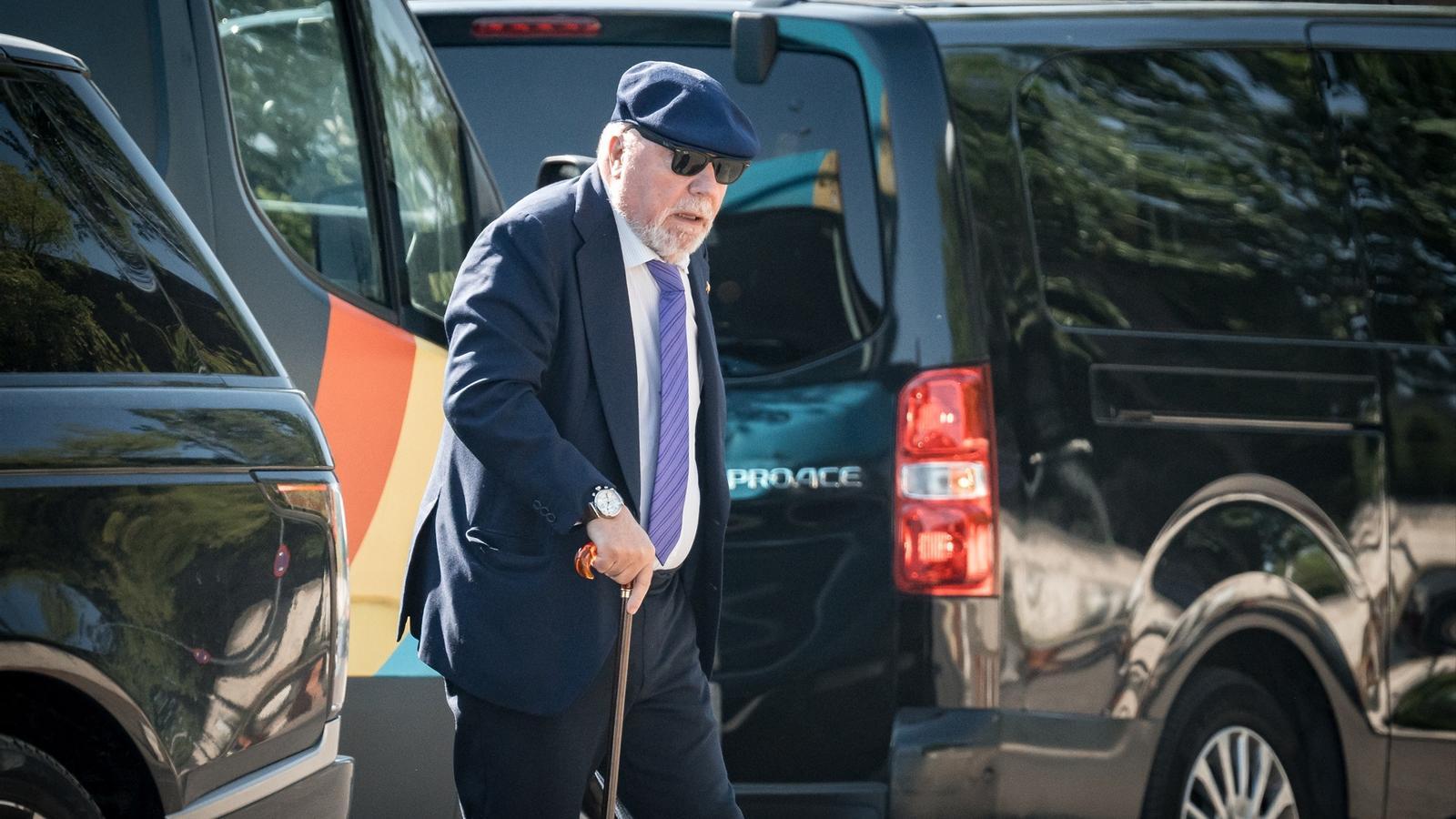
San Fernando de HenaresJosé Manuel Villarejo was the protagonist of the day in the trial of the Kitchen case. The retired commissioner of the Spanish police, who has been parading through the courts for years and is part of the patriotic police leadership, spent three uninterrupted hours answering the prosecutor's questions in a convoluted statement in which he dedicated himself to shooting right and left and put several names on the table. One of the notable ones was that of Mariano Rajoy, whom he accused of benefiting from the illegal espionage of Luis Bárcenas: "He took advantage of this official and correct operation that was to locate assets abroad in case there was anything that affected him. All those who are charged were deceived by the genius of Mr. Rajoy, who resolves everything with Cardhu [a whisky]," he said. "Possibly, he wanted to jump on the bandwagon, take advantage of the matter and 'If there's anything from my [business], I want it too,'" he added later. Previously, he assured that the former president of the Spanish government asked him "through third parties" to inform him "directly" of his activity because he "did not trust" what Minister Jorge Fernández Díaz would tell him.
The first revelation that Villarejo has made has been the origin of the concern or interest in the documentation that the former treasurer of the PP had. He has related Operation Kitchen to the "obsession" of the now-retired National Police commissioner Eugenio Pino – whom he has presented as a monarchist man – to know if Bárcenas had information about the alleged "arms trafficking" of the emeritus king Juan Carlos I with Abdul Rahman el-Assir. Just at the start, he had said that CNI officials had told him they were "very worried" because Bárcenas had "information that could affect high state instances." And he has united the three legs, showing himself convinced that in 2017 there was a meeting between Rajoy, the emeritus king, and the then director of the CNI, Félix Sanz Roldán, to pursue him: "They decided to destroy me because I was an inconvenient witness." He also assured that when Pedro Sánchez arrived at Moncloa, he received a visit in prison from emissaries of the new Ministry of Justice to speak out against the PP: "I was very comfortable doing so," he admitted.

Operation Catalonia
José Manuel Villarejo also pointed out that he met "frequently" with Francisco Martínez, who was the number two in the Ministry of the Interior, to talk about terrorism, jihadism and the "Catalonia issue", without giving further details. Furthermore, he explained –generically– that he paid collaborators and informants in Catalonia and even complained about what they still owe him: "With the Catalonia issue, I advanced a lot of money that they never returned to me".
Before him, Eugenio Pino, who was deputy operational director of the Spanish police, testified. Pino revealed that Enrique García Castaño – who had been head commissioner of the Central Unit for Operational Support (UCAO), had been collaborating with justice and was exonerated from the Kitchen case trial at the last minute due to a stroke – proposed to him some time ago that he uncover dirty laundry to get a good deal: "The Prosecutor's Office says don't give them so much trouble, that if you collaborate now by informing about the Catalonia operation, they will treat you well", Pino recalled.
Bárcenas' money
The two defendants agreed in explaining that one of the main objectives of the operation was to track Luis Bárcenas' money. Eugenio Pino justified that the operation was devised to pursue the money he supposedly had abroad and not to find documentation related to the PP's slush fund: "When there is a car waiting to go get money, obviously a service has to be set up, no matter how we arrange it. We were not looking for documents, what we were trying [to find] was the money, there were reports about the existence of other different accounts," he argued. As he explained, it was a Range Rover Evoque that was in a garage and was supposedly going to Switzerland to collect money. They learned this thanks to Sergio Ríos, the former PP treasurer's driver, who also sits on the defendants' bench because he was an informant and was paid from secret funds: "It is information that he transmits to us and I say that attention must be paid to it," he highlighted.
One last name. Eugenio Pino has also pointed directly to Ignacio Cosidó, who was Director General of the National Police. It splashes the Director of the Police with Rajoy
One last name. Eugenio Pino also pointed directly at Ignacio Cosidó, who was the Director General of the National Police. When he declared as a witness, he said he had no "knowledge" of the Kitchen case, but Pino explained that it was he who proposed that the operation on Bárcenas and his family be led by José Manuel Villarejo instead of the Internal Affairs Unit. And the retired commissioner agreed: "Cosidó summoned me to his office and told me that the DAO would give me a series of instructions on a matter of very important interest," he recalled.
