Catalonia is preparing to be the resistance to a Spanish government of PP and Vox
The president of the Generalitat shows his most progressive and Catalanist face, and claims himself as the opposite pole to the right and extreme right

-
CAT -
CAST
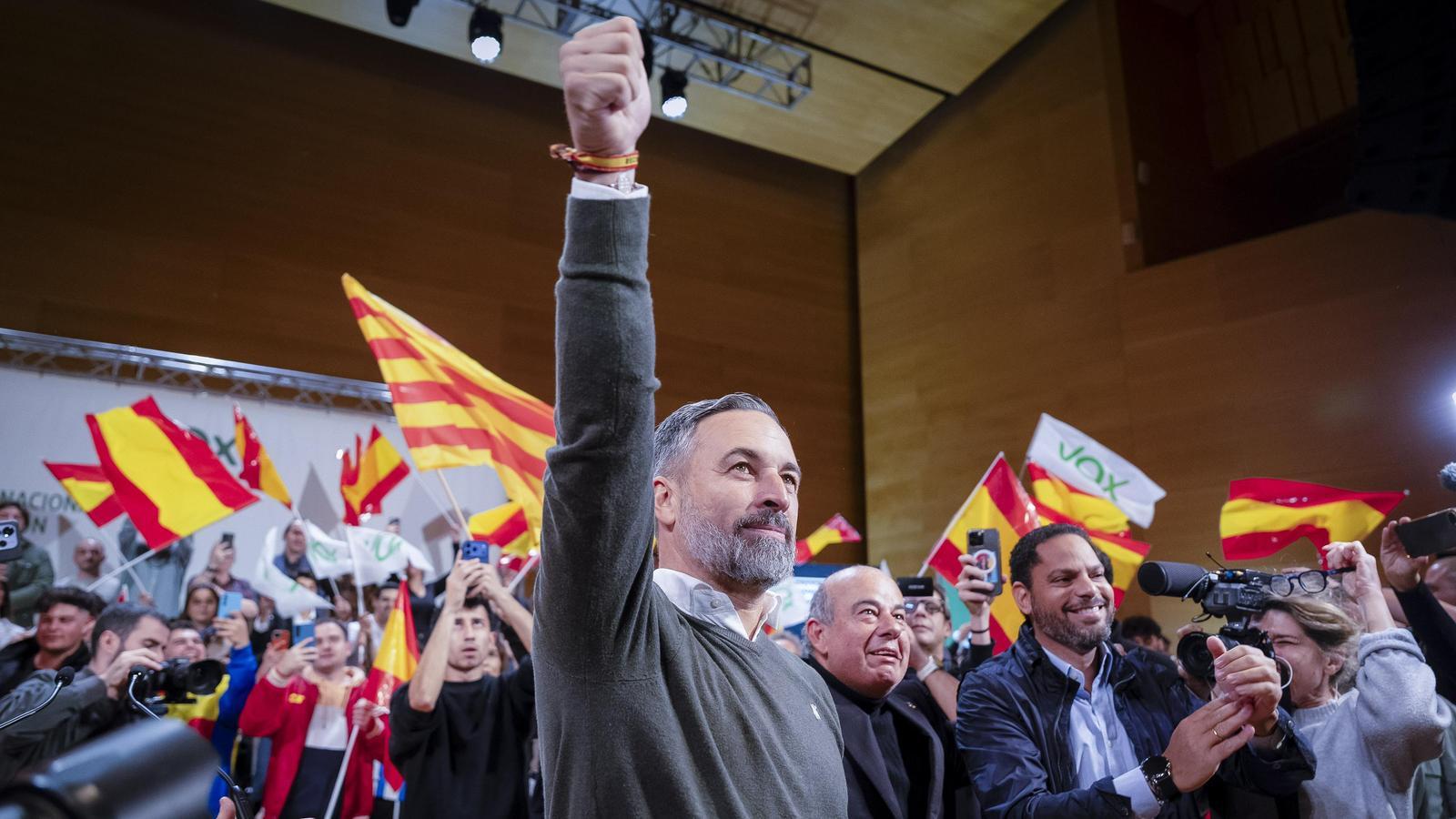
BarcelonaSalvador Illa wants to claim the rejection that the far-right generates among a majority of Catalans, and especially the arrival of a Spanish government formed by the PP and Vox. During the election campaign he is intensifying warnings of the “danger” that an executive led by Alberto Núñez Feijóo and Santiago Abascal could pose, and he is already positioning himself as the counter-power to this project for Spain from the presidency of the Generalitat. With this intention, the PSC secretary-general is showing his most progressive and pro-Catalan face. But he is not the only one. Most Catalan political forces are already preparing for a Moncloa tinged with blue and green, and they are already warning that they will stand firm to protect Catalonia's autonomy and the Catalan language.
This is not a new strategy for Illa. The president of the Generalitat has long been exploiting it with the president of the Community of Madrid, Isabel Díaz Ayuso, and he always contrasts the model of Catalan socialism with that of the conservatives from the Spanish capital. In this case, he focuses above all on social and economic issues. As in this election campaign, the leader of the PSC defends above all the need to pay taxes to fund health, public education, and care for the elderly.
Although in the past the socialist ranks had been reluctant, Illa also compares himself with the fact that he intends to intervene in housing, whereas the right—including Ayuso—opts for deregulation and the free market in this sector. In this sense, the president of the Generalitat often boasts of measures such as the rent cap in tense zones, subsidies to facilitate access to housing, and the expansion of the public housing stock. The leader of the Catalan socialists has even hardened his tone against employers' associations and vulture funds, which he now calls the people of “big money” who “always want more and more, and never have enough”.
With the potential Spanish government formed by the PP and Vox, the president of the Generalitat now adds the Catalanist component to it. Although Illa was one of the PSC's harshest voices against the 'Procés' and, for example, defended that Article 155 should have been applied earlier against Catalonia; he now presents himself as a firm defender of self-government and the Catalan language. Thus, in various interviews and campaign events, the PSC leader assures that he will not allow 'touching' fundamental elements of Catalonia's autonomy, such as the linguistic immersion model in schools or our public media. Furthermore, Illa advocates for having 'more capacity and action for self-government', something he only sees possible with another Spanish government led by Pedro Sánchez.
The Catalan resistance
This positioning can not only be electorally profitable for Illa, but it is also what represents the parliamentary majority of Catalonia. The PSC, although it governs in a minority, depends on two parliamentary allies that, in national and socioeconomic terms, push it towards government action that is more favorable to self-government and progressive, and, therefore, even further from the project of the PP and Vox. In fact, the republican candidate for the 29-N, Gabriel Rufián, advocated this Tuesday for a “concentration government” in the face of a potential Spanish executive of the PP and Vox, formed by his party, the PSC, Comuns, and the CUP. Mind you, Rufián intends for this alliance to be led by Esquerra, even though the PSC is currently the party with the most representation in Parliament. Furthermore, the president of ERC, Oriol Junqueras, has avoided backing this proposal.
The republican candidate also bets on Esquerra not looking to Junts when forging pacts and focusing on progressive forces. Even so, and despite the fact that in economic matters they coincide more with the positions of the Spanish right, the Juntaires are also very critical of the PP and Vox, especially on national issues. The Juntaire candidate, Miriam Nogueras, has already warned that she intends to “stand firm” against a Spanish executive of the “most rancid right” and that “threatens the freedom” of Catalans. In this sense, Nogueras has proposed that all Catalan parties commit to always speaking in Catalan in Congress, something that also seeks to portray deputies who often intervene there in Spanish, such as Rufián. “Whoever wants to prohibit our language will have the Catalan candidates in front of them,” warned the head of the list for Junts.
Making a virtue of necessity
Illa contrasts himself with a potential Spanish government formed by PP and Vox to mobilize the vote in Catalonia in favor of Sánchez and, therefore, prevent the extreme right from reaching power. This is, of course, the goal of the PSC and the PSOE during the campaign with this narrative. However, various socialist sources admit that an executive formed by Feijóo and Abascal could strengthen the profile of the President of the Generalitat and head of a progressive government as their main opponent. “It is an undesirable situation, but it is true that people would see to what extent the president is willing to defend self-government,” points out a prominent voice from the PSC.
Another message that socialist leaders emphasize the most is that of the useful vote. That is to say, in their view, concentrating the votes from the center and progressive space, and from a moderate Catalanism, in the PSC. Sources from the socialist ranks point out that they would be better positioned to establish themselves as the main leadership to embody the defense of increasing funding for Catalonia, self-government, the Catalan language, and the progressive measures that come out of the Parliament. Furthermore, it could weaken part of the narrative of parties like Junts, Esquerra, and Comuns, which can now more easily reproach them for not carrying out certain measures that depend on a Spanish government led by the PSOE. With the PP and Vox in power, the President of the Generalitat could also join these demands and, even, have more projection at the state level as an antagonist to the measures of a right-wing and extreme right-wing government.
In fact, the President of the Generalitat often repeats the idea that he wants a Catalonia that plays a role as a progressive vanguard for the rest of the State, especially on social issues. This is another of the narratives that can gain strength with a Spanish government of the PP and Vox, and also in comparison to the rest of the world if the rise of the extreme right on an international scale is taken into account. In this sense, one of the main campaign posters of the Catalan socialists not only shows the faces of Feijóo and Abascal, but also those of Vladimir Putin, Benjamin Netanyahu, Donald Trump, and Javier Milei. And it reads: If you don't go, they rule. Beyond the primary objective of activating the vote of the citizens of Catalonia, it also sends the message that the opposition to all these leaders is embodied by Sánchez's PSOE and intends to contribute to the construction of an image of Illa as a counter-power to the extreme right.
