Amnesty International denounces "inaction" of the Prosecutor's Office in the Pegasus case
The organization publishes a report in which it accuses the public prosecutor's office of "obstructing" investigations

-
CAT -
CAST
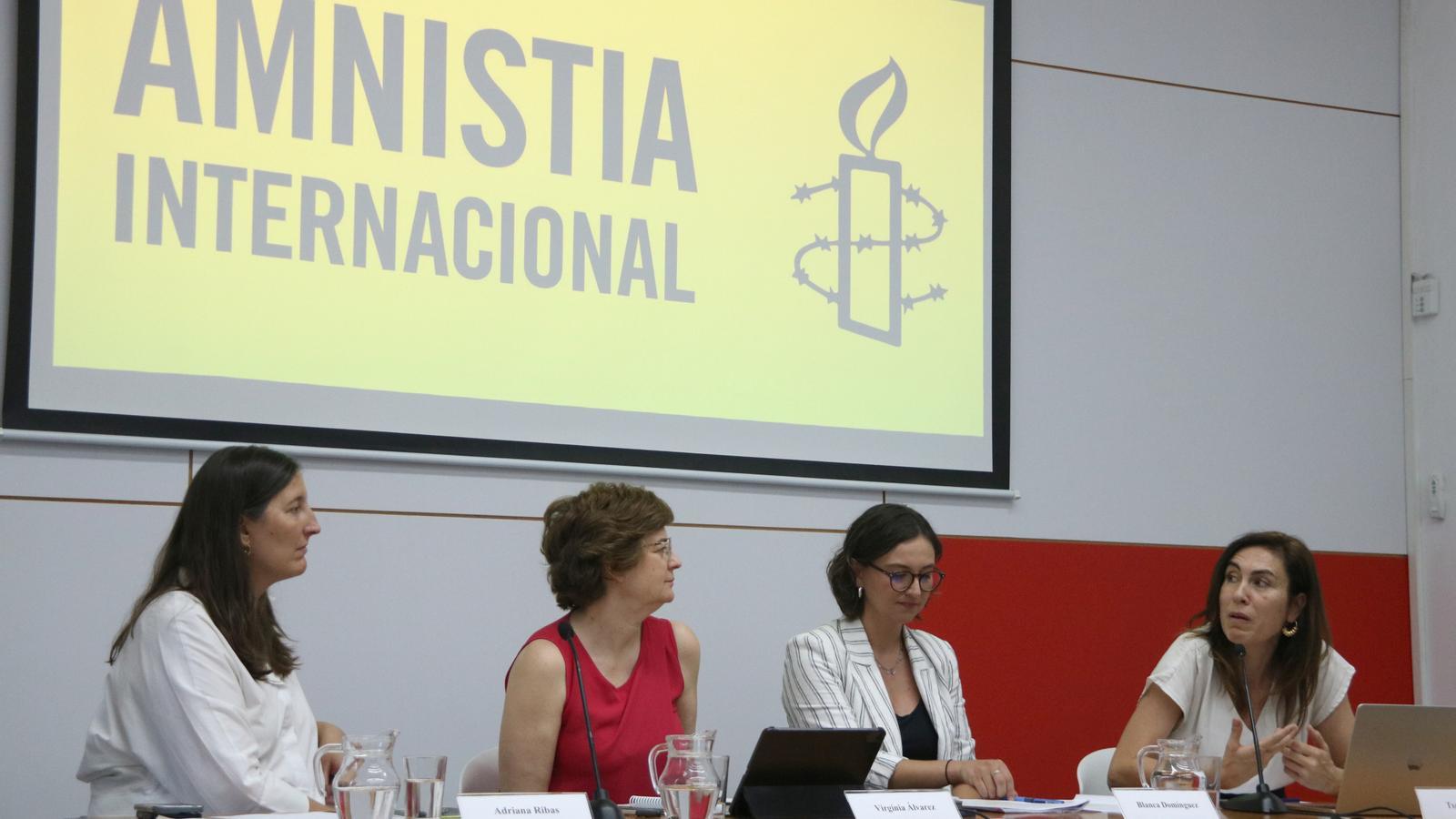
BarcelonaThe Prosecutor's Office is "obstructing" the judicial investigations opened into the Pegasus espionage of several Catalan pro-independence leaders. This is the conclusion reached by Amnesty International after studying the public ministry's actions in the ten ongoing judicial cases. Specifically, the organization denounces that the Prosecutor's Office has been hindering these investigations for six years. "The public ministry should support the victims, it has a vital role in protecting their rights," said Virginia Álvarez, head of investigation and domestic policy at Amnesty International in Spain.
The Pegasus espionage, which occurred between 2017 and 2022, affected pro-independence leaders such as former Catalan President Pere Aragonès, or the former Speaker of Parliament Roger Torrent. Activists and journalists such as Txell Bonet, partner of former Omnium President Jordi Cuixart, who participated in the presentation of the report that Amnesty International released this Thursday morning at the College of Journalists, also fell victim. "The Prosecutor's Office should be a guarantor for the victims, it is neglecting its duty. It has an obligation to act with independence and a commitment to truth. But it resists and protects power. We ask it to stop acting as a brake," denounced Bonet.
The organization denounces the Prosecutor's Office's "inaction": its actions are leading to "obstruction" of investigations and also to the "re-victimization" of victims, they point out in the report. How did they ascertain this? Firstly, they consider that there have been "delays" in the different stages of the proceedings. They denounce "obstacles" in the admission of complaints for processing, "opposition" to the investigations requested by the accusers, or to the testimony of certain witnesses. They also criticize that the public ministry has questioned whether the state courts are competent to investigate this case and that it has been reluctant to allow the Generalitat, the Parliament, or the Barcelona City Council to join the cases. Furthermore, they state that the Prosecutor's Office has not asked any questions to "delve deeper" into the "damages" that the victims may have suffered as a result of this espionage.
The organization believes this produces a "revictimization" of those affected, also due to the fact that they have been required to hand over their mobile devices to the police for forensic testing, stated Domínguez, a legal consultant who has analyzed the open cases. "The public prosecutor's office must radically change its role in proceedings, siding with the victims and abandoning the role of defender of the State and, at times, of the Israeli company NSO itself," the organization points out in its report. In this regard, they ask that the public prosecutor's office support "all necessary diligence" to clarify the facts. "The institutional violence I have suffered has been these fundamental rights violated," denounced Bonet.
Therefore, Amnesty demands that the Public Prosecutor's Office "promote" an investigation to "ascertain" how this Pegasus espionage occurred and the possible "human rights violations," and also that it be "proactive" in requesting diligence to clarify how the CNI and NSO, the Israeli company that created the software of Pegasus, acted.
The official secrets act
Amnesty International also denounces that the Official Secrets Act – which dates from 1968 and is still pending – leads to classified information not being able to be declassified as secret, and in this regard, they call for the reform of this regulation to end this "secrecy." Furthermore, they also demand that the Spanish authorities "suspend" the use and sale of mass surveillance instruments and "collaborate" with the investigations opened by the Pega Committee and the Council of Europe.
