A plastic gorilla, a naturalized squirrel, a coconut crab, a giant clam...
The Geological Museum of the Seminary of Barcelona was born so that students of seminaries and religious schools could study nature with authentic elements

-
CAT -
CAST
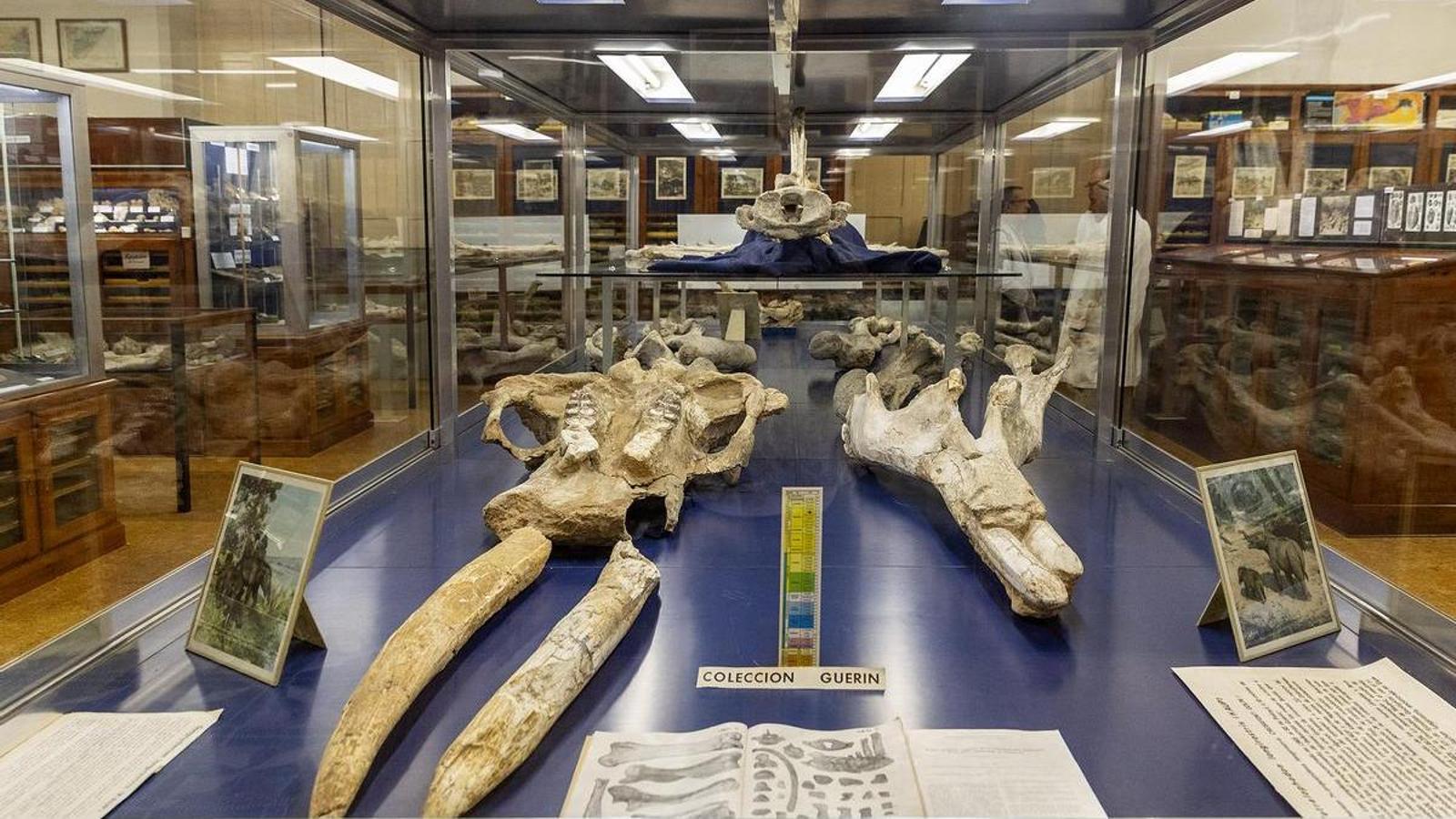
Today I'm talking about the Geological Museum of the Barcelona Seminary, a treasure located in the center of Barcelona. It is little known. I myself was unaware of it. And this is despite having visited a lot of museum centers in the country. In some texts you will read that it was born in 1874. No, that is not correct. Its seed was sown much earlier: in 1818. It was an initiative of Bishop Fèlix Torres Amat, who wanted the natural sciences taught in seminaries and religious schools to be explained with plants, animals, fossils... That first center had an original title: Museum of ancient and precious things from the same province. It was located in the Seminary building which was on the Rambla dels Estudis. It was a natural history cabinet, made up of donations from collectors and more modest contributions from students, seminarians, and missionaries. Yes, it was common here, and in other parts of Europe, for missionaries to become infatuated with some piece from the land where they preached, be it masks, fabrics, necklaces, musical instruments. And they would take it without hesitation, as if it were a free souvenir.The biologist Joan Barrull, curator of vertebrates at this museum, is in charge of managing the collection and the exhibition hall. He also offers guided tours there. Barrull has set up an interesting replica of a small natural history cabinet, made from a mishmash of pieces that have no relation to each other, as was the case in the early days of the museum. The pieces were stored in different corners of the center and were completely undocumented. Variety is one of the essential elements of any collector's cabinet, and this one is no exception. Thus, we find a plastic gorilla, a stuffed squirrel, a coconut crab, a giant clam that was used as a baptismal font... There are also glass jars with animals insidea liquid that must be formaldehyde or alcohol: a salamander, a newt, a loach, a snake... "I've tried to open the lid of these jars, but I can't; the years have hardened the screw," Joan Barrull explains to me. "Our museum started out very eclectic. Like the Darder Museum in Banyoles and many other natural history museums", he says. He uses the our because he feels it is his own: he dedicates a lot of hours and passion to it. Later, under the leadership of Father Jaume Almera – you see this is about religious figures – the museum turned towards paleontology. Almera was a great defender of experimental science. Explaining the lesson was not enough for him: it was necessary to go out into the field and collect samples. Furthermore, he created the geological map of the province of Barcelona and collected numerous fossils.Enric Aragonès, a scientific collaborator of the museum, also accompanies me, who explains to me that during the civil war some "unknown people" threw practically all the pieces out the window. During the war conflict, a marble bust of the prestigious doctor and geologist Carles de Gimbernat was also lost. Mostly the library, everything was destroyed. The religious character of the institution had something to do with it. And, of course, the museum had to start all over again.In the museum there are pieces to entertain for hours and hours. We find fossils from the Alcover and Mont-ral site, an almost complete sirenian from Montserrat, an enormous mastodon from Polinyà... and many fossils and ichnofossils (footprints left by organisms that have fossilized). The jewel of the room is a cabinet full of holotypes (unique and original specimens, which serve as a reference to name a new species).which serve as a reference to name a new species).We enter the reserve areas, where books and various curious pieces are kept. I am surprised to see a fisherman's handle in a room crowded with publications. And a whole human skeleton. Well preserved, and standing upright, inside a closet all to himself.The museum is very strict when accepting donations. Francesc Carrasco, deputy director, a specialist in sea urchins from the Eocene epoch, tells me: "If someone brings me a fossil and says 'I've never seen this!; it's not enough to accept it.' They must be paleontologists specialized in each field." And the date and place where each item was collected must be known. "Four directors have passed through," Francesc Carrasco tells me. "In so many years? That's few, right?" I say. "It's because they are lifetime positions," he replies. And he recites them like someone saying a team's lineup: "Almera, Batallé, Via, and Calzada." Now Calzada is very old and hardly comes. Will the new director be Francesc Carrasco? That is decided by the archbishop of Barcelona (after consultation)."As I leave the museum, I notice a sign that says: "Reverse box". Yes, this is a very original museum, in that regard too. At the end of the visit, depending on your degree of satisfaction, you pay what you want. The system is already quite common in plays. But I had never seen it in a museum. The sign is also in English. I didn't know it's called Honor box. It is a great honor that we have this museum in Catalonia.A building by Elies RogentTo access the Geological Museum, you must pass through some of the corridors of the building that houses the Seminary of Barcelona, the Conciliar, because it is the fruit of the Council of Trent (1545-1564), where the creation of seminaries for the training of priests was established. Today there are fewer aspiring priests than in previous years. But they are well cared for. Walking around, I see a ping-pong table. It is a good resource for spending leisure hours. The Seminary building, where the Museum of Geology has been located since the end of the 19th century, was designed by the prestigious architect Elies Rogent, author of the main building of the neighboring University of Barcelona.

