Who do the riots benefit?

-
CAT -
CAST
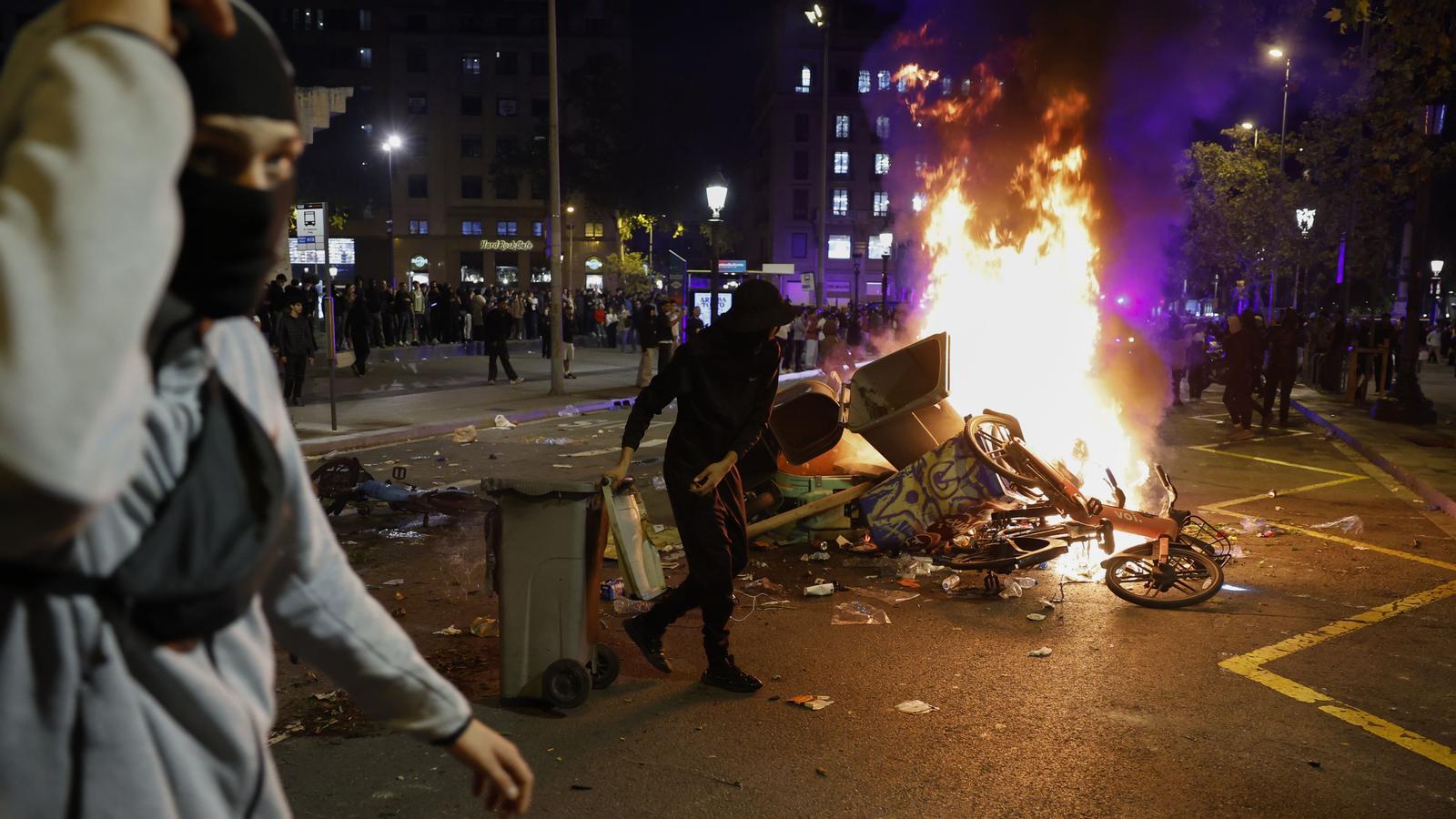
Throughout the week there had been announcements on social media of a mobilization on Saturday in the image of what was happening in France. It was not clear who was organizing it –it is still unknown–, and the call spread through TikTok and other social media and was aimed primarily at young people. In Madrid it failed, but in Barcelona more than 500 young people gathered, many of them minors, mostly boys, who barely even tried to pretend they were moved by a protest and quickly moved on to clash with the police and loot clothing or footwear shops for young people and electronics stores in a way that seemed planned. Despite the planned police deployment, it was not enough and the young people managed to loot fourteen establishments, destroy urban furniture, injure police officers and cause chaos in the city center. The result has been 128 people arrested, most of them minors, and, above all, the feeling that control has been lost.
It is hardly reassuring that the chief commissioner of the Mossos, Sílvia Catà, acknowledged yesterday that they were surprised by what happened because they did not expect such a degree of mobilization or violence. The affected merchants have complained that no one warned them and the opposition in Parliament and the city council have come out in force to criticize the management by the Government and the City Council, while both Salvador Illa and Jaume Collboni spoke of a firm hand and committed to preventing it from happening again. For the moment, it is already known that there is a similar call for next Saturday.
But beyond assessing whether or not there was an error in the forecast and the response to these riots, what everyone is asking – it is the most uncomfortable question – is why it happened and, above all, who is behind it. In the first case, for the moment all analysts seem to agree that there is a clear imitation of what is happening in France – the reasons for complaint, from the educational crisis to housing, are comparable –, but here this unrest is being channeled through encampments and assemblies of students and teachers, who have quickly come out to criticize what has happened and to ensure that they knew nothing about it. The French case, therefore, seems more like an excuse than anything else to bring out a rage that can surely be explained sociologically, but which cannot be socially accepted.
The other question, that of who is behind it, is more important. Hypotheses are emerging about whether it is the far-right or anti-system groups, but it could also be people with no political affiliation who only did it for the sake of it, for fun. It would be necessary to get to the bottom of it and truly find the origin, because it is key to being able to prevent these acts from escalating. However, there is no doubt about who benefits. And here it does seem clear that electorally it will benefit the right and the far-right, who will have arguments and ammunition to criticize the Spanish and Catalan socialist governments. We will have to be attentive to the possibility that, for electoral reasons, there may not be a reactionary authoritarian government overreaction, as has happened in France, but we will also have to ensure that in the next protests planned from now until the elections, general strike included, it is not taken advantage of to provoke more outbursts of violence.
