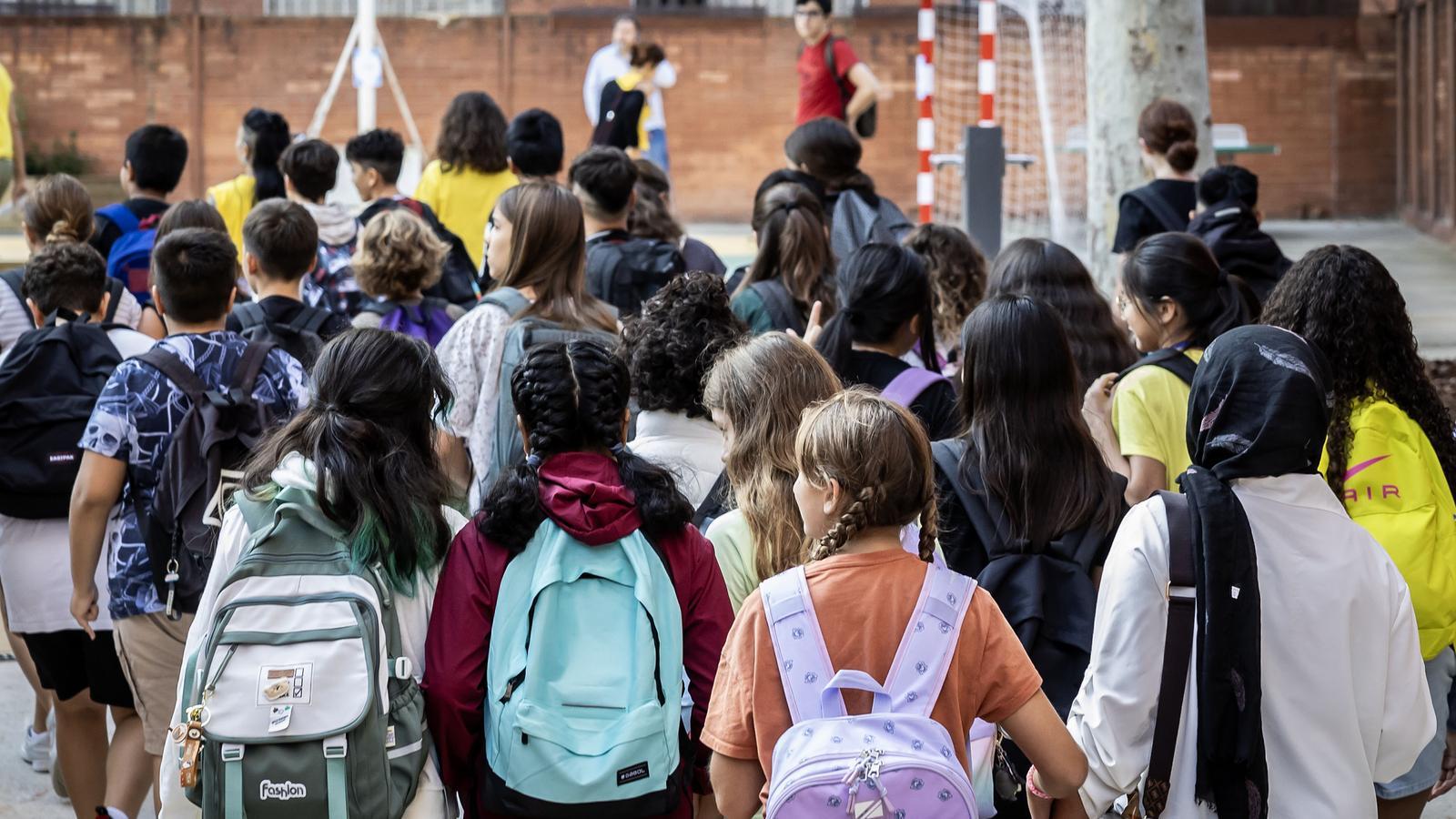

A police officer at school to complete the staff. It's just an experiment, they say. When I read it, I couldn't believe it. It seems a contradiction in terms: school as the main place for education and socialization should have basic shared values: what is happening that in an open and democratic society those in power can have a joke like this? At school you go to learn, to socialize, to enter the relational logic of society, to acquire skills to find your place in the world, to build relationships naturally, to grow up. And this requires a space of trust, recognition, and the construction of a framework for coexistence based on the development of each person's personality, which allows us to learn from the contradictions and complexity of human societies.
What is the repressive apparatus of the State doing there? Whom do they want to scare? In the degree of destabilization and bewilderment of today's world, at a time of forward flight of the great political and economic powers, certainly anything is possible. But in a time of disorientation, it is very important to preserve the fundamental impulses of freedom and democratic culture. School is a determining institution, which conditions the climate and values of a society and, therefore, the future of a country. It is in it that people advance in the process of socialization and, with a complex dialectic with the family sphere, it is there that one begins to make one's way, to build one's individuality. Children experience independence, going alone, the configuration of their own life as a gateway to the multiplication of spaces for fulfillment, that is, to socialization.
The place of learning needs space, trust, and enthusiasm. Preserving the school from the contamination of societal powers is utopian. And much depends on the social framework of each one. The very differentiation between public school and private school says a lot about all of this. And it certainly marks an idea of society built on class conflict that leads part of the hegemonic sectors to entrench themselves in private schools. In a country, moreover, where the school system has been heavily battered by ecclesiastical power, there is still much to be done. But who on earth thinks of bringing a representative of the State's repressive power onto the scene now, even if only experimentally? Before they sent priests, now they will send police?
