The left, trade unions and housing

-
CAT -
CAST
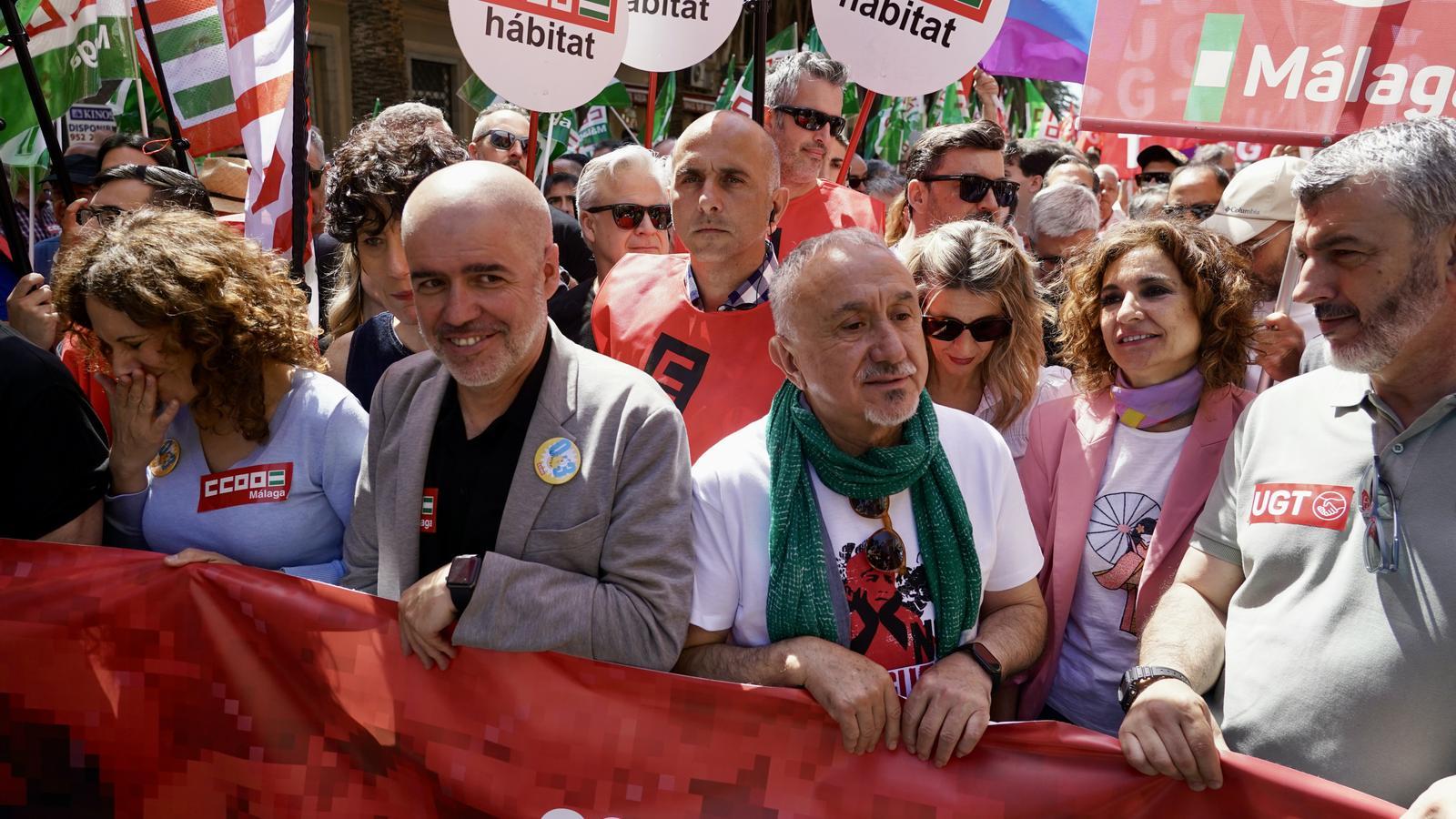
MadridThis time we have had a more representative May Day compared to some of the preceding years. In the events called for by the unions, the emotional chord was struck deeply, in mobilizations that respond to a specific political and social situation and that carry a clear message. The main celebration was held in Malaga for various reasons, starting with the fact that Andalusia votes on May 17. The call has allowed for an image of a certain unity of the left, which we already know does not exist in political terms. However, it has become clear that there are indeed essential points of coincidence, susceptible of becoming driving ideas for future initiatives, especially as the general elections approach. The fact that María Jesús Montero and Yolanda Díaz coincided at the Malaga demonstration does not reduce their differences, but it does reflect a common denominator on key issues.
It has been said that another reason for choosing Malaga is the evolution of the housing problem in this city and its surroundings. This factor has surely influenced. But one does not have to scratch much to realize that, while the left may agree in lamenting this situation, it profoundly disagrees on how to effectively find and define possible remedies. The PSOE and most of the formations that have helped it, to a greater or lesser extent, during this legislature wanted to appear alongside the unions at the main event of the day, and this joint appearance is the main issue for the upcoming elections.
What interests these organizations most is not losing spaces of power and influence. Thus, the Malaga event can be interpreted as a reaction to the movement initiated by the center-right of the political map, with the pacts between the PP and Vox to govern in Extremadura and Aragon, and with the ongoing negotiation in Castilla y León. The speeches delivered throughout Spain by union representatives consisted of a general warning to the population about the regression that could signify, in social matters, the start of a new political cycle of the same kind in the whole of Spain. Alongside this, both Pepe Álvarez (UGT) and Unai Sordo (CCOO) demanded a salary increase to cope with the rise in prices.
Aware that pacts with Vox would receive a response from the left, the PP is striving to present a counter-offensive based on an alternative reading of the social and labor situation in the country. It is worth paying close attention to their arguments, because they have been part of their discourse since the last congress of the Popular Party and will be very present in the coming months of a long electoral pre-campaign. Feijóo, this May Day, has disseminated messages that clearly aim to reach a less ideologized electorate that is very concerned about their wallets. A manifesto promoted by the PP states that "in Spain, working and making an effort must be worthwhile again." And the same popular leader, on his social networks, has said that "working must serve to live, not just to pay." It is obvious that fiscal policy and taxes will be very present in the pre-election debate in the coming months, whatever happens in Andalusia on May 17. Trade unions also need to be very attentive to this front. They have often been accused of basically looking after those who have jobs as employees, and less so for the rest – for example, the self-employed – and here too there is a large bloc of votes at stake.
In any case, the essential debate on these chapters must take place in Parliament, as much or more than on the street, and between employers and trade unions. And it is already clear with how many difficulties and the predominance of tactical maneuvering the discussion – and parliamentary votes – on the matters of this chapter takes place. The government's division regarding the housing problem, for example, is bad business for the left in general. This confrontation has gone too far and has given space to the proposal of other dissidences. With Junts there is a long-standing entrenched problem, due to the lack of full effectiveness of the amnesty law. But this situation is not the government's responsibility. On the other hand, I find it difficult to accept the idea that the expression "the three right-wings" – used to refer to the voting coincidence of the PP, Vox, and Junts – represents an accurate description of reality. It is like when Podemos accuses the Junts supporters of being racist for their claims of competencies over immigration.
Too much distance
In any case, the government must make an effort to bring positions closer with Junts, in general terms and very specifically on economic and housing matters, the control of rent prices and possible tax compensations for owners. Realism is always more useful than populist proclamations. We will not be able to solve the housing problem if it is framed as a battle between exploiters and exploited. Junts must understand, in parallel, that it will not benefit either by leaning to the right. Just as the PP will not gain much by identifying with Vox's discourse – for example, by disregarding the high probability of unconstitutionality of the "national priority" rule in access to social services –, it is also not advisable for Junts to position itself on a level that could alter the perception of its fundamental positions, whether on economic issues or on the rights of immigrants.
A final word on the role of the Parliament in this scenario. It must be reclaimed as the stage and filter for all debates. I say this because of the response that the Minister of Economy, Carlos Cuerpo, gave to the PP spokesperson, Ester Muñoz, in the last control session of Congress. He basically told her not to waste too much time with it, because he is focused on managing his department and not on issues of corruption, trials, and other matters of that nature. Everything must be discussed, especially if explanations are to be given, which is obvious. But the PP must find the right path, and not waste ammunition. Ways like Vito Quiles chasing Begoña Gómez, Pedro Sánchez's wife, through the streets are not what a democratic and liberal right-wing party should defend.
