'Gamers', useful idiots and chaos engineers
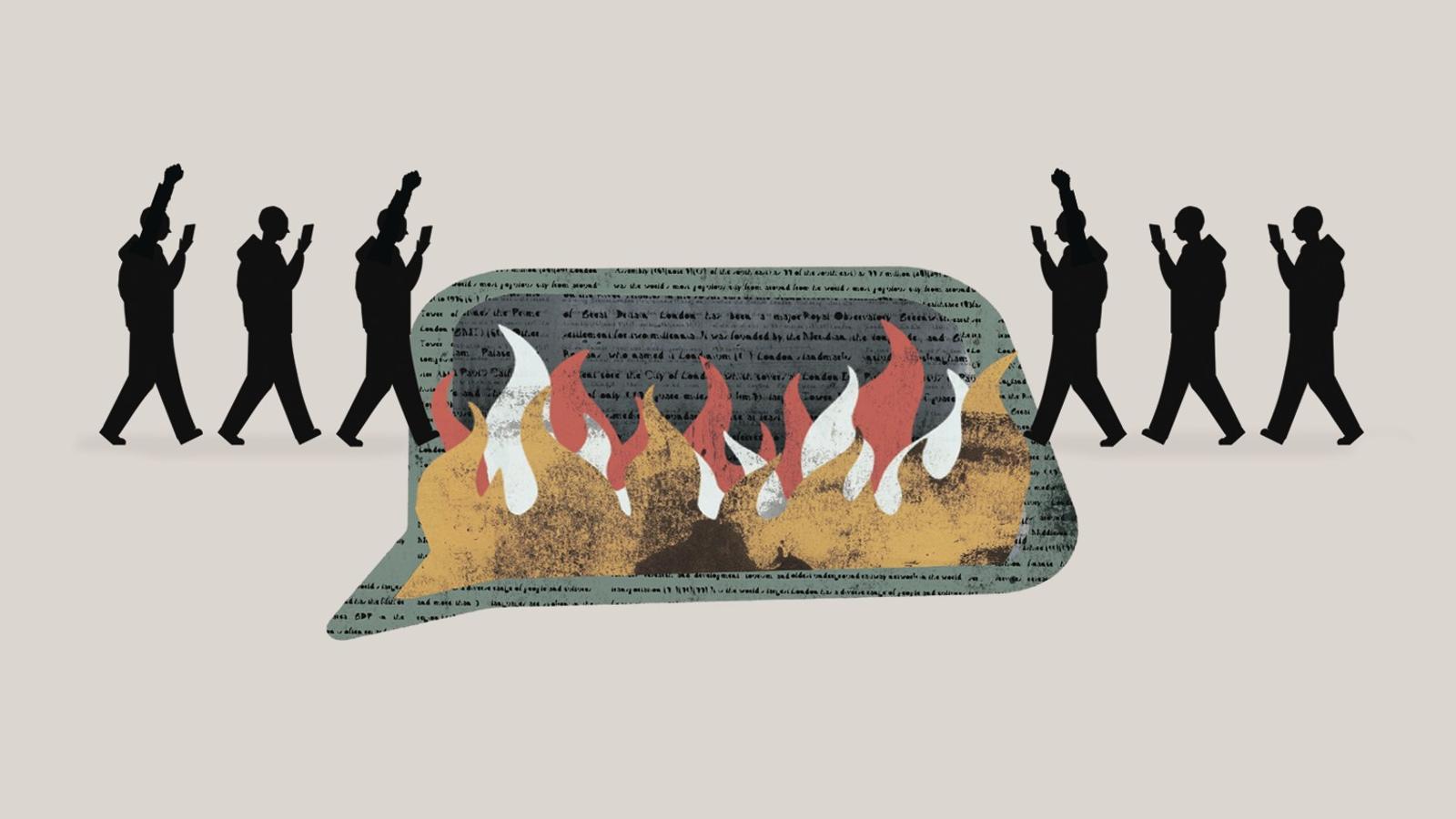

Never in history had it been so easy to organize a riot. Barcelona, the Rose of Fire, has seen it all, but never had the reason for urban uprising been a contagion of the characteristics of the riots on October 24th. A riot that was avoided yesterday with a strong police presence, but which could be reproduced at any moment. Barcelona, like other large European cities, such as Paris, Milan, and Bilbao, has experienced in recent weeks urban chaos of a new nature: fast, unashamedly violent, oriented towards looting, and carried out by very young boys. But what singularizes them most historically is that the call, through platforms and social networks, allows the naivety of many and the social frustration of some to be converted into flash mob mobilizations without the need for traditional political structures to channel discontent, anger, or to structure collective demands.
Throughout history, the exercise of politics has had diverse motivations and objectives. Whether it was Aristotle's search for the common good, Machiavelli's exercise of power, or avoiding chaos, as Hobbes proposed, by maintaining security and order; in any case, protecting freedom, creating a just society, or acting collectively and from plurality to go beyond simple administration. Now, political representation and advocacy are disappearing to give way to a chaotic substrate without a visible structure of demand. As if local politics were no longer useful for channeling an anger that is expressed by stealing sneakers, tracksuits, or what is identified as an object of luxury and status on social networks.
Contagion
The similarity of the methods does not prove a single authorship, but everywhere there has been looting there is discontent and contagion by imitation of France. There is also the crude use of AI tools that do not need to be coordinated but act with the same pattern. Among the agents of chaos, there are many young people moved by imitation who will pay dearly for emulating computer games and cinematic protests, the criminal and vital consequences of which they will see once the lust for violence has ended.
A lot of information is missing, but the thesis that can be sustained today is that Europe is observing a new way of catching urban violence in which social networks are not limited to reflecting the riots but summon, organize, and spread them. The episodes present disturbing similarities: anonymous calls, significant participation of adolescents and young people, calls for vandalism, and intensive use of TikTok, WhatsApp, and Telegram. Networks are no longer limited to explaining or amplifying what happens on the street. They can also contribute to organizing it, and the platforms do not take responsibility for it.
In some cases, open calls lead to private groups where concrete objectives are proposed, instructions are shared, and violent actions are prepared. The demands are diverse, and even contradictory. Precariousness, youth unrest, immigration, and the rejection of institutions become interchangeable arguments. The common denominator is not necessarily an ideology, but the mobilization of indignation and looting.
It is difficult not to remember The Engineers of Chaos, the essay in which Giuliano da Empoli describes how new political strategists have learned to turn social frustration into a tool of power. In this logic, indignation is a fuel that must be constantly fed, and polarization ceases to be an unwanted consequence of politics to become an instrument. Algorithms reward intense emotions, provocation, and conflict, while truth and public deliberation and serious media compete on unequal terms to capture attention.
The question is whether we are facing a phenomenon of digital contagion or a deliberate strategy of destabilization. In Italy, suspicions of possible foreign interference have entered the public debate and the investigations into the riots in Milan. But, for the moment, there is not enough public evidence to attribute these episodes to an operation coordinated from abroad, much less to point to Russia as responsible. Confusing a hypothesis with a certainty would be to paradoxically replicate one of the mechanisms of disinformation that it is intended to denounce.
However, the issue deserves special attention in a Europe that is already a target of hybrid warfare operations. The Kremlin has used propaganda, covert operations, and disinformation campaigns to project influence and exploit the divisions within European societies. Some sources (such as Newtral) suggest that, apparently, it could be an activity of Moroccan origin through "Mocro Maffia," an organization of Moroccan origin that operates internationally.
The vulnerability of democracies is rooted in the fact that it is not necessary to invent their internal conflicts: it is enough to identify them, amplify them, and contribute to turning the unrest into distrust toward institutions.
We still do not know who is behind all these calls, nor if the coincidences between cities respond to an organized coordination or exclusively to imitation. But the investigations already allow us to identify an important transformation: urban violence can be called and called off across Europe with the same speed as a digital trend. The border between legitimate protest, opportunistic vandalism, and political manipulation becomes more difficult to distinguish. And the challenge for democracies is not just to find out who lights the fire, but to understand why our societies are so easily inflammable.
