Exorcise the unforeseen
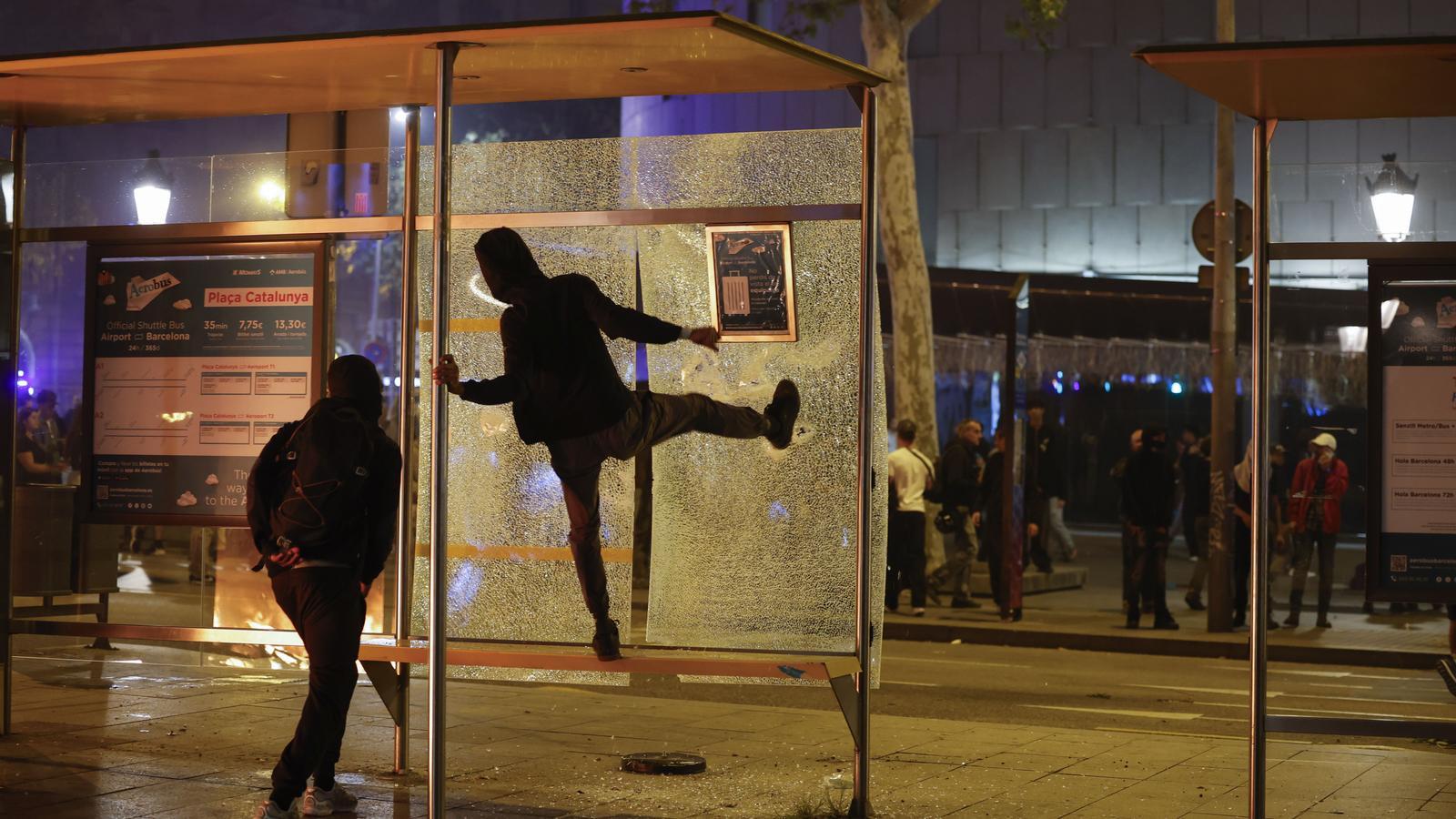

At the time of writing these lines, it is not exactly known what the nature of the riots, vandalism, and looting caused by the youth gathered last Saturday night in Barcelona was. Beyond the indisputable gravity of the damages caused, the behavior of a few has been turned into a symptom of current social unrest. Furthermore, the proximity of highly polarized elections has given them political value. However, and for the moment, we cannot go much further than observing how we exorcise the unforeseen and how we appropriate it in favor of our prejudices. Here are a few notes.
In the first place, in the face of disruptive events like those of last Saturday, that is, those that alter social routines, we have the need to see them as if they were the result of the vulnerability of normalcy itself. We want someone to tell us that “it was to be expected.” For this reason, all producers of public discourse, the media, and social networks pour themselves into manufacturing explanations by resorting to witnesses, authorities, experts, and, needless to say, pundits. Antecedents are sought, comparisons are made with similar situations, and consequences are predicted in order to, by domesticating the anomalous event, calm social anxiety.
This explains, in the second place, that exceptional social crises are presented as the expression of something deeper, whether they are or not. It is a way of quickly diluting their extraordinary character. It is about attributing the responsibility for what is inexplicable to the failure of society as a whole, as if it were the symptom of a more general illness. These are a kind of improvised generalizations that, when abused, facilitate catastrophic views that increase social distrust and which, paradoxically, can fuel reactive behaviors even more.
In the case of Saturday's events, thirdly, it is easy to discover how the illusion of control is simulated, even if it is only an illusion. On one hand, the events are described by naming them: the exceptionality begins to be controlled by knowing what to call it, classifying it, labeling it. On the other, there is speculation about who called for it, how and to whom the message reached, and why the participants followed the order received. And, of course, how it is that those who had the mission to prevent them, the government and the police, did not know how to stop them.
The pre-election climate, in fourth place, has led different political actors to attribute a meaning to the looting based on their interests. Whether the far right is behind it, whether they are the usual suspects of the far left, whether Sánchez's government is setting the streets on fire for its own benefit, whether we already know where they come from or whose children they are, whether it is clear who benefits... It is about bringing the water of the uproar to one's own mill of the supposed capacity to solve its causes. In politics, as with the pig, everything is used.
The fifth point is for the topical generalizing explanations I spoke about earlier. Here, social analysts are essential to give credibility to the suspicions: we are the current prophets of calamity. Thus, we can blame social media because they have not only been the instrument of dissemination, but are also the gasoline that ignited them. Or we appeal to supposed “mirror effects” of events like those in Paris. And according to everyone's ideological agenda, we articulate all kinds of speculations about the profile of those who perpetrated the pillaging based on age, sex, origin, or administrative situations. All this without yet having definitive data—if they ever give it to us—and only attending to one's own biases, whether they are to provoke more conflict or if it is, with good intentions, to avoid it.
And now we are at the last step in this attempt to domesticate the unforeseen. The time comes to exculpate the authors, the youngsters who naively gave themselves away in front of mobile phones, intoxicated by the trophies obtained in the looting. School, family, or, in broad terms, the political and economic system in which we have to “barely live” have been blamed for it. It is forgotten that it is the school, the family, and this perverse system that, for better or for worse, make these events exceptional, that the city is not a jungle, and that the docile civility that has now been altered predominates.
But, beyond exorcising reality, will we be able to know what happened and why? Maybe yes, but not yet. One thing is the symbolic control of reality, which is in a hurry, and another is unraveling it until its complexities are understood. And the latter requires data and time.
