Agreements and disagreements
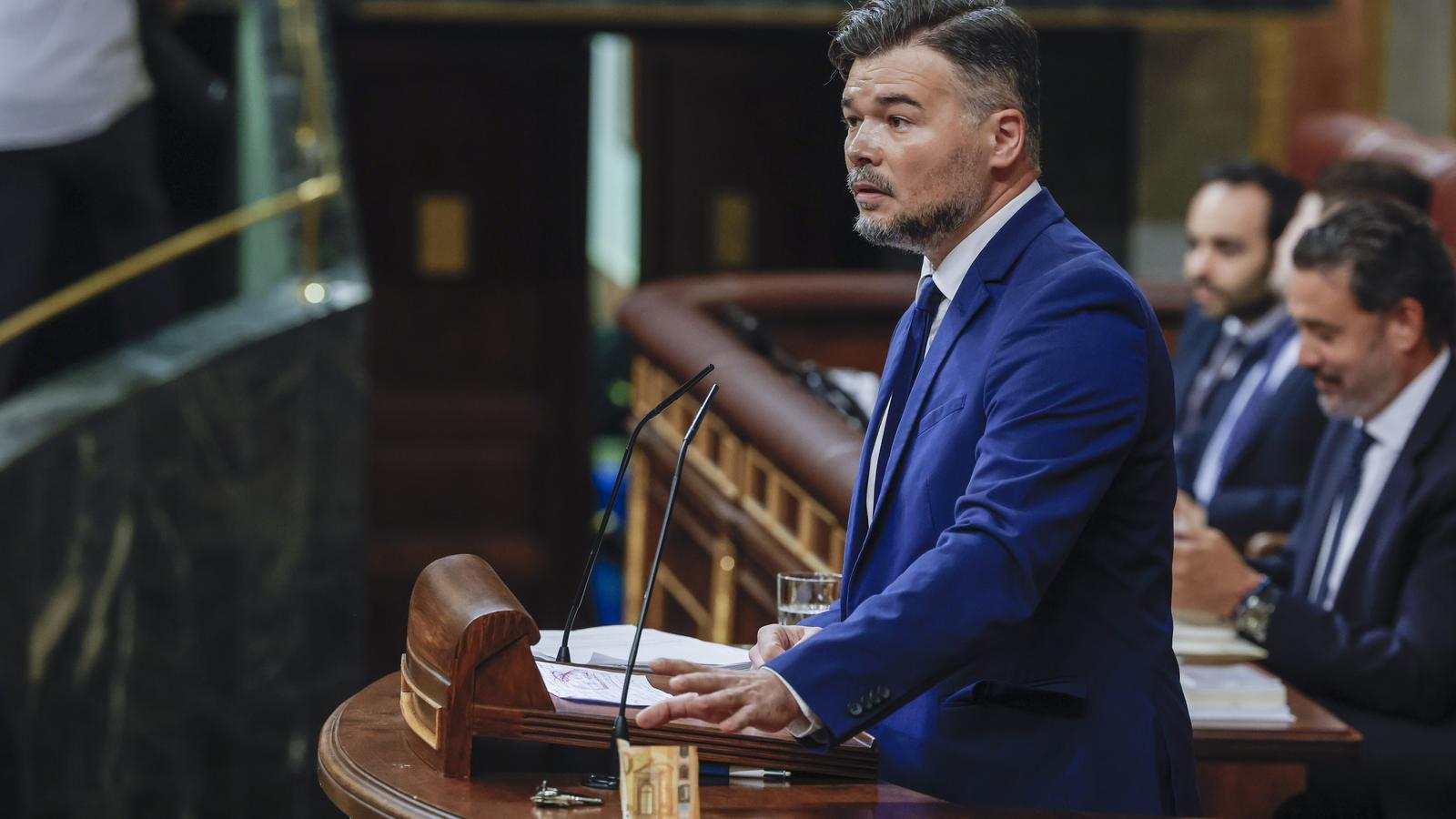

Rufián has ended up becoming a kind of half-candidate between ERC and Podemos, an idea that until not long ago might have seemed far-fetched and which now passes as a sort of compromise solution. Between now and Friday, it remains to be seen if his maneuver manages to lead the rest of the parties “to the left of the PSOE” that are looking to constitute the so-called Broad Front —Moviment Sumar, Comuns, Més Madrid and Esquerra Unida— to present a single ballot in the elections, as many of their voters and some of the parties that want to sign up for it without diluting their acronyms (as happened in 2023 with the creation of Sumar) are asking for. This is the case of Compromís, in the Valencian Country, or Més per Mallorca and Més per Menorca, in the Balearic Islands. A single ballot would be the clearest electoral message that the left could send to its voters, and for Gabriel Rufián, it would mean the validation of his thesis on the need to unite everyone who is concerned about stopping the extreme right in Spain. A frontist message and thesis, unprecedented in a candidacy for the general elections of a Catalan pro-independence party. The other thing that obviously remains to be seen is how this new configuration affects the electoral results that ERC may obtain in Catalonia. As a counterpart in the negotiations between the two parties, Podemos has renounced running in Catalonia for the benefit of ERC, but it is unlikely that the rest of the Broad Front parties with electoral aspirations in Catalonia will want to do the same.
Junts, through Míriam Nogueras, makes an announcement that is also unique, if only because at some point it will have to cease to be true: they promise not to invest what they call “a far-left government” (that is, the sum of the PSOE plus everyone mentioned in the previous paragraph, a far-left as soft, small, and furry as Juan Ramón Jiménez’s donkey Platero) nor “a far-right government” which, more accurately, would be the appropriate designation for the sum of the PP and Vox, with whom Junts has voted repeatedly throughout the last legislature on several key issues. It is a bold approach because, depending on how the correlation of forces turns out, it could lead Junts to irrelevance or to once again having the deciding votes to unblock majorities. In any case, at some point they will have to lean towards one side or the other, even if only via abstention: pretending that a Catalan party goes to the Madrid Congress only to talk about Catalonia may please the voters, but it is not what happens in reality.
The variables are many and can be combined in so many ways that predictions become more and more volatile. Another, which may seem extemporaneous but is not so much: if, as some analysts predict (such as David Remnick, in The New Yorker) in the US midterm elections a blue wave occurs that weakens Trump and could put him before a stage of political, media, and judicial suffocation, how might this affect Trump supporters and far-right populists around the world? Also the Spanish ones?
