Maria Vidal: "Women arrive at cycling from everyday life"
Illustrator and member of Maraki on bicycle
-
CAT -
CAST
Cardedeu (Vallès Oriental)Just the year of the Barcelona Olympic Games, Maria Vidal's parents decided to leave the capital and move to Cardedeu, in the Vallès Oriental. The argument to convince the children was that they could get around by bicycle. “They bought one for each of us – she recalls–. We went by bike to high school, to visit friends... We moved around without depending on anyone.” Two decades later, Cardedeu laid the groundwork for many more children, like Maria at the time, to go by bicycle: it connected the five schools with different sections of cycle lanes, so that everyone could get there by pedaling from home.
“Now those children have grown up and they get around by pedaling”, she points out. She argues that Cardedeu is an ideal place because it is flat, the distances are relatively short and cars have become accustomed to cyclists: “When you have enough volume of bikes, then you do what you want”. The cycle lanes, therefore, have created a precedent.
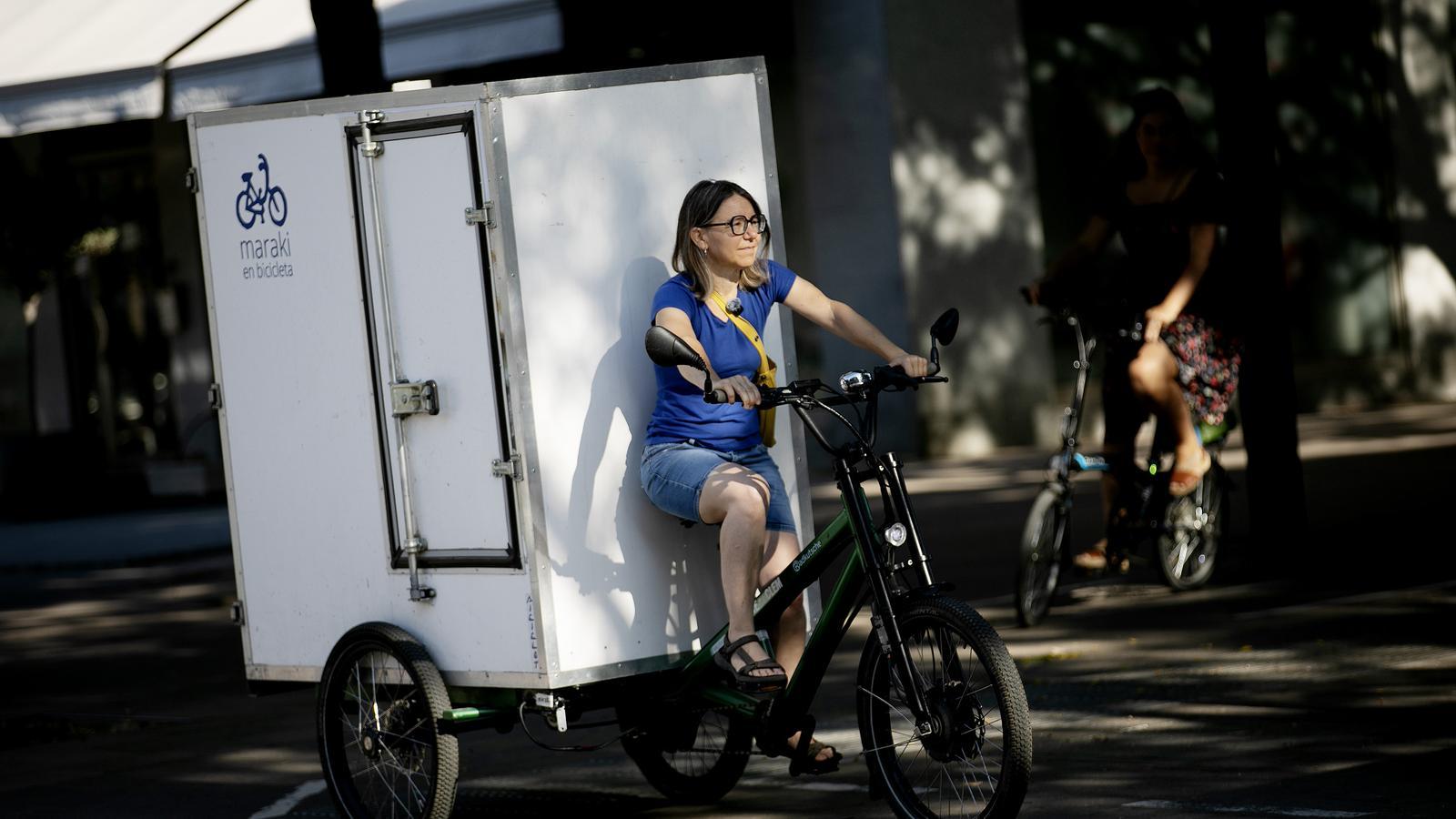
We met at a quarter to nine in the morning at the intersection where, according to Vidal, the most bikes in Cardedeu pass. It's between Llinars street and Mare de Déu del Pilar street. In one minute, more than thirty bicycles of all kinds pass, especially with children. But the one that attracts the most attention is Vidal's: a cargo tricycle on which it reads "Maraki en bicicleta". It is the cooperative she created in 2024 together with Magalí Lladó. Both illustrators promote sustainable mobility and cycling through creativity, with tailor-made workshops and training.
They are not athletes or mechanics – even though they are already capable of providing training in bicycle mechanics – but illustrators who use bikes for education, culture, and urban transformation. “We come from the creative side, and that is unusual, and it has been very fruitful,” she explains about their differential. In addition to doing cargo cycling, carrying ecological baskets and zero-kilometer products, they organize quite unique workshops: from screen-printed bags with cycling illustrations to carry on the bike, to circuits drawn on the ground and the creation of cardboard panniers for children. In the Sant Narcís neighborhood of Girona, they have inaugurated this year an illustrated square that can be explored by bicycle, scooter, or skates or painted with chalk.

Fight to pull the child with a trailer
Today Vidal brings cheeses by tricycle to La Fresca, the agroecological consumer cooperative of Cardedeu. But just a few years ago, what she always carried behind her was a trailer with her children. She was a pioneer in taking them like that around Cardedeu. She remembers that at that time the police stopped her because that way of transporting children was not foreseen in the municipal traffic code, and she managed to change the ordinance so that she and more families could do it. “We, as women, have come to cycling from everyday life, because we had children and we took them by bike. We have arrived at it in a completely different way than many other people,” she reflects.
But that experience with the trailer was not the only barrier Vidal had to dodge. With mechanics, she has also wanted to break the idea that you have to be an expert to get around by bike. At Maraki, they offer training so that women can learn to resolve small breakdowns and not depend on anyone to keep pedaling. “You don’t have to be a mechanic to ride a bike, but you can know a few things. This is a really cool thing, to claim it from here, from women,” she argues. For Vidal, learning to maintain one’s own bicycle is also a form of autonomy: “For me, the bicycle is also self-sufficiency, you can fix it, ride it, change direction; it gives you a lot of power”.
For Vidal, the bicycle is not a sporting activity or a hobby, but a tool to make daily life easier and, at the same time, to transform the places where we live. “For me, the bicycle is a tool for transforming cities,” she summarizes without wanting to sound like a cliché. Through cyclologistics, training, and educational projects, the cooperative Maraki en bicicleta works so that more people can pedal and so that the streets are more inclusive.
- Your first bike ride? My grandfather used to take me when I was very young in a small seat at the front, on the handlebars.
- What does cycling mean to you today? A tool for transforming cities, a way of making them more inclusive.
- And what does that mean? It means many things, but the one that predominates for me is freedom of movement.
- What has the bicycle taught you? Self-sufficiency. It gives you a lot of power: you can fix it, get on it, and move around as you wish.

