"I am disgusted by my imbecility": Flaubert's succulent correspondence, finally in Catalan
Club Editor begins to publish an essential anthology of the 4,000 letters that Gustave Flaubert wrote over more than 50 years

-
CAT -
CAST
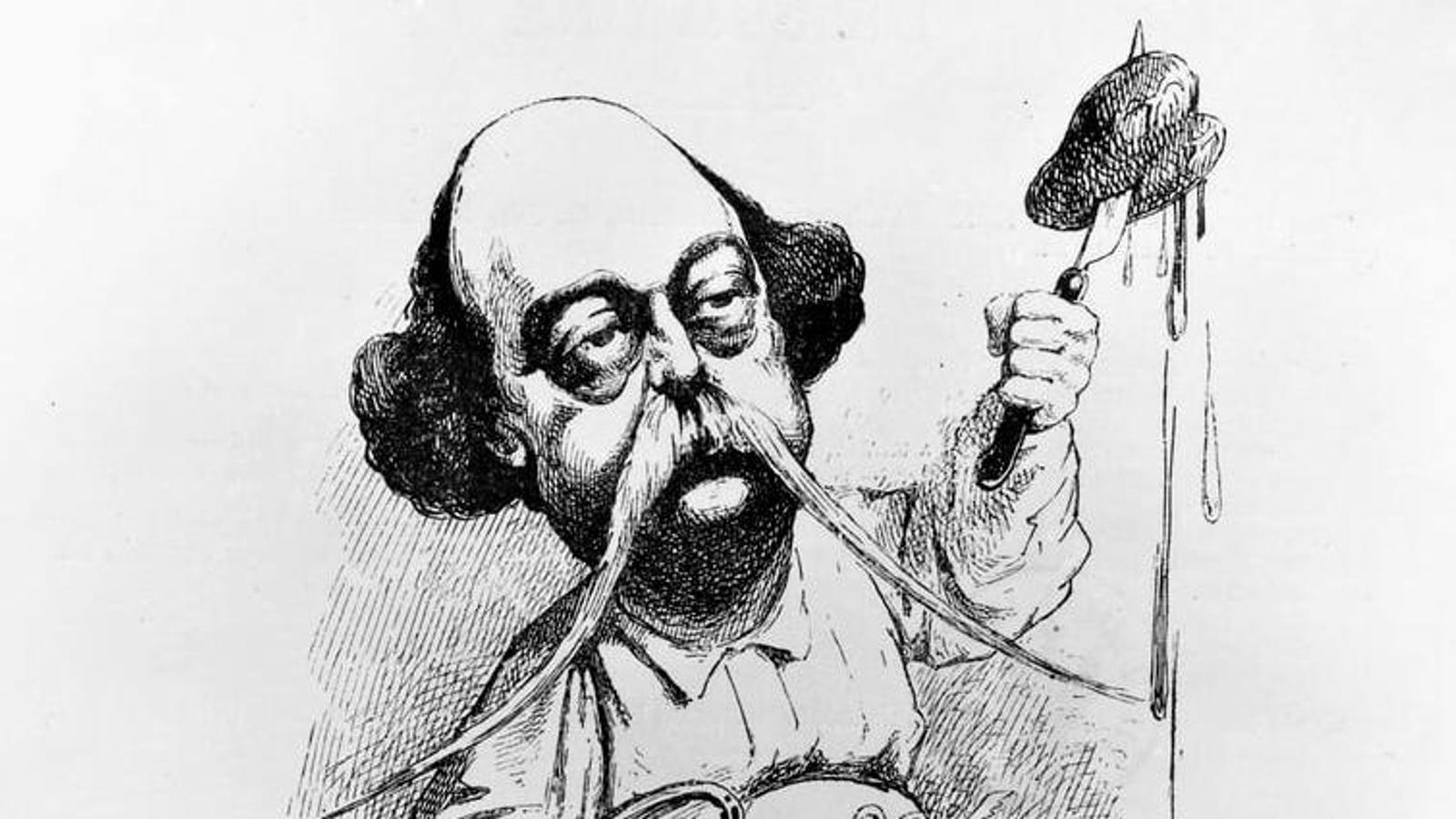
Barcelona"I don't understand how I could have separated myself from you. I am just like this! It is my lamentable nature. If you didn't love me I would die, you love me and here you have me writing to you that enough is enough. I am repulsed by my own imbecility." That is how passionate and forceful Gustave Flaubert (Rouen, 1821 - Canteleu, 1880) sounded when, at 25 years old, he communicated by letter with Louise Colet, the great love of his life. Eleven years older than the future writer, married and mother of a girl, Colet began a relationship with Flaubert that lasted for almost a decade and grew above all at a distance, thanks to the correspondence that the two authors sent each other.
Gustave Flaubert (Rouen, 1821 - Canteleu, 1880) when, at 25 years old, he communicated by letter with Louise Colet, the great love of his life. Eleven years older than the future writer, married and mother of a girl, Colet began a relationship with Flaubert that lasted for almost a decade and grew above all at a distance, thanks to the correspondence that the two authors sent each other.
Flaubert wrote the letters to Colet, who lived in Paris, from the family estate of Croisset, in Normandy, where the future author ofMadame Bovary had recently settled with his mother following the death of his father and his younger sister a few months apart. "I am like a cobblestone in the road, misfortune passes over me and treads on me without contemplation," he commented the same year, 1846, to Ernest Chevalier, one of his best friends, not long before meeting Louise Colet.
These very tempting fragments of two of the writer's letters can be read in Letters of Childhood and Youth (1829-1855), the first of the two volumes of correspondence that Gonzalo Torné is preparing for Club Editor, with the translation by Georgina Solà Sellés, and which will span the writer's entire life. "There are authors who give the best of themselves to their work and who keep diaries where they include notes, sketches, and ideas that are not at the level of their fiction. A very clear case in this sense, at least for me, is that of Franz Kafka –Torné comments–. Then there are authors like Lord Byron, in whom the work has great value, but also his correspondence, through which we can learn about his life and opinions, which do not appear in the poems. With Virginia Woolf, the literary work is very important, but her diary has an entity of its own, which allows us to verify her extraordinary intelligence." For the anthologist of the volume, Flaubert, "father of literary modernity in France," belongs to this third group.

Precision vs. richness
"There are two fundamental topics surrounding Flaubert that the correspondence clarifies –continues Torné–. The first is that he intended to transfer the strength and beauty of poems to the sentences of the novel. Flaubert was convinced that there could be no grey moments. His style is one of great precision, control and restraint, which often does not happen in these letters. Dominated by the spirit of Rabelais, he lets himself go, he exhibits an extraordinary verbal richness that can take him from the filthiest mud to the finest ideas". The second topic has to do "with the constant self-sabotage" that Flaubert practiced since the success of Madame Bovary (1857). The success and controversy that accompanied this novel meant that the writer "got involved in a series of absurd projects", among which Torné cites Salammbô (1862), set in Carthage in the 3rd century BC, and also "the historical fantasy" of The Temptation of Saint Anthony (1874). "Flaubert dreamed of writing a novel sustained by the strength of his style, but in none of his books did he achieve it", he continues.
The Club Editor project to publish the first anthology in Catalan of Flaubert's correspondence began in 2020. Torné divided into two parts the more than 4,000 letters sent to 300 correspondents between 1829, when he was only eight years old, and shortly before his death in 1880. He chose a hundred that Georgina Solà Sellés has translated. "Working with so much time allowed me to do the translation work a first time, redo it almost entirely and finally correct it thoroughly with the publisher", comments Solà, who during this process has also versioned Three Tales (1877) and the miscellaneous volume Fragments, both for Flâneur, in 2025. "In Three Tales, Flaubert put into practice a style as transparent as possible, he did not want anything to be strident or baroque –she explains–. Translating the letters I had to do the opposite exercise: Flaubert contrasts with the corsets of the bourgeoisie of the time and captures the rhythm of life in his own way. When he marvels at something, he transmits it, and also when he feels rage. Even when he writes to Louise Colet he does so without measuring the impact much".
"I am not as rude as you say"
In letters, Flaubert has no problem criticizing the lack of emotion in his monastic life at Croisset (he compares it to "a lake, stagnant water where nothing moves and nothing ever appears"), but a few days later he exhibits a burst of pride ("I am not as crude as you say, and I love something more than this precious body you have: your person"). "Behind this impressive love story there is a great complicity between the two, even if they are two artists who share very few things," explains editor Maria Bohigas shortly after returning from Paris, where she accompanied Eva Baltasar on the occasion of the Médicis Étranger prize for the French translation of Ocàs i fascinació.
"I came to Flaubert through Madame Bovary during the last stage of high school –she recalls–. It fascinated me absolutely, although it is possible that at that time I made a very literal reading of it. Later, I read Sentimental Education [1869], Bouvard and Pécuchet [1881] and the Three Tales. When, finally, I reached the correspondence, I rediscovered the magnetism of the Flaubert of Madame Bovary. While you read his letters you do not ask yourself anything, you let yourself be carried away by the extremely powerful seduction of a sensibility put into words that transports you to another reality. Little by little you get to know a character who turns out to be irresistible". For Bohigas, Flaubert "is more generous by letter than in his novels". And she adds: "Often he makes me die of laughter and tenderness. These letters make you intimate with literature in its most ambitious and vital version. They are his way of explaining that he does not want to throw his life in the trash can".

Flaubert and sex tourism
Beyond the sporadic lessons on literary creation that the author lets slip, such as "there is no worse weakness than putting one's own feelings into art" or the obsession with "the lack of order," one of the most interesting and controversial parts of this first volume of correspondence, which reaches up to 1855 –when the author had not yet debuted with Madame Bovary– is the one that captures the two-year trip to the Orient accompanied by his friend Maxime Du Camp. They leave Paris at the end of 1849 and do not return to France until June 1851, after traveling through Egypt, Nubia, Palestine, Syria, Lebanon, Constantinople, and Greece. "These are pages that abound with excess, filth, and scatology, a testimony to sex tourism and predation," opines Gonzalo Torné. "Sometimes you notice a certain tension with what he explains he does –continues Solà–. It must be remembered that these are letters he sends to his mother and his friend Louis Bouilhet".
Two examples. On June 2, 1850, he writes from Egypt: "In Qena I fucked a beautiful whore who appreciated me a lot and made signs to tell me that I had beautiful eyes. Her name was Osneh Tauileh, which means tall mare. And another dirty girl who made me touch the sky and smelled like butter". On August 20, 1850, shortly after setting foot in Jerusalem for the first time and becoming indignant because they had "succeeded in making the holy places ridiculous," he vents in Beirut with three prostitutes. "I revolted the Turkish women with my cynicism by washing my cock in front of everyone," he writes to Bouilhet before explaining to him that "the harlots drank like thieves" and giving another sordid detail: "I remember one with curly black hair who wore a jasmine stalk on her head and who I thought smelled very good (one of those smells that reach the heart) when I ejaculated inside her".
"If we wanted to edit Flaubert's letters well, we had to be politically incorrect, and for this reason, we did not want to overlook the trip to the Orient –comments Maria Bohigas–. Our present would like to erase all ideologies that are not its own. There are people who believe that by erasing some ways of thinking they will succeed in making them disappear, and that is not the case. Some of the behaviors that Flaubert and Maxime Du Camp put into practice are a reflection of the colonial fact, just as Edward Said pointed out many years later in Orientalism [1978]".
Gonzalo Torné and Georgina Solà are already working on the second volume of correspondence, which is due to be published in 2028. "The variety of correspondents will be greater, and includes such prominent authors as George Sand, Ivan Turgenev and Guy de Maupassant –Torné anticipates–. The division between the various sections will be based on the year of publication of the works and the reactions they provoke in Flaubert". While Proa has just reissued this autumn Lluís Maria Todó's translation of Madame Bovary, Viena is finalizing a new Catalan version of the novel, which should see the light of day in early 2027. A few months ago, Flâneur announced that it had the revised translation of Bouvard and Pécuchet by Jordi Llovet ready, but it has not yet put it back into circulation. Considering that Sentimental Education can be obtained in pocket format –translated by Todó in 2009–, the only ones left to recover are SalammbôandThe Temptation of Saint Anthony,which Jordi Llovet translated for Proa in 1995. The edition of this anthology of correspondence fills a significant gap in the Catalan bibliography of an author who, from the age of 30, hardly ever left his home, dedicated body and soul to his literature.
