Little fish with striped suits that swim... near the sea
We visit the park dedicated to research in biomedicine and health sciences

-
CAT -
CAST
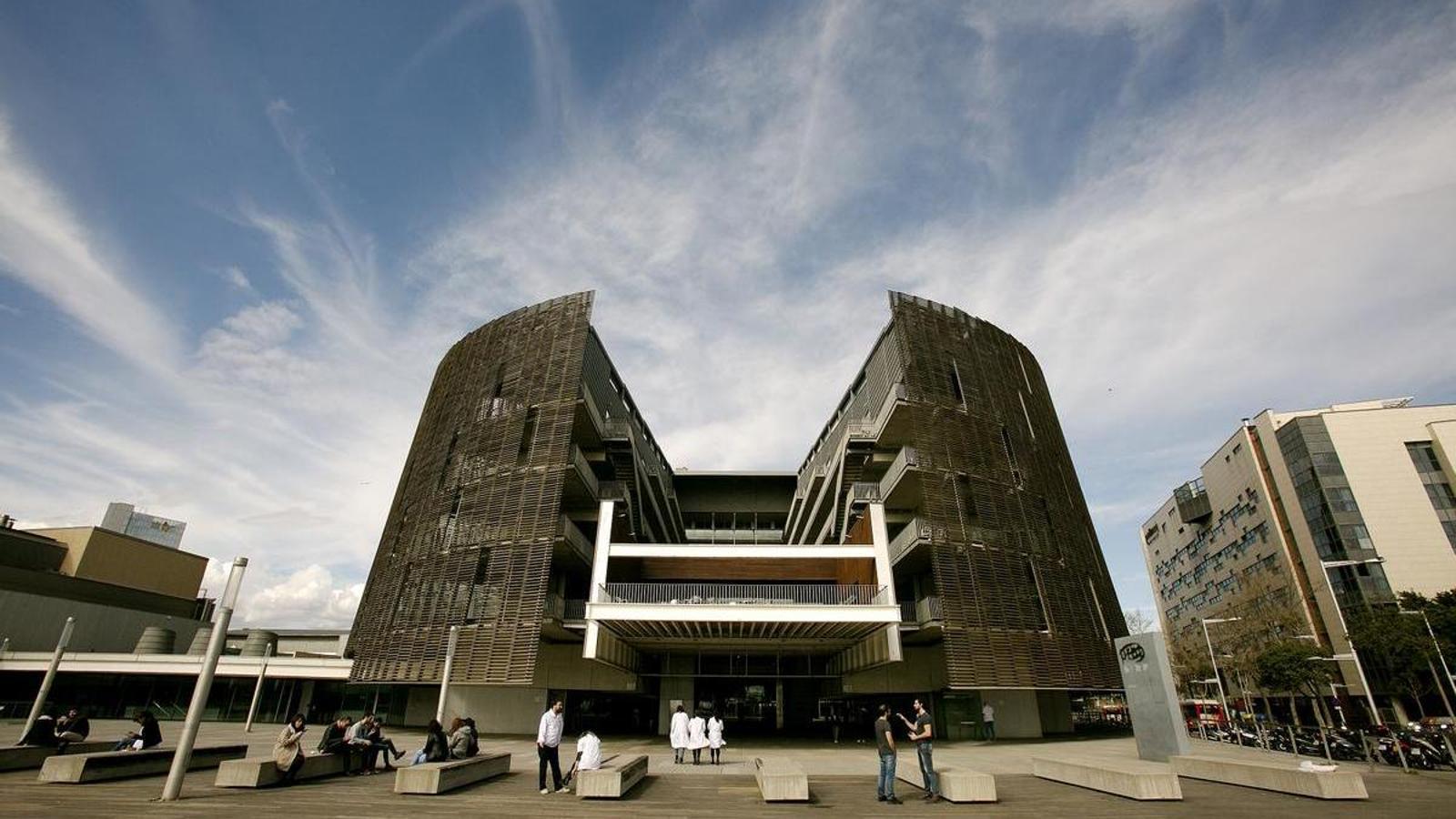
"What is it? A hotel? Offices? A convention center? A large archive?", many who walk around the Barcelona Biomedical Research Park, dedicated to research in biomedicine and health sciences, must be asking themselves. It is a building that is worth looking at. Elliptical in plan and with a sloping roof, its facade is made of wooden slats, which act as sun filters. Designed by architects Manel Brullet and Albert de Pineda, it has a large open interior courtyard that "maximizes" natural light.Gone are the days when a large part of the research in this country was carried out in prefabricated modules and basements without sunlight. It is pleasant to work here, three steps from Barceloneta beach. "It is an inspiring place to do science. Scientists really enjoy coming here," comments Reimund Fickert, Director of Communication and Institutional Relations of the Park.Every time I visit, what I see most are refrigerators and freezers. Of course, almost all samples from the experiments that are done have to be preserved. I don't doubt that if the power goes out, they have energy autonomy. Not like in my house – and in other homes – where when the power goes out, you curse having so many peas and frozen fish from a while ago. Jordi Camí, Director General of the Park, an expert in neuroscience and scientific policy, is guiding me. As we walk, Camí expresses his concern about AI. "In the world of science, AI is a real tsunami. We cannot foresee all the consequences it will have. Humans are 'bad' at making predictions," he comments. "The technological side will become increasingly important." Camí notes that the major research challenges, in almost all fields, are the ethics and regulation of AI.Meanwhile, I spot in the distance a couple paddleboarding in the sea. It's the most primitive navigation system, from before the sail. And suddenly, I return to reality, and some of the possibilities that are opening up –and are already being implemented– with AI come to mind: the analysis of medical images, which allow detecting signs of cancer, fractures..., the review of "scientific literature", the design of experiments... The paddleboarding couple has now disappeared. There are no athletes in the sea.The wave of the Olympic Games pushed the initiative for this research park, but it was not easy to get it off the ground. The project met with political reticence and took years to become a reality: it became operational in 2006.

I hear French words from a group around a microscope, like a stove in mid-winter. But French is not the most common language in this center, where researchers from a pile of countries coexist – andexchange ideas: this is one of their successes–researchers from a pile of countries. The common language is English. However, regarding foreign nationalities, the most numerous is Italian. Then, in this order, German, French, British, North American...These French researchers wear white lab coats. It is one of the most common pieces of clothing. But there are also other colors, such as navy blue. A professional wearing it, who also wears gloves and a transparent screen covering their face – like welders – delicately opens a nitrogen container, and a small white smoke emerges. Very diverse samples are kept here at minus 180 degrees Celsius.This research park has up to three underground levels. Yes, it goes quite deep underground. The animal facility is located in one of the underground spaces. I have the privilege of entering the so-called "biomodule," a temporary facility (pending the inauguration of a new aquatic area in the autumn) that is part of the animal facility. What a quantity of fish tanks there are! They tell me there are more than 1,000. I stop for a good while, mesmerized, watching them swim. They are tiny and very transparent fish. Even so, the stripes they wear can be seen well. Yes, they are known as zebrafish."During the first few days of life, zebrafish embryos are completely translucent. This allows complex biological processes to be observed with a magnifying glass in a completely non-invasive way," comments Joan Antoni Fernández Blanco, director of the fish facility."I imagine that the research done with these fish has many applications," I comment. "Yes, yes," he replies. And he gifts me with a very long list, which I don't have time to write down. I keep some of the ones he has in the field of regenerative medicine: the complex tissues of the zebrafish, including the heart or the caudal fin, regenerate without leaving scars; it's very good to study it to understand cellular restoration in humans. A very strict "monitoring" is done of what they call "critical parameters", such as pH, temperature, and water conductivity, in addition to adjusting lighting and feeding. As for diet, these striped little fish feed mainly on small crustaceans. All this makes them live without stress."Sharing infrastructure, knowledge and challengesIn the Park, six main research centers coexist: the Hospital del Mar Research Institute (HMRIB), the Department of Medicine and Life Sciences of Pompeu Fabra University (MELIS-UPF), the Centre for Genomic Regulation (CRG), the Barcelona Institute for Global Health (ISGlobal), the Institute of Evolutionary Biology (IBE-CSIC-UPF), and a branch of the European Molecular Biology Laboratory (EMBL Barcelona). It is a barrier-free space under a rental regime. This collaborative science model, based on the coexistence of independent research centers that share infrastructure, knowledge, and scientific challenges, will be replicated in the new PRBB Ciutadella building, with groups from five CERCA centers (Catalan Research Centers).

