Are you sure you don't like mathematics?
At the Museum of Mathematics of Catalonia it is forbidden not to touch

-
CAT -
CAST
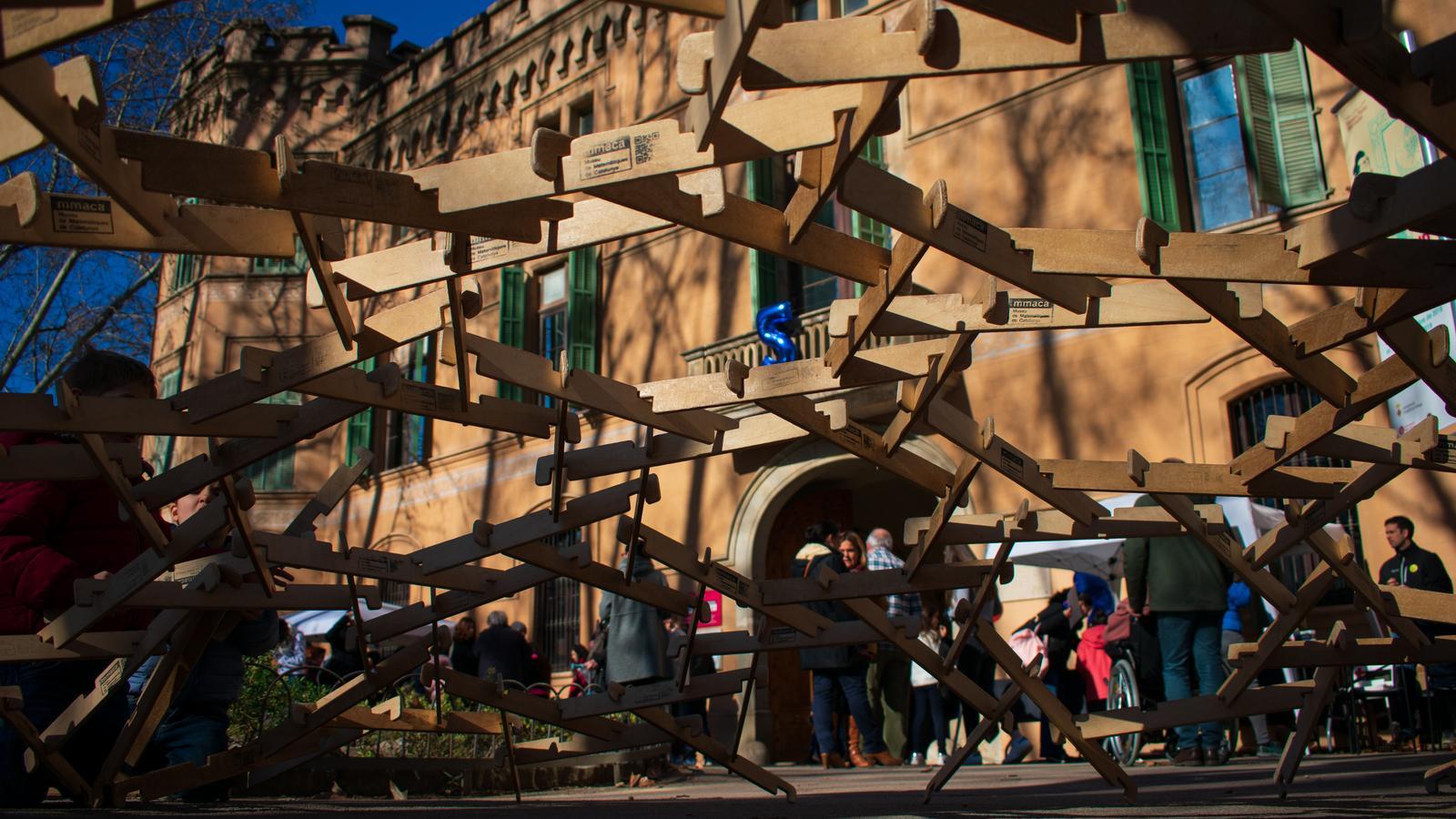
Cornellà de LlobregatIn front of the Palau Mercader, in Cornellà, a large group of smiling ESO youngsters are spinning a dome made of about 250 wooden sticks – all identical – measuring about four meters in diameter and one and a half meters in height. Suddenly, one of the girls pulls out a stick and instantly a part of the dome collapses. They have been building it collectively and joyfully in about twenty minutes.The sticks are supported by leaning against each other: if one is removed, the dome collapses. Like a castle that is being dismantled. One of the singularities of this dome is that no connecting element is necessary: the weight of the pieces is sufficient to maintain its stability. "While building the dome, many facets are worked on: computational thinking, geometric shapes, dimensions, proportions, architecture...", Sergio Belmonte, vice-president of the Museum of Mathematics of Catalonia, tells me. "This three-dimensional structure appears in two small drawings in the Atlantic Code by the brilliant Leonardo da Vinci," Sergio explains to me. The Dutch sculptor Rinus Roelofs discovered them and from these drawings he created a series of sculptures. Inspired by this, the Museum of Mathematics of Catalonia designed the dome to make a workshop. This dome can be obtained by downloading it (for free) from the museum's website. Universities and various associations download it quite often.Mercader Park is an extension of the museum. In addition to the dome workshop, it is also the setting for a mathematical scavenger hunt that includes questions such as how many sides does Mercader Palace have (keeping in mind that it has four octagonal towers) or how many four-digit numbers can be formed with the digits 1, 2, 3, and 4: 1234,1243,1324,1342,1423,1432... Mathematics gives us tools to do it quickly.One of our mottos is Forbidden not to touch", Sergio tells me as we walk through the park. The museum offers enigmas, questions, and challenges, such as discovering how a vehicle can move with different "wheels" that are not circles (it can do so with the so-called Reuleaux triangle: find out what type of triangle it is!)."This is not a museum to look at but to do," Sergio, a headline-making machine, tells me. "We don't teach at the museum, but the public does learn," he adds. We now enter one of the rooms of the museum, located within the Palau Mercader, which was built in the 19th century by order of Joaquim de Mercader i Belloch. I spend a good while making a chessboard with eight fragments that have to fit together. Sergio suggests I study the pieces well, and gives me more recommendations that I won't reveal. However, I can't manage! Suddenly a boy appears who helps me. It's a usual scene in this museum: if you find yourself stuck trying to solve a challenge, sometimes a spontaneous helper appears.Initially, the Museum of Mathematics was itinerant. It was an exhibition that was temporarily set up in other museums, cultural centers, libraries... throughout the territory, especially Catalonia. Until a few years ago it became permanent and was installed in this headquarters, in Cornellà de Llobregat. It is a good place, I think: well connected with the rest of the metropolitan area, and with this magnificent park with many trees, which generate generous shade, so appreciated these days, and a little train, which you can ride (on Sundays and other holidays in the morning).Nevertheless, the museum continues to tour schools to offer mini-exhibitions or workshops on geometry, statistics, or mathematical magic. In addition, it goes around the world: "We have been to Serbia, Ireland, the United States, France, Italy, at the Congress of Art and Mathematics (Bridges)... and we have hosted the international congress of mathematics museums (MATRIX)", stresses Sergio.If you come alone, it's more than likely you'll find people to play with. It's always better to play with someone. In a short while, I see a pair of girls very focused playing Guess Who, but instead of faces, they are fractions, and three children building a semicircular arch with a series of cushions, the most used arch in Roman architecture and Romanesque art.Before saying goodbye, Sergio looks at me intently, as if he has something important to tell me. I tell him "thank you", but I can already see that he still wants my attention. He gifts me with another headline: "There are two types of people in the world: those who like mathematics and those who don't know yet that they like them". "Wow, I wouldn't know what group I belong to", I tell him. "Maybe the second one", I decide. "That's our target!", he replies.120,000 VISITS PER YEARThe Museum of Mathematics of Catalonia is not very large, but it offers a stack of activities to enjoy and "lose the fear" of mathematics. That's why many visitors return: even if you go for work, there isn't enough time to complete all the challenges in one day.The pieces for the games or challenges are made with simple materials: ropes, fabrics, glass, plastic... and especially wood. The museum receives around 95,000 visits a year. But if we add the Tarragona headquarters (located in the old convent of Santa Clara), about 120,000 visits. The waiting list for activities is long. On weekday mornings, the museum receives school groups, and on Wednesday afternoons, Sunday mornings, and some holidays, also in the morning, it is open to the general public.
