Marisol Galdón: "What am I doing screwed in this tragedy, if I am a woman of comedy?"
Journalist, icon of the television of the 90s

-
CAT -
CAST
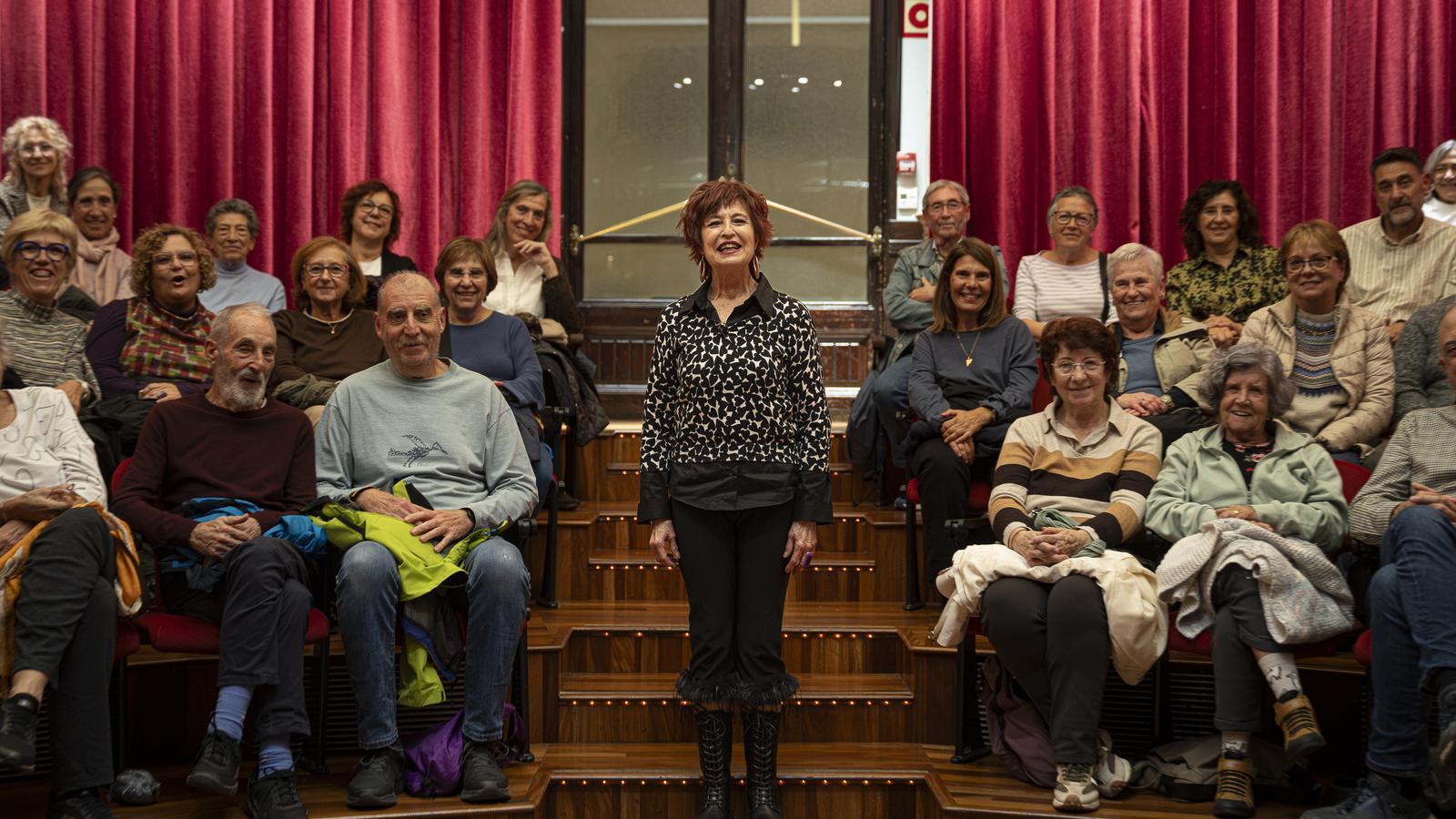
BarcelonaMarisol Galdón (Sabadell, 1962) is one of the pioneer voices of Catalunya Ràdio, one of the first women to work as a DJ in the nights of the Catalonia of the 80s, an icon of the television of the 90s and 2000s, a cultured, passionate and vehement person, who has always gone her own way and who was sought after by the best programs on all the networks. But all that changed one day. In 2021 she posted a video explaining her precarious economic situation and asking for work. This conversation arrives five years later, now that she has returned to live in Catalonia.
Are you named Marisol after the singer and actress, after that child prodigy whom the Franco regime wanted to adopt?
— Yes, my parents were fans of Marisol. My mother was Andalusian and she said: “Mi hija va a ser así de alegre”. And look...
What led your parents to come to Catalonia?
— They were very strange immigrants, because my father worked at the City Council, he had a great job, a fantastic two-story house in the middle of the village, in Jaén. But my mother lost a nine-month-old baby due to medical negligence and she developed a quite severe psychosis. Then she had a miscarriage, she got pregnant with me and came here to give birth to me so that everything would go well. She did not want another child to die on her. They already had family in Caldes de Montbui and I was born at the Clínica Santa Fe in Sabadell.
How would you say life has treated you?
— They pampered me a lot. I was a very happy child and teenager, and when I started to peek out into the world, the blows came. They could have treated me a little better.
What is the first image that comes to your mind of professional fulfillment? From when you think you will take on the world.
— The Plàstic program, on TVE. I worked as a disc jockey at Nick Havanna in Barcelona, and I was a powerful DJ, huh! I was a dance jockey, because I played music, put on my headphones, went into a trance, and wouldn't stop dancing. They told me I was the first female disc jockey, but the truth is I have no idea.
So you joined Plàstic, that music show with Tinet Rubira and David Bagés, because you were a DJ?
— A waiter came and told me that there were some guys over there who were from TV and wanted to talk to me. “We are preparing a music program, we have two boys and we are missing a girl. Would you like to or what?” Just imagine, you.
And then come other programs, you replace Àngel Casas on Tal cual...
— Before that there is Peligrosamente juntas, a diary with Inka Martí, and collaborators like Berlanga, Carandell, Wagensberg... It is the best program I have ever done.
What I mean is that these are years of splendor for you on TV, and for that reason it is harder to understand that five years ago one day you recorded a video to say: “Gentlemen, I don't have a job, I can't make ends meet”.
— It will sound terrible for me to say it, but what is most shocking is that a woman like me, with all my experience, with my voice, with my knowledge, a career, four languages... How can it be? How can it be that the media world has treated me like this?
And this question that you must have asked yourself a thousand times, how do you answer it?
— I have never had a communication group behind me, I have always gone my own way. Second, I am a woman who speaks clearly. And I am a woman. A certain age comes, and that harms us women a lot. For men, not so much. From the age of 50, you better light a candle every night because soon the party will be over.
You spent a lot of time presenting programs and then you entered another world, that of being a collaborator. You are living some splendid years now here, now there...
— When the media paid well, not the misery of now.
Could you explain, if you don't mind, the time you were paid the most to go on a program and the time you were paid the least?
— Gee, can I say that? People don't chirp, because they are afraid that they won't be called back. For example, on Crónicas marcianas I was paid 1,500 euros per appearance. And on Estudio Estadio, on Teledeporte, 100 euros for two hours of debate, and I had to get there by my own means. What was left for me? 30 euros?
Does the major crisis begin in 2008?
— Yes, everything goes to rack and ruin there. To survive, you had to have many small jobs.
And you hadn't been able to save?
— No, I have always lived day by day. When I worked at Crónicas, I collaborated on the radio with Abellán and wrote for the magazine Rolling Stone, I took the opportunity to buy myself a humble little house, in the middle of the countryside, in a village of 90 inhabitants in La Alcarria, 18 kilometers from Guadalajara.
What has become of this house?
— I had to sell it in 2014, because I was absolutely in debt. My parents sold their house in Caldes, bought an apartment in Guadalajara, and they gave me what was left over so I could survive. I rented a house in another town until last year when the landlord kicked me out. Now I share a house with an acquaintance in Baix Llobregat, thanks to their generosity. I didn't think I would return to Catalonia, because everything here is very expensive.
One thing I didn't know is that you had been one of the first voices of Catalunya Ràdio.
— Not many people know that. I was studying information sciences in Bellaterra, but my obsession was cinema. When I was in my third year of university, one of my professors, the great Ramon Barnils, told me that Catalunya Ràdio was being set up and that I should do myself a favor and apply for the auditions. Can you believe they hired me? It was one of the greatest joys of my life. The first classical music program on Catalunya Ràdio was hosted by me, Divertiment clàssic. The love for classical music had been instilled in me by my father.
And why is your time at Catalunya Ràdio coming to an end?
— Two years, that's how long I lasted. Like all projects that start, at Catalunya Ràdio there were people with a lot of enthusiasm, but after a year, politics started meddling. And a guy named Carles Vilarrubí appeared to control the political side. You always think it will be more directed towards those in news, but those of us who were freer and crazier were already being watched.
If I am not mistaken, you voted for or even were part of Left-Wing Nationalists.
— I was in Nacionalistes d'Esquerra because in those years being an independentist was a very rare thing. I had run in the Caldes elections with Nacionalistes d'Esquerra. So one fine day Vilarrubí summoned me to his office, asked me if I was an independentist and if it was true that I had run in the municipal elections.
Are you saying they kicked you out of Catalunya Ràdio for being an independentist?
— No, no. When we had been on the radio for some time, TV3 was launched and Salvador Alsius told me to do a screen test to present the Telenotícies. And, listen, everyone was delighted, me too, we were almost signing the contract and, all of a sudden, they told me: “Have you passed the psychotechnical test?”. And I, big-mouthed as I am, replied: “Has Alfons Quintà passed it already?” He was the director of TV3 and years later it was proven that he was a bad person. Apparently this reached him in some way, and that was the end of TV3 for me. It was the beginning of my end, because at that time I was the partner of Mingus B. Formentor, music director of Catalunya Ràdio, who was considered subversive among the subversives. This was the first major disappointment of my life.
What is money to you?
— They are the devil's invention. It is the greatest headache in the history of humanity. Who would have told me that I would have to reach 60 years old finding myself this way? If when I was doing Plàstic you had told me “Save, because you don't know what will come after for you”, I wouldn't have believed it.
As of now, five years after that video, are you still without a job and having trouble making ends meet?
— My friend gives me a good price on the house; if I can't pay one month, I pay him nothing. And now I have returned to paying social security as a freelancer, which is extremely expensive. I collaborate with Isabel Gemio on National Radio, and I have a gig this November as a master of ceremonies for the Zoom awards in Igualada. These gigs have saved my life in recent years.
Making that video, what did it give you?
— Occasional gigs, but not a job.
Is thinking about that golden era of yours on television a good memory now, or is it painful?
— I am a woman who does not have problems with my self-esteem. I have never lost it. The ones who I think have lost their minds are them. What a bunch of fools, the media, to have a powerful communicator like me and not take advantage of it. You might think I'm stuck-up, but I've worked on my self-esteem a lot since I was a young girl. That doesn't mean I'm made of stone. I have cried a lot and there have been moments when I have thought: I'm leaving this world. Just like that, directly. I'm fed up, you bunch of wretches, I'm leaving. If you are not interested in me, I am not interested in you either. I have a little postcard of the Christ of Velázquez and next to it, a Buddha. And sometimes I talk to them. One day I approach them and say to them, especially to God: “Let's see, you who move the castings of life, what the hell are you doing putting me in this tragedy, if I am a woman of comedy? Get me out of here and give me joys”. He has given me a little bit of bait, but there has been no way.
You are an extremely sociable person and, at the same time, very lonely. How do these two things go together?
— Look, I am a highly sensitive person, as they say now. I have too much empathy and that brings many problems, you pick up on things you would rather not have picked up on. When you are alone, you build your own world. If you live with another person, unless the understanding is very good, there are always things that make you suffer.
If you had had a partner, you could have shared income, expenses...
— That is exactly the problem. I have been without a partner for thirty years. People approach me, but I can't find guys I like. I really want to fall in love again, but there's just no way.
Do you miss love or sex?
— Looove. That's why I did the monologue Reír por no follar. Most women always get emotionally involved.
But you have had many exclusively sexual relationships.
— Absolutely! I have had phases of being a total slut. I've fucked like crazy, that's not the problem, but there comes a moment when you get fed up with it. One day I woke up and next to me, I must have been forty years old, there was an Iberia flight attendant, who must have been in his early twenties. What is this guy doing here? What are you doing, Galdón? Stop.
If the Christ of Velázquez and the Buddha tell you that they only have one thing for you and let you choose: a job or a partner?
— A partner, I would say. I have had stories, but it has been a long time since I knew what it was like to fall in love. When you go through it so badly, you miss someone to hold you. Not someone to have sex with. You miss emotional, sentimental warmth. And also someone who says that if you are short on cash now, we will get by on what I earn. When you are alone, if you collapse, everything collapses. And that is very hard: not being able to share your miseries or your debts with someone.
Elections are coming. Will yours win?
— Which ones are mine? I don't have any, mine. But well, I have always been on the left.
Will you go to vote?
— Indeed. As if things were in a state to not go vote.
How do you imagine the Catalonia and Spain of the years to come?
— Oh my God! In the media there are many people who insult, who shout, who create tension. I handle this tension very badly. With these elections, I am terrified of what will come out. These fascists scare me a lot.
And how do you imagine your next few years?
— I don't know, Albert. When you have gone through such hard circumstances, one of the first conditions to be happy is not to be thinking all the time about what will happen. Life is what is happening now.

It's raining outside the Palau de la Música Catalana and Marisol arrives walking with a tigress-print umbrella. It must have been more than fifteen years since we last saw each other, since we worked together on El Club, on TV3. She smokes a cigarette, we talk about gray hair, the latest books by Julian Barnes and Ian McEwan, and she asks to go to the bathroom to touch up her makeup before 2xCENT begins, those monthly interviews with an audience, today with her as a guest. The full version of the conversation is available in the video attached to this piece. There you will find, for example, how after her militancy in Nacionalistes d’Esquerra she got tired of nationalism and felt more comfortable in Pasqual Maragall's Barcelona than in Jordi Pujol's Catalonia.
