A journey into the bowels of the earth
From Italian brands to an Andalusian town: four caves that are a spectacle of nature and a refuge from high temperatures
-
CAT -
CAST
In Homer's Odyssey, Ulysses and his companions enter the cave of the cyclops Polyphemus and get trapped; in The Adventures of Tom Sawyer, the protagonist and his friend Becky get lost inside McDougal's Cave, a Missouri grotto known as Mark Twain Cave; the visit to the sea caves of Fingal, on the Scottish island of Staffa, inspired the opening of The Hebrides by the German composer Felix Mendelssohn... Since time immemorial, the subterranean world in general and caves in particular have fascinated humans: they are a secret door to the bowels of the earth, a transitional space between two realities, a dark, mysterious, and often sacred place. Discovering an impregnable cave is always celebrated as a human feat, but above all it is a reminder of nature's creative capacity when it has water, limestone, and thousands of years. Furthermore, when the summer heat intensifies, a cave is the best climatic refuge.
By the smoke of a cigarette
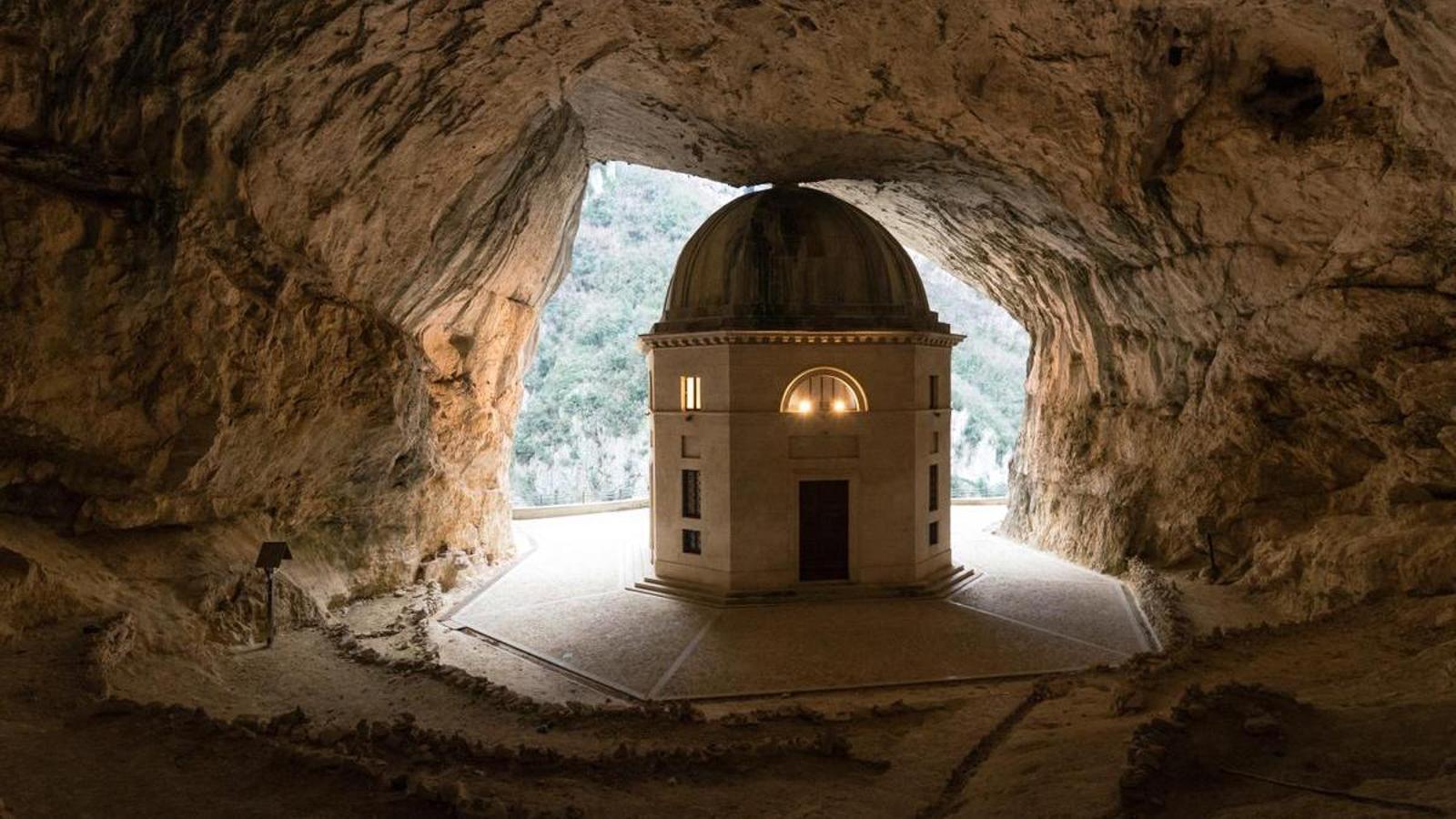
Nature is one of the great attractions of the Italian region of The Marches, whose capital is the port city of Ancona, facing the Adriatic Sea. 60 kilometers from there is the natural park of Gola della Rossa e di Frasassi, where Monte Valmontagnana rises. Inside hides an extensive karst complex discovered on September 25, 1971, by a group of young speleologists from Ancona. The expedition was led by Giancarlo Cappanera after Rolando Silvestri, one of his students, insisted that he had seen small holes that seemed to go into the mountain. Silvestri was right: behind one of them, which they widened by removing earth and stones by hand, they found a cavity of about 15 square meters. It seemed that the adventure ended right there, but before returning home, they decided to rest for a while. Two of the young men lit a cigarette. Cappanera realized that the smoke dispersed very quickly even though the entrance was very small. This made him think that perhaps behind one of the walls of that cavity there were air currents. From this discovery and in several epic expedition days, Cappanera's group managed to reach the heart of Monte Valmontagnana, a magical place they named Grotta Grande del Vento and which, with the subsequent connection with the neighboring Grotta del Fiume, discovered in 1948, came to be called Grotte di Frasassi.

Whoever visits these caves today does not enter through the same place as those intrepid speleologists, but through an artificial tunnel of 223 meters inaugurated in 1974. The first sight, however, is exactly the same as that experienced by Maurizio Bolognini on October 10, 1971, the first to descend a 120-meter metal ladder and touch the ground. He and his companions found themselves in such an immense space that they named it Abisso Ancona. "Dazzled by the splendid and immaculate views that presented themselves before us, everywhere and in all directions, we wandered in silence, walking on pristine crystal floors that our hearts did not want to tread, but that our legs violated without stopping, driven by the desire to follow the discoveries of our eyes," recalled Capanera in a writing from the day they stepped into Abisso Ancona, so large that in some points it reaches up to 200 meters in height.
Currently, a system of stairs and walkways – 1.5 kilometers long – allows exploration of the different halls, where stalagmites and stalactites become natural sculptures with suggestive names such as The Giants, The Camel, The Bear, The Sword of Damocles (a stalactite 7.40 meters high and 1.50 m in diameter) and The Obelisk (with stalagmites of 15 meters high emerging from the center of Hall 200). Inside the cave, which maintains a constant temperature of 14 degrees throughout the year, there are also lakes of crystalline water and wells where water accumulates from a millennia-old dripping. The exceptional acoustics of the Frasassi caves have made it the setting for various performances such as a Christmas concert by Andrea Bocelli, which was broadcast live worldwide on December 18, 2020, in the midst of the pandemic.
The Versailles of Canigó
The journey on the Yellow Train from La Tor de Querol to Vilafranca de Conflent is a luxury: not only for the landscape, but because upon arrival at your destination you can stroll through this medieval city fortified in the 17th century by the military engineer Vauban. However, to escape the heat, the Canaletes caves are the best option: as with the Frasassi caves, they maintain a constant temperature of 14 degrees throughout the year. Access to a first cave was discovered by chance in 1951 and, just three years later, the first visits began. However, the popularity of this cave at the foot of the Canigó massif skyrocketed in 1984, when the discovery of new galleries so monumental that they received the tourist nickname of underground Versailles was made public. The beauty of the Canaletes caves is revealed progressively: it begins in the Gallery of the Porticos and continues to the White Hall, a space covered in calcite where stalactites and stalagmites coexist with immaculate drapes and pillars. The visit continues towards the Angkor Network, through rooms as majestic as the Nave, the Lake of the Atolls, the Temple of Angkor – where the capricious shapes of the rock resemble a Khmer palace in the Cambodian tropical jungle, but where there is also a calcareous formation christened with a name as explicit as the Sagrada Família – the Red Dome and the Balcony of the Tenebres, a sort of viewpoint that closes the route.

A navigable underground river
The Caves of Sant Josep in Vall d’Uixó, in the province of Castelló, were already known in prehistoric times: archaeological remains and samples of rock art have been found at the entrance (thick strokes of schematic red paint). Its great attraction, however, is that they hide one of the longest navigable underground rivers in Europe. Here lies its great mystery: even today it is not known exactly where this water is born, which travels through the entrails of the Serra d'Espadà and emerges to the outside through a spring that also bears the name of Sant Josep. The cave, with a stable temperature of 20 degrees, was documented at the end of the 19th century when, at the request of the Town Council, an engineer and a boatman ventured in to ascertain the course of the river. Currently, its extraordinary limestone formations – the Medusa, the Cascade of the Flower, the Portal de Betlem and the Flags, among others – are contemplated through a boat trip along 800 metres of crystalline water (in 1960, when the works that made the river navigable were inaugurated, there were only 380). Nevertheless, a small part of the route must be done on foot. The most adventurous can opt to do the visit by kayak and reach more hidden spots.

The first great wonder
A month and a half after the outbreak of the First World War, in a village in Huelva, Andalusia, one of the first tourist caves in Europe was inaugurated: the Gruta de las Maravillas in Aracena. Although legend attributes the discovery to a shepherd, the reality is that mining surveys alerted to its existence in the mid-19th century. Unlike previous ones, this is a phreatic cave formed by the erosive-dissolutive action of water on the marbles of the Cerro del Castillo and with a stable temperature between 16 and 19 degrees. Besides the underground lakes, it stands out for the great variety of stalactites, stalagmites, columns, flowstones, pisoliths, and curtains in the galleries – superimposed on three levels – which have received evocative names such as Sala de las Conchas, Baño de la Sultana, Cristalería de Dios, Sala de los Desnudos, Brillantes… To celebrate the cave's centenary, since 2014 a special guided tour with prior reservation has been offered, allowing visitors to discover two new areas: La Marmita de los Gigantes and Los Banquetes.

