Hatim Azahri Akhnous: "I was ashamed of being poor"
President and founder of the association Joves Units del Poble-Sec and Princess of Girona award in the Social category

-
CAT -
CAST
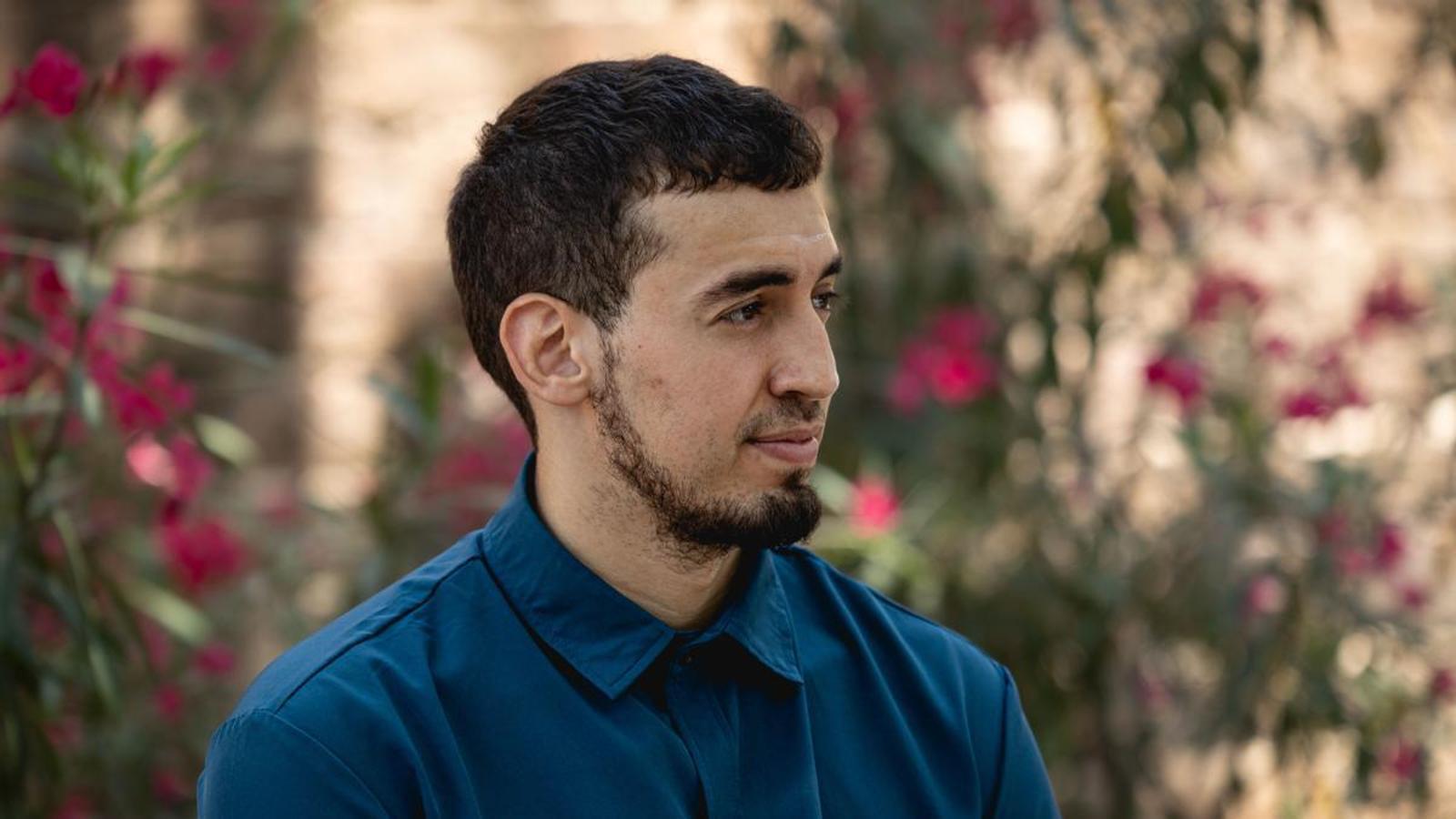
BarcelonaHis own experience has led Hatim Azahri Akhnous, 28, to dedicate his life to transforming the reality of the most vulnerable people. A higher technician in social integration and a student of social work at the UB, in 2019 he founded the association Joves Units del Poble-Sec with the aim of generating real opportunities for young people in the neighborhood at risk of exclusion. Since last year he has been a trustee of Equitat.org (formerly Fundació Bofill) and this year he has been awarded the Princess of Girona Prize in the Social category and has participated in the VI meeting of Lafede Changing education to change the world.
You arrived from Nador to Poble-sec in Barcelona when you were only two years old. How do you remember your childhood?
— When I was only eight years old, my parents separated, and the three siblings and I stayed with our mother, and that's where a moment of personal crisis began for me. However, I was fortunate to meet Rosa and Conxita at the Mossèn Jacint Verdaguer School, two wonderful teachers who managed to make the whole situation less violent and intense. They did work of positive reinforcement, recognition, and public validation in front of the class. The school became a place I wanted to go to.
Did you also notice this support from your classmates?
— What was happening was that I was ashamed to be poor. Among your peers, you want to go unnoticed, but you found that some of your classmates could afford books, shoes, or tracksuits, while those of us suffering from this poverty tried to pretend, as if the situation we were going through didn't affect us. You always tried to tell your classmates about the positive things that happened to you instead of telling them that your parents had separated, that you were moving apartments because you couldn't afford it, or that after a while I ended up in an irregular situation because a document had expired. You keep all this to yourself because you feel it's a form of weakness, and nobody wants to seem weak.
When did you manage to get out of that well?
— I made a huge leap at the end of third grade. My teacher, Conxita, would have me go to the blackboard to do a math exercise and she would highlight it in front of the whole class. She would tell me "you are super smart" and even sometimes give me a hug. She always had nice words and people like to be spoken to well, to be positively reinforced. I started to believe that I was very intelligent, and when you believe it, you also try harder to meet those expectations. From third to sixth grade, I got good and excellent grades.
You arrive at the institute. How do you approach it?
— Regarding the grades I did quite well, but I did notice different dynamics from the teaching staff. There wasn't as much closeness and even now that I reflect on it, I can say there were strange comments from professors, which I dare say were racist and discriminatory, which limited many opportunities for many colleagues.
Do you think this situation has changed?
— I trust so, but I guess it also depends on the school. Both I and some colleagues of mine left secondary school believing we couldn't do baccalaureate. My tutor told me, even though I had an average of almost a pass, that I couldn't study it because it was very demanding and that I should go and do a vocational training in welding, which is very good and very dignified.
What happened?
— With a friend I enrolled in the welding FP, but the brother of another friend told us that he had studied high school at IES Coromines and in September we went there. The person at reception told us to bring the documentation and that if there were free places she would let us know. The next day she called us and told us "start next Monday". The experience was wonderful because we found a relationship with the teachers very similar to the one we had with those in primary school. I took the selectivity exam because the teaching staff insisted a lot and I passed it. I was clear that I wanted to study, but here I encountered the psychological barrier of not having papers and, therefore, of not being able to study either a higher vocational training or a degree because I could not do the internships.
How did you solve it?
— I worked for two years in a restaurant with the hope that they would give me a contract that never came. In the end, I chose to go to the Concòrdia community center in Poble-sec and started taking courses in Catalan, English, and guitar. In 2020, the Generalitat (Catalan Government) launched a program in which an organization would present a person to undergo a complete training process, and in return, that organization would receive a sum of money to hire the person in question for one year, and thus subsequently regularize their situation. I was the chosen one and I worked for a year at the reception of Casal Concòrdia to then officially regularize my situation.
And did you go back to studying?
— Exactly. When I finished my contract year, I found work as a monitor and also founded the Association of United Youth of Poble-Sec. The fact of seeing that I already had the papers was an impulse. In fact, my mother tried to regularize our situation many times, but since the administration does not guarantee minimums, this leads many people to seek solutions outside the system that are always traps.
And what do you start studying?
— Social integration at the Miquel Tarradell Institute in El Raval, and now social work at the UB. When I was working at the reception of Casal Concòrdia, I realized that I needed more skills, more technical knowledge, to be able to lead a social project like the Association of United Youth of Poble-sec.
We are in a context of the rise of the far-right. What message would you like to give to people who defend phrases like "all our taxes are used to help immigrants"?
— I believe these discourses grow when people are disappointed, not because of the rise of the far-right. There are many gaps that have not been addressed, such as the housing problem. People believe that these discourses may bring about radical change. Added to this is that, in a time of crisis, people need to believe they are part of something. And on a psychological level, the far-right has worked on this a lot and knows that in moments of desperation what they need is to project an enemy, and it is always the most vulnerable group in the entire social pyramid. The problem is that this radical change will indeed be seen, but it will not be for the benefit of the people. And what happens on the other side? The attacked populations tend to withdraw, and this is indeed dangerous, because for coexistence to flow they need to feel safe, without fear of being judged or attacked. This leads to the creation of first-class, second-class, and third-class citizens, and to the division of society, a dangerous fact for the democratic system.
At the beginning of the year you were awarded the Princess of Girona Social Award. What would you say to that Hatim who hit rock bottom when he was little or to the many Hatims who are now going through a similar situation to yours?
— Let them ask themselves why they are doing what they are doing. This is a question that suits me well and that guides me a lot and also helps me to discard many things. In the end, what I am looking for is to improve the world. In fact, there are many very good people who are constantly working to make the world a better place. Perhaps they are not so visible, perhaps they do not occupy headlines, but they are everywhere and have very good intentions. Sometimes, when we are on these paths that we tread, where it seems we are going alone, we must find these alliances, connect with these people and remind each other that a better future is possible.
