Why are some families reluctant to send their daughters to summer camp?
The Pere Tarrés Foundation accompanies families in vulnerable situations so that they get to know the colony houses and gain confidence when leaving their children there, especially girls

-
CAT -
CAST
Barcelona“At first I was afraid of everything: of the food, that something might happen to them, I was even afraid of them sleeping away from home. But after the first experience, the girl came back very happy and the fear has passed,” explains Nabila, mother of three, about the summer camps. Her daughter Yosra, eleven years old, has already been to camps twice, once with school and once in the summer. Her son Marouan, 16 years old, has also been – this year will be the fourth time – and the youngest, Omar, hasn't dared to go yet, although Nabila has hopes.
This family, originally from Morocco, has been living in Catalonia for 17 years and has had their three children here. Nevertheless, at first, she was afraid to send them to summer camps. “There is a cultural barrier. For many of these families, the term 'going to summer camps' is an empty concept: they haven't had much experience in their countries of origin. They don't know what a summer camp house is, nor what kind of activities take place there, nor what happens there,” explains Rafael Ruiz, deputy director of the Pere Tarrés Foundation. Nabila explains that she never went to summer camps in Morocco, neither she nor her siblings, and the closest thing was outings that were done from the age of 16.

When colonies are an unknown concept
Precisely, at the Foundation they work to try to eliminate these cultural barriers in various ways: by informing families through the socio-educational centers where the children participate and, at the same time, by encouraging them to participate in weekend outings to get to know the colony houses. “We manage socio-educational centers, which are spaces where, after school, educational reinforcement and leisure activities are carried out to work on transversal skills, relational abilities, etc. Normally, these children are referred by social services, they have some type of follow-up, and families are also worked with on an individual basis,” explains Ruiz.
It was through one of these centers – as Nabila calls these places where she takes her children – that they explained to her what a colony house was. “They explained well what they would do and where they would go, the place and all the activities. They showed us photos and videos on the computer,” she recalls.
Nabila has been taking her three children to the center in Sant Adrià de Besòs since they were little. For years, the eldest, Marouan, has gone to summer camps and participated in summer activities. As for the girl, the family had certain reservations about letting her participate, but the experience was very positive and this year she will repeat the July summer camp. Precisely, for Ruiz, these cultural barriers appear especially with girls: “It is very difficult for certain families to facilitate their daughters' participation in these activities, you have to work on all these aspects so that they normalize it”.
“They are families who find themselves in a certain situation of vulnerability and, therefore, in the work we do regularly, we invite them and encourage them to get to know these realities, gain confidence and want to participate,” explains Ruiz. This work is done from the centers they manage: three in Barcelona – in Poblenou, Poble-sec, and Raval – and another in Sant Adrià de Besòs.

To see it to be able to trust it
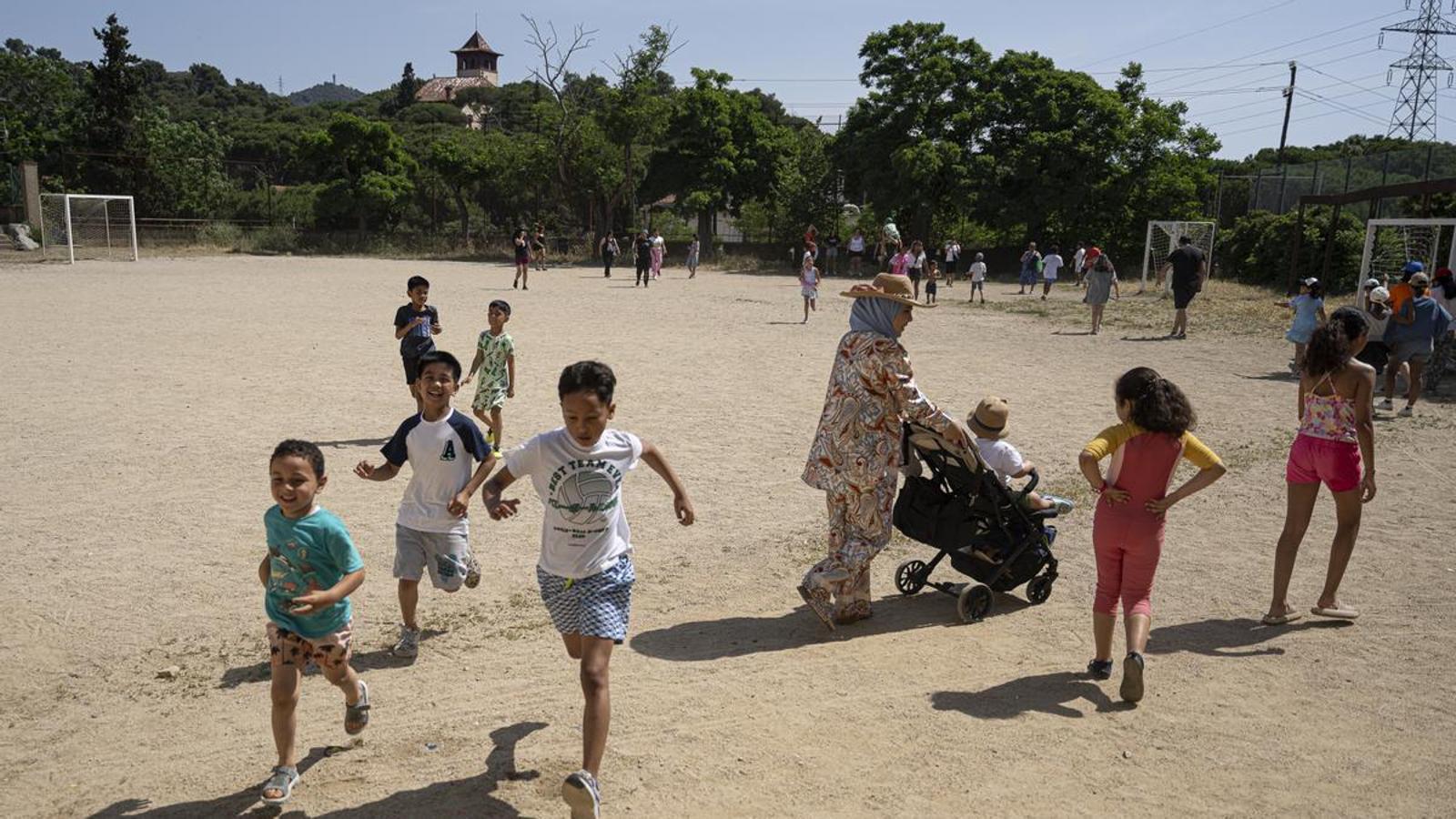
In addition to explaining and showing what it means to go on a camp, the Foundation also promotes a second option: inviting these families to take a day trip, during a weekend, to get to know the camp house firsthand. On the last weekend of May, about forty families got off the bus that took them to the La Conreria camp house, near Tiana. After breakfast, they visited the house and its surroundings, they were explained what camps are and they spent the rest of the morning doing various activities, such as games and treasure hunts.

“Understanding that there are rooms, that they have bunk beds, that there is a place where you eat, that there are spaces for activities, that there is a swimming pool... All this is what we have to try to fill their minds with to give them security. We also need to explain that there are sanitary and safety conditions. And then, not only do they know the infrastructure, but we do some activity with them: they see that they have a good time and that it is a rewarding experience, that it transmits values,” explains Ruiz.
For Nabila, this reconnaissance trip was a turning point. “My eldest son went with a friend of mine, who also took her children, and they loved it. It gave us a lot of peace of mind. That was five years ago. It was from then on that we were encouraged,” she comments.
The diversity of families is very broad and with very varied profiles: “They are families, many times, single-parent families, who come from a migratory context. But we also have families who are native to here, in a precarious labor and housing situation. We try for the whole family to come to these activities, for the men to come and also get involved in the activities, many times they are the ones who end up making the decisions to allow or not allow a child to come, especially in the case of daughters,” details Ruiz.
These camps are sponsored by the Pere Tarrés Foundation itself and are for summer, although some centers also organize them for Christmas or Easter. They always take place outside of ordinary school and, therefore, become a “space without the stigmas that these children may carry in their school life,” points out Ruiz. Children who participate in these socio-educational centers and who are in a situation of vulnerability are normally 100% sponsored for summer activities; this year they expect to reach 7,500 scholarships.
Missing out on camp is missing an educational opportunity
some teachers question the conditions under which they have to accompany children on these outings
In fact, according to data from the Pere Tarrés Foundation, the success is clear: in the first year, approximately 80% of the families who participated in the information sessions and the outing to get to know the colony house ended up encouraging themselves to let their children go.
“Now I see it as a very good thing. It’s a very positive experience for the children, because they have a good time and get out of their routine. Thanks to the support of the people at the center, I feel much more confident when they go,” explains Nabila. For Rafael, it is important to break down cultural distance, but above all the lack of reliable information. “If the person giving it to you doesn’t generate that trust, you’re not willing to have your children participate,” he warns.
A shared challenge
But barriers do not only appear between families. In recent years, the debate about colonies has also moved to educational centers, where part of the teaching staff questions the conditions under which they have to accompany the children on these outings. Ruiz admits that it is "the most thorny issue" and assures that they understand the situation of the teachers: "Many things have happened in schools, they are asked to know and do everything, with very complex class compositions and 36% child poverty in Catalonia". Nevertheless, he defends that the challenge must be addressed in a shared manner: "We must all assume it among all educational agents and public administrations. We are all in the same boat to guarantee quality education. If there are to be adequate conditions for accompaniment, they must be found, but we would like these children to be able to participate", he warns.
Now, the challenge is to be able to finance the project. “Our intention is to try to recover it and continue maintaining it every year, for those families who we see have doubts and need this push,” explains Ruiz. This afternoon, Nabila is preparing the bag because tomorrow her daughter Yosra is going on a camp with school to a house near Girona, it will be her third time at camp. “If there are families who are considering it, I would tell them to get rid of their fear, I also had it, but thanks to my experience and seeing that my children return happy and well, I encourage them to let them go and make the most of it”.
