Schools and institutes seek alternatives to colonies due to lack of volunteer teachers
Teacher burnout and lack of remuneration force some schools to reduce outings or hold them on weekends and with chaperones

-
CAT -
CAST
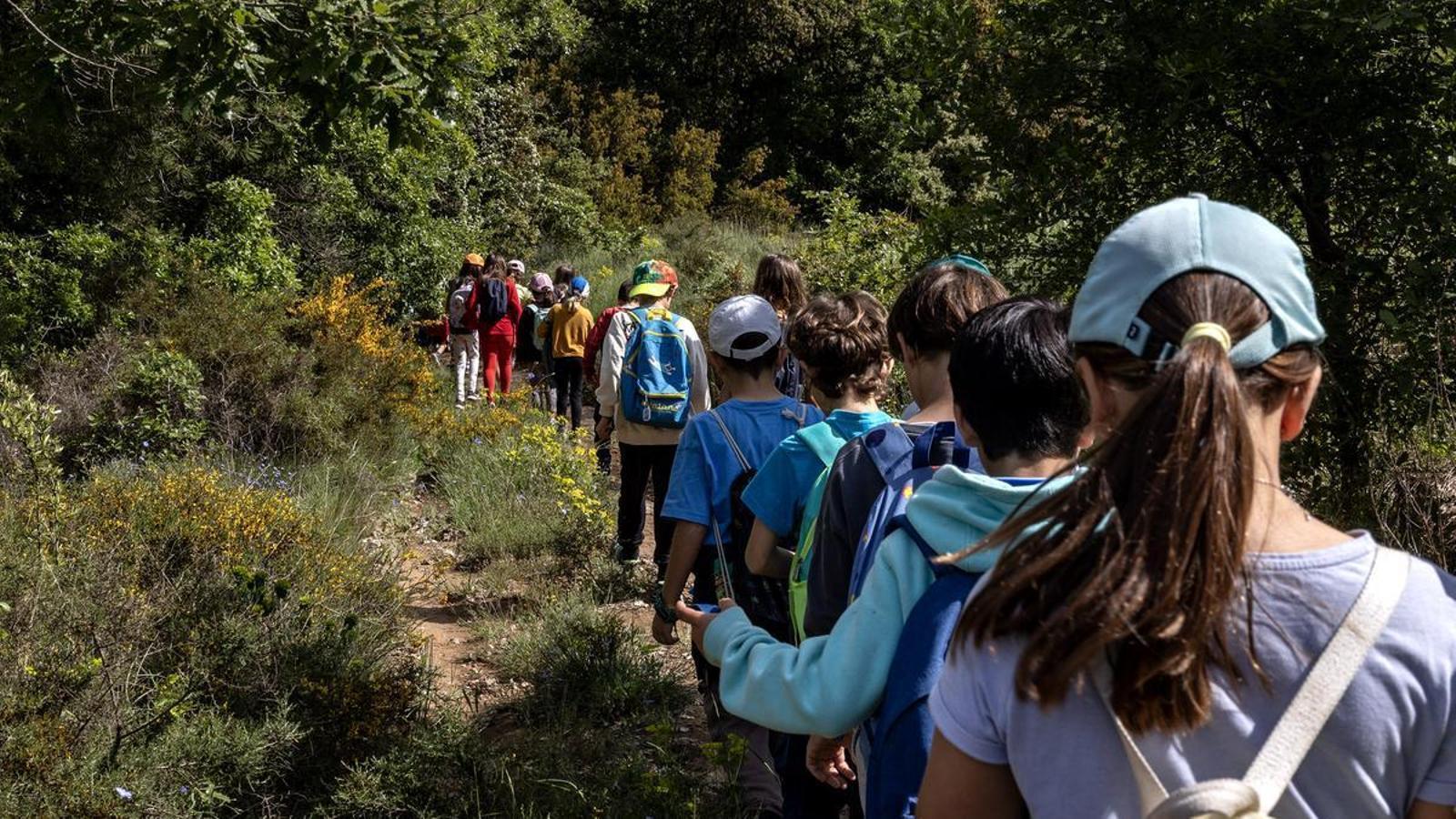
BarcelonaA few weeks ago, the students of the Baldiri i Reixac School in Barcelona went on a school trip. The children in I5, second, and fourth grade did. Until last year, all grades went, but the teaching staff decided to reserve them only for the end of the cycle because it was becoming increasingly difficult to find teachers willing to go each year. They thought that the fact that not everyone had to go each year would lead to greater availability on the part of the teachers. Years ago, the opposite decision was made. The trips were held at the end of the cycle, and it was agreed to extend them to all grades. “We teachers attached great importance to the trips, but little by little we have been getting worn out,” comments a teacher from the center.
The reason for the wear and tear is clear: no remuneration and little recognition in exchange for the effort of the teachers, who have to spend many hours away from home, have to work miracles to balance those days, and assume great responsibility caring for between 20 and 25 minors day and night, some of them with medication, some with night terrors, some with special educational needs.
When the decision was announced, there was some concern among families. Even the AFA, in view of the many inquiries and requests received from families, is studying possible alternatives for the coming years. Among the proposals they have received are weekend trips with supervision or sleeping at school. However, in general, the families of the students who this year have missed out on school trips for the first time believe that the children have accepted it without too many problems.

At the end of the cycle
It is not the only center where school trips have declined in recent years. La Roser is the mother of a second-grade child at a school in Viladecans. A few years ago, it was agreed that the trips would only take place at the end of the cycle. But the faculty also decided to set the condition that one of the course tutors must always attend. This year, this condition was not met for her son's course, and therefore, the trips had to be suspended. As an alternative, the AMPA has organized an outing for the second graders, which will take place over a weekend with monitors from the cafeteria and after-school activities.
The high degree of responsibility and the little recognition for teachers is also one of the reasons why at Escola l'Univers in Barcelona they have never had school trips every year. They only had them in sixth grade, to conclude their schooling with this shared experience. “We believe in their great educational value, in the fact that they are a golden moment to work on coexistence and cohesion in a non-urban environment,” states its director, Marta Rodoreda. Two years ago, they also incorporated them into third grade. In this case, they do them at the beginning of the school year for a specific reason. Before starting third grade, the children are mixed, and two new class groups are created. And having the trips then is very beneficial for creating good bonds in these new groups. Another thing they achieve by having them only in these two courses is to reduce costs for families. Each year, they include an amount for the trips in the fee for materials and outings, and thus the school saves money so that no family is in the position of not being able to go for economic reasons or having to expose this need to the school.
An extra responsibility in secondary school
The Vila de Gràcia Institute in Barcelona has also reduced its trips this academic year and will only hold them in the fourth year of ESO and the second year of baccalaureate. The director, Elisenda Jorro, declares herself a great supporter of the trips – in fact, she says, she always goes on them even though she has to do directorial tasks when the students have breakfast or sleep –, but she understands that many teachers have gotten tired. In addition to the fact that the remuneration for overnight stays was removed years ago and has not been recovered, she believes that the wear and tear in the case of secondary education has a lot to do with the great responsibility that teachers assume. According to her, in recent years, the bad behavior of some students on overnight trips has led to sanctions and meetings with families upon their return. Last year was particularly tough in this regard, and that prompted a request to the faculty to reduce the trips.
Jorro adds another factor to the wear and tear on the part of some educational centers. The Barcelona Education Consortium, within the framework of measures to support schooling (Shock Plan against Segregation and School Backpacks), makes contributions to centers to cover the purchase of books, materials, or trips for vulnerable students. However, according to Jorro, these resources do not cover the costs, and therefore, the centers end up assuming a part directly.
Faithful to the trips
At Els Xiprers School, on the other hand, they have not wanted to give up having the colonies as they have always done. Towards the end of the school year, all grades from I3 to fifth grade (sixth grade has a five-day trip) spend three nights away, and more than 90% of the teaching staff attend. In fact, according to the director, Quirze Espí, for this school, the colonies are an important aspect that goes beyond what they represent in other centers. Espí highlights that the colonies provide children with autonomy and responsibility, in addition to experiencing things outside the family environment. For teachers, he says, it represents an opportunity to observe the children, gather information, and even change group dynamics. Therefore, he says, they have a very interesting pedagogical value.

Pedagogical and educational value
In the educational community, there is broad consensus on the pedagogical and educational value of camps. “They are much more than a change of scenery or a purely recreational activity. They are part of a way of understanding education as an integral experience, linked to life and context, and not limited solely to the classroom.” This is the interpretation from the Federation of Movements for Pedagogical Renovation of Catalonia (FMRPC).
Its vice-president, Jordi Puche, states that camps, conceived and designed with learning criteria, generate privileged contexts for deep learning. Children connect curricular content with real, concrete, and memorable experiences that amplify understanding and retention of knowledge. They apply knowledge to the natural environment, work on linguistic and communicative competencies in real-use contexts, and consolidate habits from everyday life situations.
Furthermore, according to Puche, camps foster discovery experiences that promote a sense of belonging and understanding of the territory, especially for children who, for economic reasons, have fewer opportunities to engage in leisure or cultural activities outside of school. They are also a conducive space for building positive bonds, both among children and between students and teachers. Roles different from the usual ones in the classroom emerge, cooperation is encouraged, and dynamics are generated that improve group climate and the feeling of belonging.
From the FMRPC, they consider that the positive contributions are not limited to children, but that teachers also benefit. “They are a space for professional and pedagogical development for teaching teams, who find in them a space of great value,” he comments, adding that elementary and secondary school teachers can observe students in different contexts and better understand their needs, deficiencies, and potential, design and implement active methodologies that may have limitations in the classroom, and reinforce the center's educational project from a community and integral perspective.
Instrument for equity
The coordinator of the Childhood Platform of Catalonia (PINCat) of the Social Third Sector Table of Catalonia, José Antonio Ruiz, emphasizes that summer camps are the only opportunity many children have to leave home, have these life experiences, and be in contact with nature. “If we cut summer camps, we cut equal opportunities”, states Ruiz, who advocates for greater recognition from the administration for the teaching staff and monitors who make them possible.
The director of the Education 360 Alliance, Maria Truñó, emphasizes the importance of this idea in a context of growing child poverty. In fact, according to a survey on the participation of children and adolescents in summer activities in Catalonia, conducted by this entity in 2022, only two out of every ten Catalan children and adolescents go to summer camps or colonies. With this scenario, says Truñó, school camps play a fundamental role in generating equity.
Real recognition
According to Jordi Puche, the reason why the colonies are on the brink is the structural lack of resources and institutional support. They are maintained by the voluntarism of teachers and the funding of families, he says. A situation that makes them vulnerable and fragile, despite the existing consensus on their educational and pedagogical value. And he affirms that the defense of this value implies guaranteeing the working and material conditions that make the colonies possible. In the same vein, Maria Truñó believes that this debate highlights that the colonies are not sufficiently recognized or regulated, and do not have the necessary resources. “It is an example of how the underfunding of education is compensated by the commitment of the teaching staff and the money of families”, she says. Truñó hopes that the debate that has been generated around this issue will serve for the administration to take note and for the commitment to full-time education that expands opportunities to be strengthened. Ruiz goes a step further and recalls that educational leisure is a right recognized in the Catalan legal framework.
The situation for colonies could worsen next year if negotiations between the Generalitat and the main teaching unions do not progress and an agreement is reached. Around 500 have already joined the manifesto "Aturem les sortides i les colònies" (Let's stop trips and colonies), which threatens to do away with school trips and overnight stays from the 2026/27 academic year if the Department of Education does not implement real, structural, and effective improvements in the public education system. According to one of the manifesto's promoters, Claudia Cebrián, a teacher at a high school in Tordera, the campaign's goal is to add another action, to show the department that there is discontent among teachers that materializes in concrete actions and to continue negotiations. "We want a real agreement to be reached and for the majority of teachers to agree, for us to see the improvements," she states. The spokesperson for USTEC, Iolanda Segura, believes that the payment for overnight stays will not be the decisive point in this negotiation. First, she points out, there must be a salary increase to recover the salary lost due to the increase in the CPI. Segura criticizes the agreement announced by the Generalitat with the minority unions UGT and CCOO, which included the payment of 50 euros per overnight stay. The union considers this figure insufficient and does not compensate for the losses suffered by teachers when they have to spend the night away.
