What options are there to form an anti-Netanyahu government in Israel?
The final count does not change the scenario and, although the prime minister has the cards to resist, the parliamentary arithmetic does not guarantee a majority for either of the blocks

-
CAT -
CAST
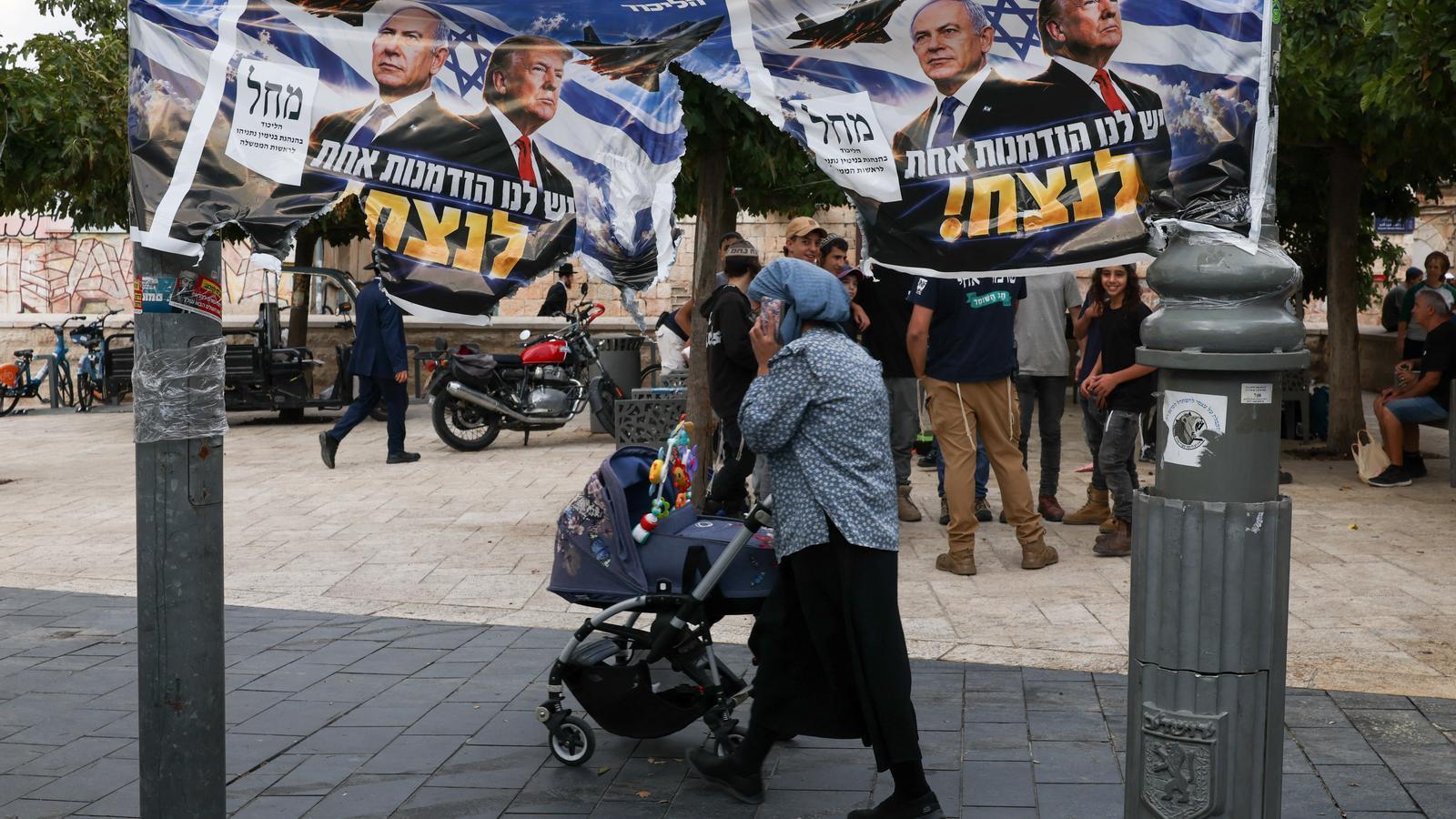
JerusalemIsrael has finished counting the votes, but the result has not clarified who will govern the country. The Tuesday's legislative elections have left Likud, Benjamin Netanyahu's party, with 27 seats, a figure that does not guarantee him a parliamentary majority, and have opened negotiations in which all government options have a political cost. The opposition can try to remove the prime minister with the support of the Arab parties, explore a unity government with him, or take the risk of new elections. Netanyahu, meanwhile, still has an ace up his sleeve: if his adversaries cannot reach an agreement, he could remain in power.
The final count confirms the scenario that was already taking shape this Wednesday, without changes in the distribution of forces: the prime minister's bloc totals 53 seats, while the opposition led by Gadi Eisenkot obtains 48 and the Arab parties gather 19. No bloc reaches the 61 deputies necessary to control the Knesset, the Israeli parliament. The results thus consolidate a scenario of political deadlock in which the paths to forming a government face significant obstacles.
Netanyahu's rivals want to remove him from power, but they still have to find a formula to replace him. The most direct path goes through Eisenkot, former chief of staff of the army and leader of Yashar, who with 21 seats, is the most voted force of the opposition. If the entire anti-Netanyahu bloc were to add the nineteen deputies of the Arab parties, the alternative majority would reach 67 deputies and could govern. But the numbers hide a considerable political difficulty: almost all the Jewish opposition parties have ruled out forming a government with these forces.
Ra’am, which would obtain eight seats, has shown itself willing to join an alternative executive, while the Joint List, with eleven deputies, could provide it parliamentary support without assuming ministerial portfolios. This formula would allow Eisenkot to avoid a formal coalition with the Arab parties, but would force him to negotiate with them the issues that most divide Israeli society, from Gaza and the West Bank to civil equality and the funding of Arab communities.
Although Ra’am was already part of the coalition government of Naftali Bennett and Yair Lapid in 2021, a new agreement with an Islamist formation is now more delicate after the Hamas attacks of October 7, 2023. For the moment, the only Jewish leader who has openly advocated collaborating with this force has been Yair Golan, leader of the Democrats.
Another possible scenario, albeit politically difficult, would be the formation of a national unity government that included Netanyahu and Eisenkot, with the incorporation of the B’Yachad and Yisrael Beiteinu parties, which would total 67 seats. More than programmatic discrepancies, however, the main obstacle is that Eisenkot has built his campaign on the promise of ending Netanyahu's government. In fact, during election night he demanded that the prime minister withdraw from politics and accused him of having fueled a culture of lies, division and incitement.
Netanyahu would also have to make significant concessions to incorporate into a unity government rivals such as Naftali Bennett and Yair Lapid, from B’Yachad, which holds twelve seats, and Avigdor Lieberman, leader of the Yisrael Beiteinu party, with seven. Both are right-wing leaders and defend a hard line on security matters, but during the campaign, they promised to unseat the prime minister and advocated for extending mandatory military service to the ultra-Orthodox. This measure clashes with the interests of the two ultra-Orthodox parties that support the prime minister, so a pact with his rivals could force him to do without some of the partners who have guaranteed him power in various stages of government.
Possible power-sharing agreement
Despite the difficulties in closing such a deal, the Israeli media outlet Channel 14, which is aligned with the government, has reported on a possible power-sharing agreement under which Netanyahu would continue as prime minister for two years, in order to maintain cooperation with the President of the United States, Donald Trump, before handing over the position to Eisenkot. In exchange, he would retire from political life and receive a full pardon for the corruption cases he has pending.
According to this information, the Israeli president, Isaac Herzog, who is to begin consultations with the different political groups to designate the candidate with the best chances of forming a government, had allegedly promoted this formula before the campaign to avoid an institutional deadlock. The presidency, however, has categorically denied the information and labeled it an "absolute lie".
In a similar vein, the Israeli public broadcaster Kan has reported that the Trump administration is considering supporting a unity government, although it has not offered further details. For its part, the American media outlet Axios has explained that when they asked Trump if he was considering getting involved in a unity deal led by Netanyahu, the president replied that he had not considered it, but that he would look into it.
The option of new elections
The third scenario looming over Israel is a new call for elections. If attempts to form a government fail, the country could return to the polls in early 2027, although this would not necessarily lead to a change in majorities. It would remain to be seen whether the record mobilization of the Arab vote would be repeated, whether Israelis who returned from abroad to vote would do so again, and whether voters of right-wing parties that did not pass the 3.25% electoral threshold would end up opting for Likud. Meanwhile, Netanyahu would continue to head a caretaker government.
Amid political uncertainty, the prime minister does not have a guaranteed majority, but the opposition has yet to demonstrate that it is capable of building a viable government alternative. The coming days will be decisive in determining whether Israel enters a new political phase, whether Netanyahu manages to hold onto power, or whether the political deadlock leads the country into new elections.
