What does "associate member" mean? The EU and Canada postpone the details of the alliance
Ottawa will contribute 500 million euros to the European loan for Ukraine

-
CAT -
CAST
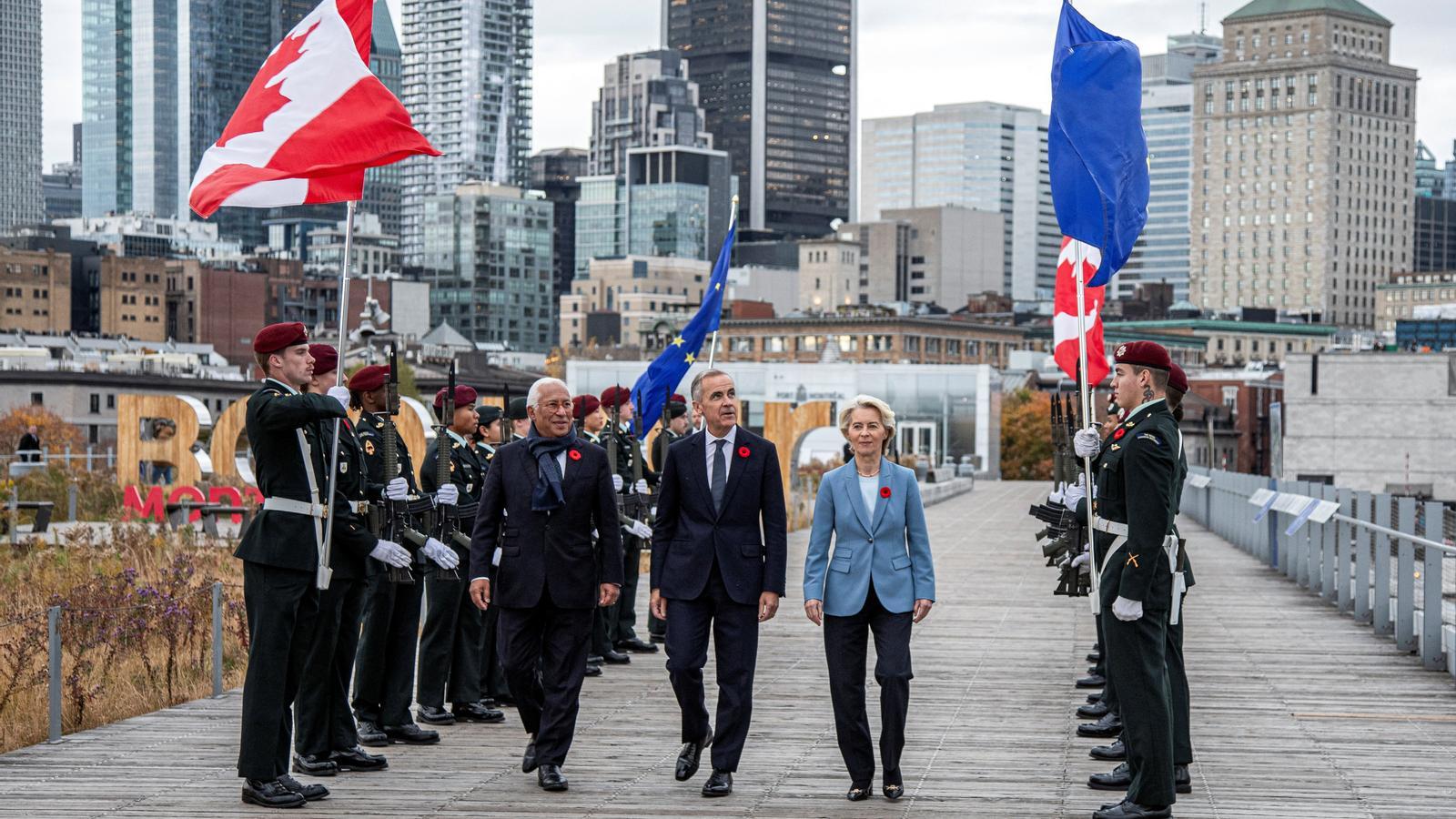
BrusselsCanadian Prime Minister Mark Carney has celebrated Canada becoming "the first associate member of the European Union." At a summit with representatives of European institutions, who traveled to Montreal, he rescued the label proposed by Ursula von der Leyen –which caused a stir among the capitals–, but has given himself until June 2027 to fill it with content. "We will determine the full substance, scale, and scope of this new form of membership," he said.
The President of the European Commission has also insisted on the need for Canada to become an associate member. "We would have liked to speak of full accession," said Von der Leyen, who immediately added that the treaties prevent including any member from outside the European continent. Thus, they are exploring "the closest possible association –she added–. "An association without accession," she clarified.
In writing, however, EU and Canadian leaders have avoided the "associate member" formula. According to the final statement they jointly issued, Brussels and Ottawa have reached a commitment to move towards an "increasingly close partnership," without this implying Canada's full accession to the European bloc.
The statement comes after a row that pitted the President of the European Commission against some capitals, most notably Berlin. While Von der Leyen insisted on Thursday that Canada must become the first "associate member" of the EU, Germany reproached her for not having reached a consensus on this definition with the member states and for the lack of legal fit with the bloc's treaties.
Whatever the label, Ottawa and Brussels are clear that they want to bring their positions closer in the face of the shadow of an increasingly unpredictable Donald Trump. Thus, they have presented an "alliance for the future" that must have three pillars: an alignment of policies, more cooperation in governance, and more coordination between programs. In what areas? Especially strategic areas such as AI, energy, critical minerals, and supercomputing. The ministers and commissioners of each branch have been in charge of staging this rapprochement, signing, one by one, a series of cooperation agreements.
The EU and Canada have concluded negotiations for a digital trade agreement and a pact between Ottawa and the European Investment Bank to facilitate European investment in Canadian critical minerals. Furthermore, Canada is joining the European High Performance Computing Joint Undertaking (EuroHPC), has signed a working arrangement with Frontex, and is opening the door to negotiate access to the Galileo navigation system.
More money for Ukraine
The other line of work, which interests the European Union the most, is defense. In this regard, Ottawa has committed to participating in the 90 billion euro loan that the EU has launched to cover Kyiv's military needs in 2026 and 2027. Carney has estimated Canada's "initial participation" at around 500 million euros, which will be the second partner from outside the bloc to join, after the United Kingdom.
When a journalist asked Carney about the "price" to pay to enter this partnership, the Canadian Prime Minister refused to frame it as an expense. "We don't see it as paying for something," he said, but rather as a pooling of resources in which "one plus one equals more than two." This alliance, he argued, has concrete benefits for Canadians: if the negotiation to expand Canada's participation in Erasmus+ succeeds, a student will be able to study in Barcelona "as easily" as in Montreal.
European authorities, on the other hand, have primarily highlighted the economic argument. "More jobs; primarily, good jobs," said Von der Leyen. A larger market means more scale for SMEs, more resilient supply chains, and European supercomputers open to Canadian researchers and startups, she argued. All these commitments will be fleshed out during upcoming meetings. In March, the European Commission and the Canadian government will meet in Canada, and in June, Carney will attend the European Council, where he hopes to finalize the content of the partnership.
