The EU plan for Canada runs into a name problem
Germany, France, Italy and Greece brake the "associated member" formula that the president of the European Commission had announced the day before the Montreal summit

-
CAT -
CAST
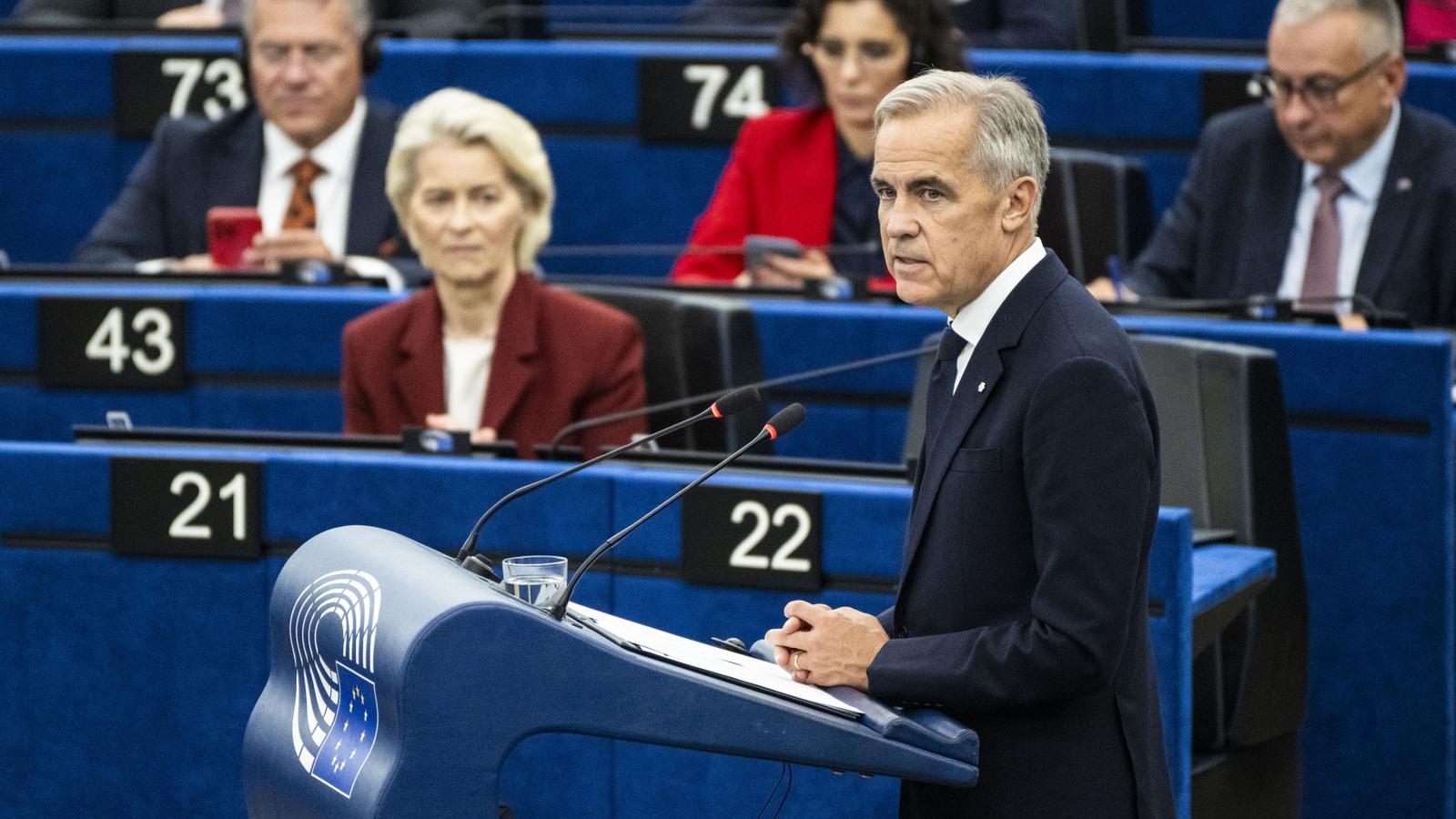
BrusselsDuring her State of the Union address, European Commission President, Ursula von der Leyen, announced with great fanfare that Canada would be a "new associated member" of the European Union. The rapprochement between Brussels and Ottawa was evident, both by the presence of Canadian Prime Minister, Mark Carney, in the chamber and by the previous talks to strengthen ties. But the announcement caught the member states off guard, as they did not expect the initiative to be presented with that label.
What was actually behind this designation? "A big and beautiful idea." With this euphemism, community spokespeople dodged questions from journalists who, day after day, hounded them with the same doubts. It turns out that the formula proposed by European Commission President, Ursula von der Leyen, and which does not exist in the European treaties, also worried the states. Particularly Germany, France, Italy, and Greece, who have had this designation removed from the text based on which the member states will negotiate with Canada at the Montreal summit starting this Thursday.
According to diplomatic sources who spoke to ARA, the member states' unease had nothing to do with the European capitals' desire to strengthen transatlantic ties. On the contrary, the consensus that it is necessary to stand together in the midst of a turbulent geopolitics is clear. But countries like Germany reproach the community executive for not even having a definition prepared for the term.
In fact, for Berlin it posed a problem that could lead to confusion. Just a few months ago, Chancellor Friedrich Merz had proposed a similar status for Ukraine as a way to provide security guarantees to Kyiv before it fully joins the bloc. Conversely, in Ottawa's case, the "associated member" designation was intended to serve to strengthen trade and defense agreements.
For this reason, after two days of intense negotiations, the states finally agreed to erase the "new associated member" designation and replace it with a more diffuse one. Thus, in the version they will present in Montreal and which they adopted this Wednesday, they have limited themselves to committing to work on an "even closer partnership".
Mark Carney, on the other hand, used the expression "alliance for the future" when he picked up the gauntlet from Von der Leyen in a speech to the European Parliament this September. The priority, for the Canadian Prime Minister, is to focus on the content of the agreement.
The staging of the alliance
With the name still to be decided, ten members of the European Commission, including Ursula von der Leyen and the head of European diplomacy, Kaja Kallas, have traveled to Montreal to participate in what will be the 21st summit between the EU and Canada. The event, in which the President of the European Council, António Costa, and Mark Carney are also participating, coincides with the tenth anniversary of the signing of the Strategic Partnership Agreement between the two countries.
On the table, Brussels and Ottawa have a long list of pending issues. One of the most important is defense, an area in which they are already collaborating through the SAFE program. This program, in which Canada is the only participant that is not part of the EU, serves to boost the joint purchase of weapons and reinforce European defense capabilities.
For the community bloc, this alliance is an opportunity to ask the Canadian Prime Minister for greater efforts in military support for Kyiv, at a time when the United States has turned its back on it. In a time when our societies are "shaken by new storms", according to Carney's diagnosis, the EU and Canada also want to strengthen cooperation in defense and in the Arctic, coordinate against foreign information interference, and maintain pressure on Russia.
The other major dossier is economic. In this negotiation, they want to extend the free trade agreement that has already united them since 2017—called CETA by its English acronym—to digital trade and modernize cooperation between competition authorities. The other priority is critical minerals, for which they want to facilitate investments through the European Investment Bank. The ambition is, at the same time, to incorporate Canada into European research and satellite programs and even study how to receive Canadian liquefied natural gas.
All in all, however, it is still a starting point. The Montreal summit opens a year of negotiations that will serve for the leaders to give substance to this alliance. Between now and the next summit in 2027, there will be time to define this new relationship, and perhaps also to find a name for it. For the moment, however, Von der Leyen's proposal will remain in a drawer.
