The alliance with Canada, the new apple of discord between Von der Leyen and the member states
The President of the European Commission defends the alliance with Ottawa in the face of a deterioration of the international order

-
CAT -
CAST
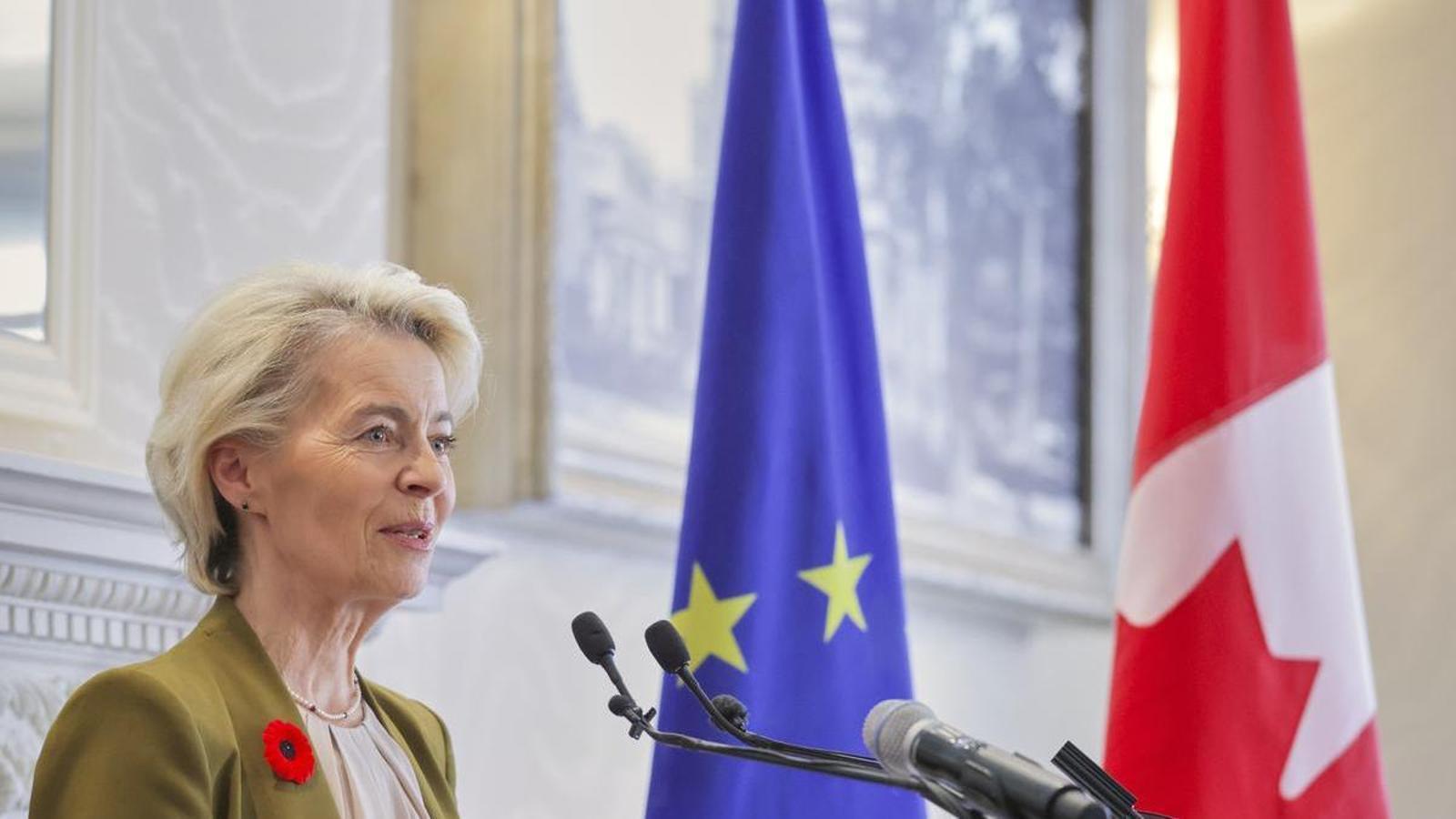
BrusselsUrsula von der Leyen wants to make it clear that it is she –and not the member states– who holds the reins in the European Union. The day after European capitals, at Germany's initiative, dismissed the "new associate member" label for the new alliance with Canada, the President of the European Commission has used this designation again from the summit being held this Thursday and Friday in Montreal, to reach out once more to Mark Carney.
"Canada cannot become a full member of the EU for geographical reasons, but both of us want to take our relationship to the highest possible level," Von der Leyen stated during a speech at the C.D. Howe Institute in Montreal. "That is why we are debating the idea of Canada becoming the first associate member of the European Union," she insisted.
Von der Leyen first launched the proposal during the start-of-term speech at the European institutions this September, in a gesture of outreach to Canada in the face of threats from US President Donald Trump. But some states, including France, Germany, Italy, and Greece, saw the announcement as a grandstand move and had doubts about its legal fit.
For this reason, the German leader's return to offering Ottawa the chance to become a new "associate member" of the bloc has been read as a challenge, especially towards Berlin, the capital that had questioned the label proposed by the EU executive most vehemently. In fact, just a few months ago, Chancellor Friedrich Merz had proposed a similar status for Ukraine as a way to provide security guarantees to Kyiv before it fully joined the bloc. This, added to doubts about how the term might fit into EU treaties, led member states to finally discard the label this Wednesday.
Friedrich Merz has not backed down in the face of Von der Leyen's words and, in a message on X, he celebrated the strengthening of relations with Canada by using the Canadian Prime Minister's formula, "an alliance for the future." "The European Union and Canada are about to open a new chapter in our relationship. Today's summit kicks off our 'alliance for the future.' Germany fully supports this unprecedented initiative," he wrote.
The President of the European Council, António Costa, in the middle of the dispute between the states and the European Commission, has tried to downplay the matter. "I share this ambition," he said in reference to Von der Leyen's initiative, and added: "Whether we use this term or another, one thing is clear: our partnership will be the closest, deepest, and most unique that exists."
Protecting against Trump's unpredictability
Von der Leyen defended from Montreal, where she will meet with the Canadian Prime Minister this Friday, the "simple idea" she has for Canada: "It is a partnership without accession," she said. It would involve replacing accession with "a shared ambition and vision." What should it consist of? In the view of the head of the EU executive, the alliance must translate into a closer alignment of policies (from energy to AI, through to security), governance (with more cooperation between the European Commission and the Canadian government and between the two parliaments), and more coordination between programs.
While she made no explicit mention of the United States or Donald Trump, the EU leader recalled that the alliance must serve to protect the interests and independence of both parties in the face of a "profound deterioration of the international order." "The alliances and premises that have guaranteed our prosperity and security are changing," she warned. She also recalled that relationships with a single supplier, "which we previously considered a guarantee of stability," can turn into "instruments of pressure," and she warned that this could have consequences on both sides of the Atlantic.
Thus, picking up the gauntlet thrown by Carney in Davos, when he invited middle powers to unite if they did not want to end up becoming "the menu" for the great powers, she defended partnerships "based on trust and driven by shared interests and convictions." "Sovereignty and independence are no longer just the freedom to act alone. It is the capacity to act together," she stressed.
In line with creating a common space to protect supply chains, Von der Leyen championed technological sovereignty and announced an agreement on supercomputing to integrate Canada into European infrastructure and also in the field of AI. Thus, she insisted on the need to strengthen cooperation on rules, standards, and global governance, and highlighted the merger of the German company Aleph Alpha with the Canadian company Cohere to create a transatlantic sovereign AI company.
